Recently Lily Wellington, executive director of the NH State Commission on Aging, gave her teenage children a challenge over dinner: Imagine at the strike of midnight you have more income; far more free time to learn, travel or volunteer; and the wisdom of a lifetime of experience.
The thought exercise was reflective of what Wellington does at work—helping the public and policy members see the aging state as a benefit, rather than a burden. “Aging is truly an opportunity, and I think this is very much lost in some of our deeply held beliefs,” Wellington says.
Changing perceptions is one of the first steps to preparing for the reality of our aging population, according to Wellington. “How can we realign policies and practices to capitalize on making the state longevity ready?” she asks.
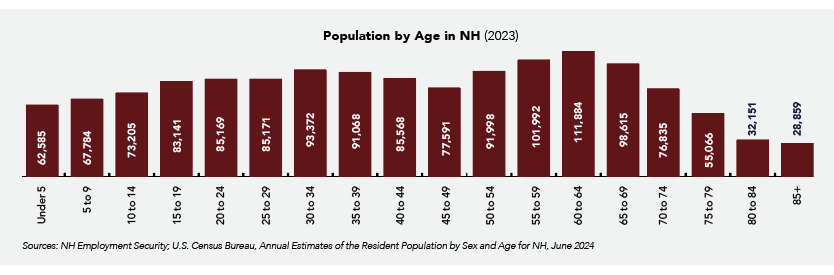
It’s well-known that NH’s population is old. The Granite State’s median age of 43.4 years old is tied with neighboring Vermont for the second-oldest in the country, according to 2023 Census data, and is well above the national median of 39.1 as of 2024. (Maine, with a median age of 44.8 years, has the oldest population.) Aging demographics are associated with several economic challenges, including increased healthcare costs and a strain on retirement systems like social security.
While experts are clear-eyed about the challenges, they say there are ways to cope with the economic impacts of an aging population by adjusting policies and social structures to help all ages thrive. A 2024 research paper in the scientific journal Medicine concluded that the economic impact of an aging population could be “minimal” if society is willing and able to adapt to this new norm. In NH, accommodating younger people migrating into the state (from within the U.S. and abroad), building infrastructure to support older adults, and adapting business practices to accommodate older workers can all contribute to a smoother transition to an older population, experts say.
“An aging population requires some shifts, but it is a positive development,” says Christina FitzPatrick, state director at AARP NH. “So often, it’s painted as a doom and gloom scenario with pejorative labels like ‘silver tsunami.’ [Yet] the older population contributes an enormous amount to state and national GDP and economic growth.”
NH and its Neighbors Are Aging Quickly
Just how old is NH? It depends on which metrics you use, says Ken Johnson, senior demographer and professor of sociology at The University of NH.
In addition to being tied for second-oldest median age, NH is among the states with the highest percentage of residents over age 65, and the fastest-growing senior population, Johnson notes. New Hampshire is also one of 11 states with more seniors than children, according to 2024 Census data.
“Any way you look at it, the state has an older population,” Johnson says, “and [that population] is going to grow.”
State projections support that. Today, about 21.5% of Granite Staters are 65 or older, but that’s expected to increase to 27% by 2050, according to a 2022 report from the NH Department of Business and Economic Affairs. (For comparison, the percentage of the U.S. population expected to be 65 or older will be 23.5% in 2050). The percentage of Granite Staters who are 75 or older is expected to triple between 2020 and 2030, according to the Commission on Aging.
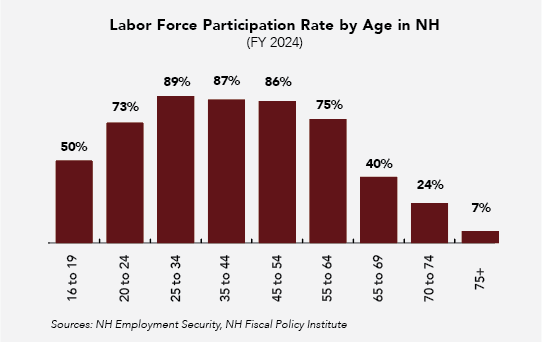
Those shifts are already impacting NH’s workforce. Currently, nearly one-third of the workforce is over the age of 54, according to the NH Fiscal Policy Institute. That means about 210,000 Granite Staters are approaching traditional retirement age.
Data show that adults are working longer than they used to: About 40% of people ages 65 to 69 and a quarter of those ages 70 to 74 are still working, data show. That can be a boon for employers, FitzPatrick says, especially if they’re willing to accommodate seniors who wish to work fewer hours or have a more flexible schedule.
“[Older people] have skills that developed with experience in terms of judgment, decision making, and interacting with customers and colleagues,” she says. “That’s a real asset to employers and something that they can take advantage of.”
Aligned Generational Needs
Despite longer working lives, ultimately, “a lot more older adults will be retiring or leaving the state’s workforce,” over the next decade, says Jessica Williams, policy analyst at the NH Fiscal Policy Institute.
To address the reality of older adults leaving the workforce, NH will need to continue to attract talent from outside the state (migrants both from within the U.S. and abroad), experts say. Between April 2020 and July 2024, NH’s population grew by 2.3%, according to the latest Census Bureau estimates. All this growth was a function of migration because deaths exceeded births in the state. Many of those migrants are well-educated and in the prime of their working years, according to Johnson.
“A lot of states would do anything to have a migration profile like New Hampshire has,” he says.
The state’s Department of Business and Economic Affairs (BEA) is building a “tourist to talent” pipeline to attract more young workers and business owners to NH, a BEA spokesperson confirmed, noting that the department is supporting affordable housing through programs like Housing Champion and InvestNH grant programs, and infrastructure updates including broadband internet expansion.
The state needs to not only attract those workers, but also retain its existing labor force, Johnson says. Some of their needs, like good schools and affordable childcare, are specific to younger adults, he says, but many of the needs of the workforce, like transportation and housing, align with the needs of aging adults.
“Their needs benefit everyone,” FitzPatrick says.
The NH State Commission on Aging is creating a 10-year plan, called AgeWellNH, to better accommodate an aging population. Two areas of focus are increasing transportation options and creating more affordable housing.
The Commission was created by the Legislature in 2019 to advise the governor and other lawmakers about issues and policies related to aging in NH, according to Wellington. Prior to its creation, the Council on Aging operated under the Department of Health and Human Services.
“We need[ed] a body that was a bit more empowered to collaborate across state agencies,” Wellington notes. Today, the Commission includes members from eight state agencies and each county.
(The state House of Representatives voted to eliminate funding for the Commission earlier this year in its proposed state budget, but reduced funding was later allocated by the Senate, a move that Wellington attributes at least in part to public support for the Commission.)
The Challenges
Even the most optimistic experts don’t shy away from the very real concerns that come with an aging population. Data are clear that healthcare spending increases drastically with age, which can strain state and federal budgets.
In addition, social security—the cornerstone of retirement for many Americans—is on an “unsustainable path,” according to a 2025 report from the Bipartisan Policy Center. The center notes that in 1960 there were more than five workers contributing to social security per each beneficiary, but today that’s dropped to just three, due to the increasing older population.
Aside from the big policy and spending issues, there’s a dearth of social supports for seniors, especially in a rural state like NH, says Bobbie D. Bagley, director of the Division of Public Health and Community Services for the City of Nashua. “As we age, we see where the gaps are, where older adults kind of become invisible,” says Bagley, who also serves on the steering committee for the NH Alliance for Healthy Aging.
Bagley, along with her husband, cared for her mother, mother-in-law and father-in-law as they aged. “We had parents in our household, and they all died at home with us,” and being able to live with them and care for them at the end of their lives “was a very pleasant experience for us as well as them,” she says. She and her husband were able to provide care by taking family and medical leave thanks to having jobs with good benefits.
People with family support or financial resources to afford long-term care have a brighter horizon when it comes to aging, Bagley says. She notes that a state program that allows people to be compensated for providing in-home care to their relatives can make aging in place more accessible across the socio-economic spectrum.
Yet, Bagley worries most about older adults who are isolated and have few resources. “We’re seeing an unbelievable increase in the number of people in their 60s and above unhoused, living in their cars or encampments,” she says. People who are unhoused or isolated often don’t receive health care until it’s an emergency, at which point delivering that care is “really, really expensive,” she says.
Strengthening the state’s social safety net will be imperative as the population ages, Bagley says. “It has to be a multi-pronged approach that we take,” she says. “We have to make sure the population is not invisible.”
After all, Wellington notes, getting old is the best-case scenario for most people. “The whole point of living is to age,” she says. “If you’re not aging, you’re not living. There’s no alternative.”