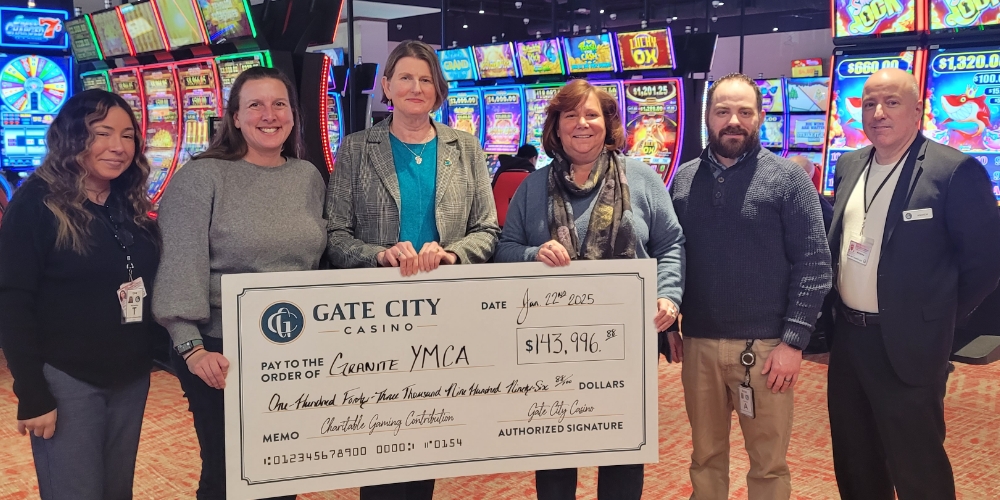
From left: Giovanna Bonilla, director of partnerships, Gate City Casino; Jessica Riendeau, director of annual giving and impact; Michele Sheppard, CEO, The Granite YMCA; Lisa Bernard, director of strategies and partnerships, The Granite YMCA; Brian Smith, assistant general manager, Gate City Casino; and Andrew Gentile, general manager, Gate City Casino. (Photo Courtesy of Gate City Casino)
If a friend or family member told you they were paying their bills with money earned at the poker table, you would be justly horrified. New Hampshire nonprofits, however, have depended on charitable gaming revenue for years to help fund basic operations.
Casino gambling has exploded in NH in recent years with 14 licensed facilities, regulated by the state, now operating. This regulation defines where some of their revenue goes. Under current law, charities receive 35% of the revenue from table games and 8.75% from historic horse racing machines, and the state takes 10% and 16.5% respectively. In FY 2024 alone, casinos generated $244 million in revenue, with $39 million going to charities and the state raking in $35 million.
The Charitable Gaming Oversight Commission, formed earlier this year, is looking into potential changes as to how nonprofits are selected by casinos and whether individual caps on proceeds are warranted. It expects to release a report by November 2026. The new commission follows the NH Charitable Gaming Study Commission which released a report in 2024 finding a “symbiotic relationship between the NH Lottery and the casino operators, as they share the mutual goal of maximizing gaming revenues so as to maximize the proceeds for registered charities.”
Direct relationships between gaming halls and charitable organizations are rare in the United States. According to the NH Charitable Gaming Study Commission report, Iowa is the only state other than NH where the gaming industry benefits charities directly.
The NH Center for Nonprofits supports the recent commission, calling it “a proactive step toward ensuring transparency and fairness in how charitable gaming supports nonprofit organizations.” However, nonprofits are duly worried about funding cuts.
The arrangement in NH ties the fortunes of social service agencies, food pantries, veterans’ programs, and youth organizations to the turn of a card or the press of a button. In FY 2024, Nearly 800 nonprofit organizations benefited statewide.
One thing the new Gaming Commission may address in the coming year is stretching the number of sponsorships to include more of the state’s nearly 5,000 registered charitable organizations that would like a slice of the gaming halls’ pie, says Kathleen Reardon, CEO of the NH Center for Nonprofits. Charities, which are chosen and sponsored by gaming halls, vie for a limited number of available seven to 10-day slots they have to earn revenue from gaming halls.
A state-commissioned study last year found that a substantial number of nonprofits receiving gaming funds deemed the revenue vital to their operations. “They’re using it for essential community needs including food services, domestic violence programs, and education scholarships,” says Reardon. “More than half said if funding was cut, it would have a drastic effect on their organization.”
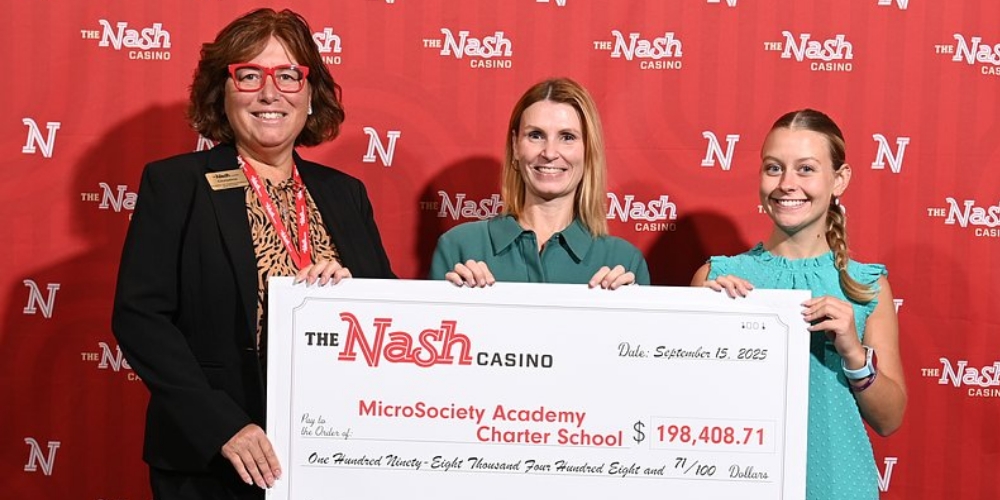
From left: Christine Latino, director of communications & charity, The Nash; Amy Bottomley, founding head of school, MicroSociety Academy Charter School; and Grace Greenaway, outreach and development coordinator, MicroSocety Academy (Photo Courtesy of The Nash Casino)
The Stakes
Embedded within House Bill 2, the state’s fiscal 2026 budget, were provisions to expand video lottery terminals—electronic gaming machines like those in Las Vegas—and to adjust how proceeds are taxed and distributed. Video lottery terminal revenue will be taxed at 31% and of that amount 35% will be contributed to local charities while the remainder will go to the state’s General Fund, Education Trust Fund and other state programs.
These, and other rules about how charitable gaming proceeds are directed to nonprofits, will be studied, leaving many nonprofits concerned about funding basic operations.
“New Hampshire doesn’t have a traditional legalized gaming operation,” Reardon says. “Our unique model requires revenue to go to charities, and that’s something we have to keep an eye on. ”
At The Nash Casino in Nashua, the partnership between gaming and nonprofits is daily business. Since opening in March, the casino has seen heavy traffic and distributed millions to local organizations.
“I would definitely say business is going well,” says General Manager Eric Althaus. “After opening right in the heart of winter, when there’s not a lot of outdoor activity, we had very high traffic levels, even through the summer months.”
Each week, The Nash partners with two different charities, donating a portion of net gaming proceeds to those nonprofits. “Our philosophy since opening has been to give a week at a time per charity,” Althaus says. “The law allows up to 10 days, but we’ve maintained seven days a week for each. Charities must be registered within the state, and we have a committee that reviews applications monthly.”
The Nash set up what they call pillars, says Christine Latino, The Nash’s director of communications and charity, who coordinates the casino’s nonprofit partnerships. “They include law enforcement, first responders, veterans, food programs, housing, education, youth programs, and the arts. The three top considerations are category, location in and around Nashua, and reach.”
Still, the process isn’t without challenges. Latino says nonprofits often express frustration with inconsistencies between casinos. “Each casino has its own approach, and that gets really confusing,” she says. “I’d welcome a consistent process that all of us follow. If the state says, ‘This is the process we want all of you to follow,’ that would take away confusion and questions.”
To expand its reach, The Nash plans to shorten the length of each nonprofit’s rotation from seven days to five in 2026. “That will allow us to support 146 [charities] just here at The Nash,” Latino says, adding that 42 more charities will receive funds in 2026.
The results of charitable gaming have been tangible, Althaus says. “We get to see firsthand where the funds are going. Bringing Back the Trades used our funding to provide more educational opportunities and scholarships for students in plumbing, electrical, and construction,” he says. “The Boys and Girls Club told us the funds they’ve received from us have been life changing.”
As of September, The Nash surpassed $10 million in charitable proceeds in its first seven months of operation, leading the state’s other casinos.
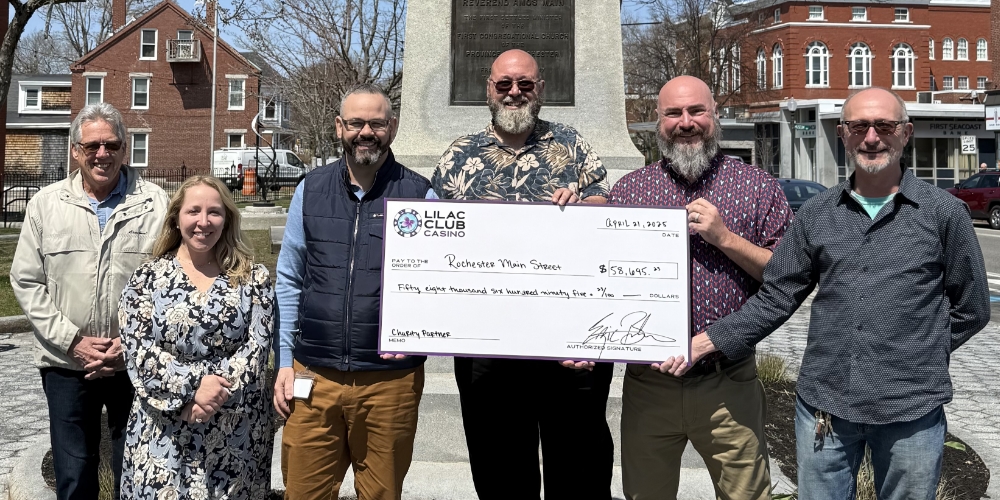
Members of the Rochester Rotary Club and Rochester Main Street organizations along with Lilac Club Casino executives gathered in downtown Rochester for a ceremonial check presentation. (Photo Courtesy of Lilac Club Casino)
Economic Crosscurrents
The stakes for nonprofits are high because the state’s financial structure leaves little margin for error. Without income or sales taxes, NH depends heavily on business taxes, the lottery, and charitable gaming. New Hampshire raises 37% of its revenue from taxes, compared with 46.7% of total state revenue nationwide. As of Q4 2024, total tax collections in NH were 5.8% lower than the state’s 15-year trend, according to The Pew Charitable Trusts’ states fiscal health project.
Neighboring states like Massachusetts and Vermont, which have broader tax bases and direct grant systems, can cushion their nonprofit sectors. In NH, a cut or cap in gaming allocations can feel seismic, especially for smaller organizations with limited reserves.
Reardon warns that the wrong policy choices could push many nonprofits over the edge. “If government and gaming revenue streams are cut or capped, the most vulnerable nonprofits including food pantries, rural health providers, early childhood programs, behavioral health agencies, will be the first to lose,” she says. “Those are the organizations with heavy client demand.”
The overall revenue picture in NH is mixed. While business tax revenue (about 35.3% of the General and Education Trust Funds for SFY 2025) was down, some bright spots exist for the state’s overall revenue, according to an October report by the NH Fiscal Policy Institute. Lottery Commission revenues, which have expanded significantly in recent years, were $2.7 million (or 8.9%) above planned amounts for Q1 and up $8.4 million (or 34.3%) over the first three months of last year. The report also says newly legalized video lottery terminals could generate future revenue and that “gambling is likely to grow in importance relative to State revenues overall in the next two years.”
In the months ahead, the newly formed Charitable Gaming Oversight Commission will review how casino revenues are distributed and whether current reporting systems are sufficient. Lawmakers are also expected to consider gambling bills next session, including one that would increase allocations for problem gambling services as gaming expands.
Meanwhile, casino operators like Althaus say they’re focused on transparency and community impact. “We’re operators—we stay out of the legislative debates,” he says. “But we care deeply about ensuring these funds make a difference.”
Reardon says her organization will continue pressing for clarity and stability. “Charitable gaming is a really important source of funding for nonprofits in this state,” she says. “We understand the need for oversight and balance, but we also have to protect the sector that depends on it.”