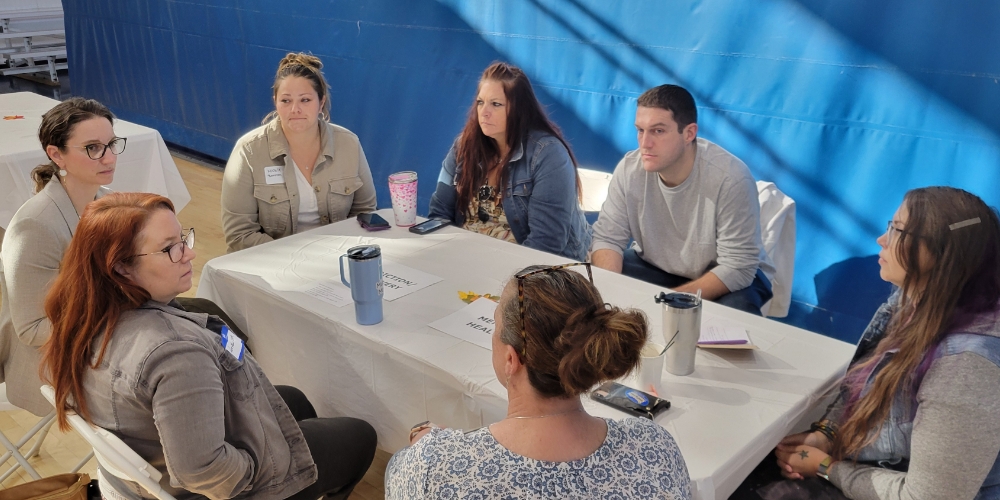
Attendees at the Monadnock Region Nonprofit Summit broke into sector tables for conversations on challenges, solutions and opportunities for partnership with different organizations. (Photo Courtesy of the Keene Family YMCA)
As the Granite State faces federal budget cuts, policy uncertainty, and shifting social needs, the message from NH’s nonprofits is clear: Collaboration, innovation, and strategic planning are not optional, they are essential to sustaining NH’s safety net and strengthening the economic fabric of the state.
New Hampshire is home to 9,600 nonprofits that employ 14% of the state’s workforce—roughly one in seven people. This is more than the national average of 9.9% but the lowest level in New England. According to tax filings, NH nonprofits reported collective revenue of $17.2 billion in 2023.
This year, uncertainty and worry, as well as determination, have been the overriding emotions of many nonprofit leaders.
At the heart of the challenges are directives from the Trump administration, including those restricting diversity, equity, and inclusion (DEI) initiatives, causing many nonprofits to scrub websites of DEI-related language and making them subject to intensive audits that detract from their day-to day-operations and possibly lose funding. Nonprofit leaders say the orders are coupled with longstanding frustrations around contract rates, delays, and bureaucracy.
Kathleen Reardon, CEO for the NH Center for Nonprofits says, “The foundation [of nonprofits] is being threatened and attacked.”
“Nonprofits get the work done quietly; they’re the invisible backbone of our communities. If they lose credibility, funding, or policy space, especially in this era of political polarization, the impacts will ripple far beyond the sector,” Reardon continues, adding that some executive orders and executive actions have challenged the very idea of partnership between nonprofits and government. “The federal government is creating anxiety and advancing a very harmful narrative about nonprofits as wasteful partisan organizations. This really undermines the trust people have in nonprofits.”
And the government support is imperative to nonprofits. Based on tax filings from 2022 and 2023, the proportion of nonprofits receiving government grants is fairly consistent across the country, with state averages ranging from 21% to 47%. The three states with the highest proportion of nonprofits receiving government grants are Vermont (47%), Alaska (46%), and West Virginia (44%). New Hampshire falls somewhere in the middle at 35%.
Reardon is cautiously optimistic despite the challenges facing nonprofits as they remain committed to finding ways to serve their communities. “Even under pressure, they are finding ways to innovate and collaborate, to advocate and put the needs of the communities they serve first,” she says.
Reardon points to recent nonprofit summits in Concord and Keene as well as one hosted by the NH Center for Nonprofits, all emphasizing collaboration and the collective work of nonprofits. “We’re still able to make a difference and will continue to do that. But I’m not going to take a Pollyanna approach; there are going to be harmful impacts.”
Coming Together
The idea of nonprofits coming together around common challenges is nothing new, Reardon says, referencing the work done by nonprofits during the pandemic. This often happened in collaboration with the state, local businesses and other nonprofits, she says, to support communities with housing and fuel assistance and an array of other services. Today’s crisis, she explains, necessitates “real-time collaboration” around issues like the delay of funds from the Supplemental Nutrition Assistance Program (SNAP) for millions of Americans.
“Nonprofits are doing real-time crisis mapping while responding to needs in their communities,” Reardon says, noting a November virtual meeting of over 60 organizations in response to the federal delay of SNAP benefits. The meeting was convened by the Community Action Partnership of Strafford and Rockingham Counties and attended by U.S. Representative Chris Papas. “This was a real time collaboration to find out who’s hosting mobile food pantries and other discussions to make sure no one falls through cracks.”
The arts and culture community held a summit in September in Concord. The Creative Culture Summit, which brought library, arts, humanities, and culture organizations together, was convened by Sal Prizio, executive director of the Capitol Center for the Arts in Concord. “I told people, ‘If you get nothing else out of today at least you know you’re not in this alone,’” he says, adding that a shared sense of purpose from events like this is leading to innovative approaches.
In Concord, arts and cultural organizations have begun experimenting with shared back-office operations, joint marketing campaigns, and co-hosted community events. These efforts not only reduce costs but also strengthen the sector’s advocacy voice, Prizio says, making it easier to lobby for stable funding and supportive policy changes. “Advocacy has never been more important for arts and culture organizations,” he says referencing recent cuts to the state’s Council on the Arts that received only $150,000 in direct funding in this year’s state budget after receiving $1.5 million in FY 2024.
Another summit bringing nonprofits together was held in October by the Keene Family YMCA. CEO Christy Sterbenz Filby says the impetus behind the event was to bring nonprofits together to address current challenges and provide connections. “The way forward is to work together,” she says. “Even if a nonprofit goes away, the work in the region doesn’t go away. In my experience, getting people together to talk goes a long way.”
The NH Center for Nonprofits held a summit in September where nonprofits broke into small groups to discuss their challenges and their missions. “We continue to convene people through traditional programming, but the leadership summit allowed us to hear from people and how they’re navigating challenges,” Reardon says. The summit also included various “mission circles” where participants learned from one another and convened in mission-related areas to compare notes. “Some of the themes that emerged involved how resources can be shared and other opportunities to work together. Nonprofits are exploring administrative changes like outsourcing of HR, and accounting.”
Filby says participants in Keene were surprised by the sheer number of nonprofits in the region. During the meeting, participants broke into sectors to answer questions and identify opportunities. “Next time, they didn’t want to be isolated in their own sectors,” she says, noting future opportunities to connect and share resources are in the works. “They’re looking for partnerships, ways to engage with one another. The YMCA is hoping to create smaller, sector-specific discussions alongside larger regional gatherings, creating ongoing communication channels to strengthen collaboration.”
A collaborative approach mirrors the strategies emerging across the state. Nonprofits are pooling resources, exploring mergers, and testing shared services to reduce back-office costs. In some regions, nonprofits are even sharing accounting teams, IT support, or marketing resources to stretch limited funds while maintaining frontline services.
Nichole Martin Reimer, president and CEO of Granite United Way, witnesses the pressure nonprofits face today and the need for collaborative support as both funder and contracted partner.
“We just did a round of responsive emergency grant-making and had about five times the number of requests we normally do,” Reimer says. “We know the need is great and people are anxious in these uncertain times.”
Reimer says nonprofits are educating funders, decision makers and clients about the impacts of policy changes and funding cuts. Granite United Way, in addition to scenario planning and conservative budgeting, is finding ways to collaborate with other nonprofits to meet these challenges. “This can be done through advocacy but also on the operations side too,” she says. “There may even need to be discussions among some nonprofits around merging and collaborating, and that’s something our United Way has a lot of experience with.” Granite United Way is the result of eight different United Ways across the state coming together over the last 15 years.
“Advice on mergers and collaboration could be a role for us in helping support some of our partners, whether that’s with governance, such as talking to boards about keeping their local and unique identity while still gaining some efficiencies by collaborating more, or working together, or doing back-end work together,” Reimer says. “We’re always ready to pivot and adapt to needs that arise in the community, but it’s important to maintain local control and we need those small nonprofits to fill gaps. But we also must consider where there are opportunities to consolidate or create some new efficiencies.”
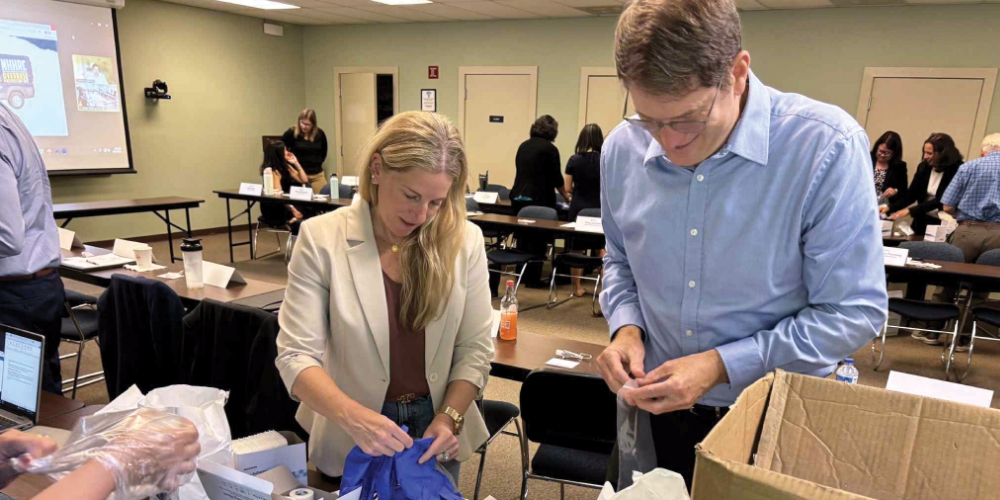
Granite United Way board members packing care kits (Photo Courtesy of Granite United Way)
Ongoing Challenges
While funding is always a challenge for nonprofits, it has become particularly acute as nonprofits have suddenly lost government funding they relied on and had new conditions placed on them that conflicts with their mission. (See funding story.)
More than half of respondents to the 2025 National Nonprofit Trends and Impact Study, specifically 55%, reported finances were their biggest concern. The study was conducted by the Urban Institute at the end of 2024.
That national report is in line with local trends. A 2024 survey of 102 nonprofits by the NH Center for Nonprofits found that 58% said government contract rates fail to cover administrative overhead, 52% cited reimbursement delays, and 44% flagged excessive compliance burdens.
“Most of those challenges have been ongoing challenges,” Reardon says. “We released that report, ironically, the day before the Federal Office of Management and Budget issued a memo freezing all federal assistance. That report remains a valid description of some of the challenges of government contracting and opportunities to work with state partners.”
In response to the disruptive climate, nonprofits are looking for ways beyond collaboration to be more efficient while the demand for services increases.
White Horse Recovery Center, founded in 2014 by Matthew Plache, started with three volunteers in Ossipee. White Horse now operates across four locations, serving roughly 40% of the state. It runs walk-in community centers providing peer support, food, clothing, housing assistance, and clinical care.
Plache emphasizes operational efficiencies. “We’ve brought in unified billing, centralized service tracking, and coordinated outreach with community partners, all to reduce administrative overhead and keep focus on our mission.”
Plache has also focused on a workforce pipeline strategy to be more efficient. By training staff to take on multiple roles, from peer support to clinical assistance, White Horse increases organizational resilience while enhancing service continuity. The nonprofit has formed partnerships with local community colleges and recovery-friendly workplaces to ensure a steady stream of trained personnel.
The Battle for Predictability
At its core, the challenge for many nonprofits is about predictability and trust. When funds can be rescinded by executive order, delayed by agencies, or reallocated by legislation, organizations must expend scarce leadership hours navigating policy shifts.
Reardon notes that many nonprofits are also walking a tightrope regarding mission language, adjusting programs to align with what funders perceive as “safe” goals to preserve funding eligibility.
This uncertainty was reflected in a recent survey by the Urban Institute about nonprofit funding. In its National Survey of Nonprofit Trends and Impacts, a third of nonprofits reported experiencing federal, state, or local government funding disruptions and were more likely to report reductions to staff, programming, and hiring in 2025. Twenty one percent reported losing at least some government funding; 27% reported experiencing a delay, pause, or freeze in government funding; and 6% reported receiving a stop work order.
For arts and culture groups, the squeeze is particularly acute. Prizio, at the Capitol Center for the Arts, says while state funding has dwindled, and ticket revenue has softened for mid-level shows by 10% to 30%, marquee shows are still showing resilience for the time being. The Capitol Center for the Arts implemented centralized contract tracking, automated billing, and unified venue management software to lighten administrative loads. “It is an unrealistic expectation to believe that arts and culture organizations should be competing with basic human services for private foundation support,” he says.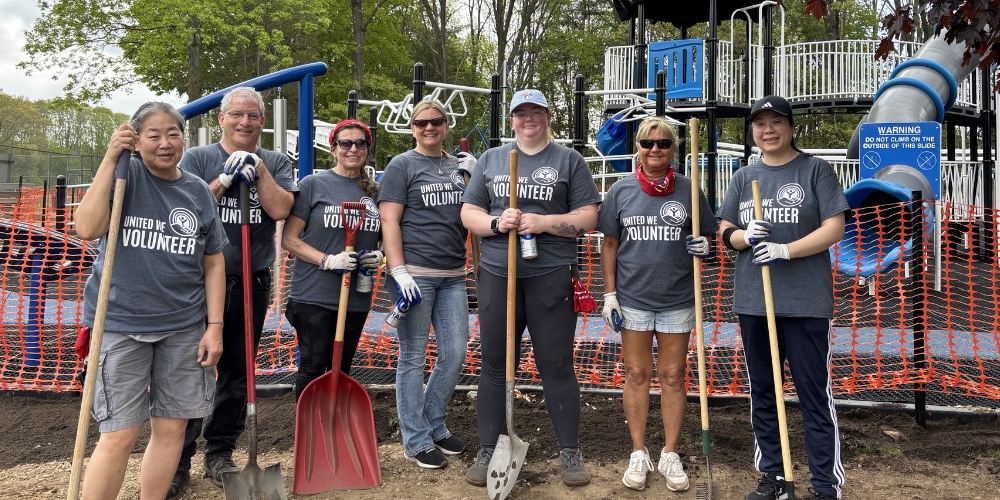 Volunteers during A Day of Caring 2025 by Granite United Way (Photo Courtesy of Granite United Way)
Grassroots Solutions
Despite these challenges, not everything is bleak. Mutual aid groups, community volunteer networks, and place-based initiatives continue to emerge across NH. Simon Delekta, vice president of community engagement and impact at the NH Charitable Foundation, cites Wakefield and Portsmouth, where neighbors, in addition to formal nonprofits, are helping to coordinate fuel and food assistance, and also helping residents navigate cuts to federal programs. “The only way we get through these cuts is by working together in dialogue, asking people what they need,” he says.
Nonprofits are leaning into their local networks to help sustain services. Donnalee Lozeau, CEO of the Community Action Partnership of Hillsborough and Rockingham Counties, notes that the tripartite board structure of the state’s five Community Action Partnerships—which includes public officials, people being served, and private industry leaders—reinforces community accountability. “We all work together,” she says. “Our success relies on strong relationships at the local and state levels, and that gives me confidence we’ll find support moving forward.”
Nonprofits are doubling down on strategic planning. White Horse Recovery is expanding services to include a new recovery house in Ossipee, providing transitional housing for seven people in sober living. Community Action Partnership of Hillsborough and Rockingham Counties is mapping workforce programs to align with economic trends, ensuring training leads to job placement. And Granite United Way is continuing to explore how to aid nonprofits seeking to merge, shared service opportunities, and digital infrastructure improvements to scale operations efficiently.
Reardon, who sees collaboration and strategizing between nonprofits as a sign of hope, says nonprofits are innovative by nature due to their funding structures. But responding quickly to policy changes, she explains, is difficult.
“It’s hard to innovate when you’re in crisis,” she says. “This requires time, energy and space to explore different business models and possibilities. Many of these crises aren’t for lack of planning. Nonprofits manage changes in policies well. But these are major changes happening quickly and we were already in a situation where costs are going up like they are for all businesses.”