
Gather’s Food Pantry in Portsmouth (Courtesy of Gather)
Portsmouth-based food pantry Gather had big plans this year. It moved into a new, larger facility, and was poised to expand its Seacoast Waste Not collection program, which picks up food from restaurants, caterers and food manufactures that would otherwise go to waste. A $347,000 EPA grant would have allowed it to get another refrigerated box truck on the road, meaning more food could be collected from more restaurants and turned into healthy meals for families in need.
Then the Trump administration abruptly shut down the grant program, an environmental justice initiative created by Congress as part of the 2022 Inflation Reduction Act.
“We were told that we were awarded it, and almost in the same breath, we were told that the funds had been frozen and then ultimately terminated,” says Gather Executive Director Anne Hayes.
The Trump administration’s push to slash billions in grants and other federal spending this year has buffeted NH’s nonprofit sector, forcing some organizations to delay or cancel projects, scale back services, scramble for alternate funding or guess which once-stable sources of funding might simply disappear.
Nonprofit leaders say that could have major implications for the vast array of social services that federally-funded nonprofits NH provide, particularly in a state that prizes limited government and often partners with private charities to deliver such services.
“There is widespread uncertainty, as what was expected to be committed federal dollars are suddenly, in some cases, being pulled back,” says Simon Delekta, vice president of community engagement and impact at the NH Charitable Foundation. “And it’s hard to understand any rationale for where and why.”
Funding Cuts Affect Nonprofits Across the Spectrum
More than 600 NH nonprofits received a total of $1.1 billion in local, state or federal government grants in 2021 according to a recent Urban Institute study. And that’s likely an undercount as it doesn’t include organizations that bill for services through programs like Medicaid. The same study estimated nearly two-thirds of all nonprofits in the state would be at risk of falling into the red if government funding evaporated.
Shortly after taking office in January, the Trump administration sparked widespread confusion and panic among nonprofits when it froze nearly all federal grants and loans. That funding freeze was lifted within days by a federal judge. But in the months since, federal officials have paused or canceled a huge swath of grants and other programs.
Kathleen Reardon, CEO of the NH Center for Nonprofits, says that has upended a wide range of services in NH. “It’s safety-net programs, as well as arts, as well as programs that serve immigrants and refugees, as well as economic development” and many other sectors that have been impacted, she says.
On top of that, Reardon says the cuts to Medicaid that Congress passed this year could threaten the stability of nonprofit health care providers that serve low-income patients. Nonprofit community health centers in Canaan and Franconia already announced plans to close, according to the Boston Globe.
“Some [nonprofits] are having very deep conversations with their boards about whether—if they have reserves—whether they could dip into those reserves,” Reardon says, adding that they’re also “being very careful about hiring.”
Delekta adds that some organizations could be further strained by recent state budget cuts, some of which remain unknown, like the millions in unspecified “back of the budget” cuts that the Department of Health and Human Services will have to find in the coming fiscal year.
Laura Milliken, who leads NH Hunger Solutions, says organizations like food pantries could be facing a perfect storm—a surge in need as more people lose Medicaid and SNAP benefits and funding for their services is being cut.
“Already in New Hampshire, people are going to food banks and food pantries in unprecedented numbers,” she says. If people can’t access SNAP benefits, “they’re going to look for what other possibilities there are to feed themselves and their families,” she says, which could further strain food pantries.
 Volunteers and staff from the NH Food Bank at a mobile food pantry (Photo Courtesy of NH Food Bank)
A ‘Hunker Down’ Approach
For some nonprofits, the effects have been immediate. When the federal government cut funding for refugee and immigrant services, Ascentria Care Alliance, one of two refugee-resettlement organizations in the state, “made the difficult decision to scale back our services for [the] New Americans program and reduce our staff by seven positions back in March,” states Vice President of External Relations Amy Moore in an email.
“With federal funding for FY26 still uncertain, we’re taking a ‘hunker down’ approach, carefully preserving resources until we know which contracts will be renewed,” she says.
Elsy Cipriani took over as the NH Food Bank’s executive director in March. Almost immediately, she learned the U.S. Department of Agriculture decided to ax nearly $1 million in funding that the Food Bank had been allocated through 2028, saying it was from a pandemic-era program and no longer needed. The money was for the group’s Feeding NH program, which buys food from local farmers and distributes it to people in need.
“We have reached out to private donors and foundations and little by little we are closing the gap,” Cipriani says. She says she’s grateful for the community’s support. “But this is just a temporary response. We can’t expect a private donor to deliver the level of funding we were getting from the federal government.”
Federal funding meant to tackle the state’s homelessness crisis has also been impacted, says Jennifer Chisholm, executive director of the NH Coalition to End Homelessness.
The state’s three regional continuum of care organizations, which help coordinate resources to address homelessness, spent months preparing to apply for Department of Housing and Urban Development grants to build more supportive housing. Then the notice of funding opportunity was rescinded, she says.
The notice was later re-issued, rescinded again, and then re-posted once more in September, this time with an entirely new set of conditions that required compliance with administration priorities on policing and gender, such as being located in a jurisdiction that enforces a public camping ban and certifying they “will not deny the sex binary in humans.”
Chisholm says agencies were given a week to respond, and only one of the three organizations ended up applying.
“Many other states, from my understanding, are able to sort of say, ‘You know what, we don’t agree with these requirements, so we’re not going to complete an application because we have other means by which things can be funded in our state,’” she says. “But New Hampshire is very reliant on federal dollars, and so it puts homeless service providers in a really tough position.”
Meanwhile, in November, after months of delay, HUD announced major changes to another source of funding that many organizations rely on to provide housing for youth and adults experiencing homelessness. It sharply curtails how much can be spent on permanent housing, and also makes funding less predictable by decreasing the share that is guaranteed to continue from one year into the next.
“That has the real possibility of crashing some of the programs that we have running already,” Chisholm says.
Even for organizations that haven’t lost funding, the uncertainty is taking a toll. Littleton-based White Mountain Science works with schools on after school programs, teacher development and other STEM education initiatives. Executive Director Jeremy Knowlton says the organization (known as WMSI, pronounced like “whimsy”) gets about half its funding from U.S. Department of Education grants for schools.
“That used to be a very stable source of funding for us,” he says. Then in July, federal officials held up $6 billion in education funding for a month.
“It really shook us,” Knowlton says. “A lot of schools reached out to us and said, ‘Oh, actually, never mind. We’re not sure if we can set up projects.’ We actually lost a couple projects just because of the delay in funds.”
Though the funding was eventually released after pressure from Republican senators, Knowlton says he’s no longer confident those grants will be around in the future, which his organization is factoring into its strategic planning. “We can’t be bold right now,” he says. “This isn’t the moment to heavily invest in the next big thing that we’re going to be able to do to help kids or help schools. We’re trying to maintain our current services.”
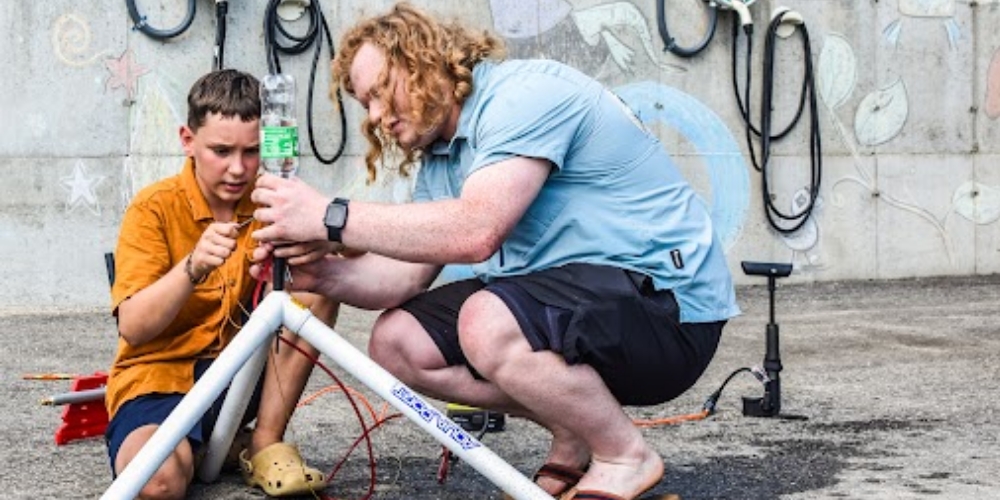
White Mountain Science students design and prepare a water-based rocket for launch (Photo Courtesy of White Mountain Science)
‘It’s a Rainy Day’
Local foundations in NH say they’re doing what they can to help nonprofits weather those challenges. The Foundation for Seacoast Health upped its fall grant cycle this year to $535,000, more than double a year ago, says CEO Blair Demers. The foundation also made direct, one-time support grants of $50,000 to five nonprofits working on critical issues like food insecurity, mental health and access to health care.
Demers says the foundation surveyed dozens of nonprofits in July and designed its grant cycle in response. “What we heard from the sector directly was overwhelmingly concerns about funding, concerns about the ability to meet this moment when so many of our social service infrastructure funding sources are being stripped away,” she says.
Similarly, Delekta says the NH Charitable Foundation pulled $3 million from its operating reserves to increase its grant making this year, including $2 million in immediate, unrestricted grants to organizations that were facing cuts or work with vulnerable populations like immigrants, LGBTQ+ people or unhoused individuals.
The foundation also partnered with the NH Center for Nonprofits to fund an employee assistance program for small nonprofits, hoping to address employee burnout.
Meanwhile, the NH Charitable Foundation is reaching out to its donors. “Many of them want to understand, ‘Where can I help? What can I do?’” Delekta says. “And we’re encouraging our donor community to give now. Give now, give more, don’t wait. It’s a rainy day.”
Anecdotally, some nonprofits have seen an uptick in donor support. Susan Stearns, executive director of the mental health nonprofit NAMI-NH, says its annual fundraising walk in October raised over $300,000, when previous years have topped out around $200,000.

NAMI Walks NH, a fundraising walk in October (Photo Courtesy of NAMI NH)
“Our sponsors who come back every year increased sponsorships. We had new people come in and sponsor. And then our walkers—personal fundraising was also just off the charts,” she says. “I’m still trying to figure out, really, what to attribute all of that to. Is it because people are concerned at this time about what’s happening?”
But while philanthropy can provide stopgap funding in a crisis, Stearns and others say private giving, whether from foundations or individual donors, will never come close to matching the scale of what the federal government spends on social services.
“There’s a reason that there’s so much government funding in nonprofits, and that would not be replaced with individual giving,” Reardon of the NH Center for Nonprofits, says. “It’s just not at that scale.”
Some experts have also warned that new rules for charitable deductions for individuals and corporations, slated to take effect in 2026, could lead to a net decrease in charitable giving (see sidebar).
“What I do see already happening is corporate giving cutting back pretty significantly,” partly because companies are being squeezed by tariffs, says Mike Apfelberg, president of the United Way of Greater Nashua. As federal grants are cut, he says more nonprofits are competing for the same limited pool of private philanthropic dollars, leaving funders with tough choices about which organizations to support.
“Food, clothing, shelter—you know, the basic needs—when those agencies start asking for support of the community, those are compelling asks for any of us,” he says. “And if I’m asked to choose between, do I prioritize maybe something in the arts, or do I prioritize feeding people, you know I’m probably going to make a decision that will not be good for the arts.”
Reardon says nonprofits remain committed to their missions. “One of the challenges for nonprofits is really communicating to donors about how dire the situation is, that the cuts mean there will be less services, and it will have an impact on communities,” she says. “And yet, when you’re trying to talk to donors, you want to reassure them that you’re committed to the community, which nonprofits are.”
Side Bar
Charitable Tax Deduction Changes Contribute to Uncertainty
Changes to the laws around deductions for charitable giving, set to take effect in 2026, are adding uncertainty to nonprofits’ fundraising forecasts.
The One Big Beautiful Bill passed this summer makes several changes:
- Non-itemizers who take the standard deduction can deduct up to an additional $1,000 per individual (or $2,000 per married couple) in charitable donations.
- Itemizers, who tend to be wealthier, must give 0.5% of their income before they can take a charitable deduction. The deduction is also capped at 35%, rather than the maximum tax rate of 37%.
- Corporations have to give a minimum of 1% of taxable income to qualify for a charitable deduction.
Melinda Mosier, vice president for donor engagement and philanthropy services at the NH Charitable Foundation, says it’s hard to predict what the overall impact will be. On the one hand, the deduction for non-itemizers, who make up 90% of taxpayers, creates a new incentive for people at the low-to-moderate end of the income spectrum to give.
But that’s balanced against the other changes, which could reduce giving from wealthy individuals and corporations or lead to more year-to-year swings as people “bunch” contributions for tax reasons. A study by the Lilly Family School of Philanthropy at Indiana University estimates capping deductions at 35% could reduce giving by anywhere from $2 billion to $8.2 billion per year.
Mosier says that may require a shift in fundraising strategies. For example, asking a donor to commit to a certain total over a number of years but leaving the timeline up to them, using donor-advised funds, or asking a company that’s limiting charitable donations to consider a sponsorship instead.
And the impact of those changes could be overshadowed by other factors that influence giving, like the economy. “Giving historically follows the markets,” she says.