
When Annette Carbonneau thinks about the challenges of rural health care, she thinks about an 83-year-old woman from Colebrook who lost her Medicaid coverage two years ago.
Suffering from arthritis, the woman struggled to fill out her Medicaid paperwork and her renewal was denied. She couldn’t afford to pay out-of-pocket on the $813 per month she got from Social Security and started postponing medical care.
A community health worker spent six weeks trying to enroll her in a Medicaid program for older adults and people with disabilities. They kept getting bounced around to different people within the state health bureaucracy and the private contractor that administers the program. At one point, the company said it would need to do an in-person assessment, but it didn’t have anyone working in Colebrook and probably wouldn’t for months.
In the midst of all that, the woman’s food stamps lapsed because she didn’t get a notice in the mail. Her benefits were eventually restored, but Carbonneau—who oversees the community health worker program for the North Country Health Consortium, a Littleton-based public health network—says the experience illustrates some of the barriers that patients in NH’s most remote regions face when seeking care.
“Think about it if you were in that person’s position,” she says. “You have chronic diseases of your own. Now you have lost your saving grace for medical care, prescriptions and your food—and you’re being told we don’t have anybody that can come to your area.”
Rural areas of NH tend to have higher rates of poverty and chronic disease, and patients there face a host of barriers to accessing care. Among them are long travel times, spotty emergency medical services coverage, shortages of health care professionals, and the steady erosion of maternity care and other essential services. These last two are especially hard to maintain in areas with low population density and limited resources.
Over the next five years, NH is slated to get hundreds of millions of dollars in federal funding to address some those problems, part of a new pot of money included in last year’s One Big Beautiful Bill Act intended to “transform” rural
health care.
But the same law includes steep cuts to Medicaid, the safety-net insurance program that’s a key source of funding for rural hospitals and health centers. New Hampshire stands to lose an estimated $2 billion to $3 billion in funding over the next decade— more, notably, then the state will gain.
Health care providers say the new Rural Health Transformation funds are welcome but won’t be enough to compensate for those losses. One nonprofit clinic in northern NH, Ammonoosuc Community Health Services’ Franconia location, has already closed its doors because of the cuts.
“[The new funds are] going to hopefully do some really great things,” says Lucy Hodder, director of the health law program at the UNH Franklin Pierce School of Law. “It doesn’t in any way make up for the losses coming at us from the Big Beautiful Bill.”
A ‘Structural Redesign’
The bill, which passed last July with the backing of President Donald Trump, includes work requirements and other provisions projected to reduce federal Medicaid spending by more than $900 billion over the next decade, according to estimates from the nonpartisan Congressional Budget Office. An additional 7.5 million people are projected to become uninsured as a result.
In NH, anywhere from 14,000 to 29,000 Granite Staters could lose health coverage under the law, depending on how the state implements it, according to a report from the Robert Wood Johnson Foundation and the Urban Institute.
The Rural Health Transformation Program was added to the bill to address concerns from some Republican senators about the impact of Medicaid cuts on rural areas. The five-year, $50 billion program isn’t meant to cover existing expenses, but to fund infrastructure, technology, and other one-time investments that can lead to lasting improvements in rural care.
With an annual allotment of $204 million for the next five years, NH officials say they’re prioritizing investments to expand access to care, boost the rural health care workforce, deploy advanced technology, and make rural health care providers more financially resilient in the long term.
The newly formed state entity administering the funds, the Governor’s Office of New Opportunities & Rural Transformational Health, or GO-NORTH, has outlined a variety of ways to achieve those goals. That includes mobile nursing units; community health workers and telehealth access points in schools and libraries; more education and training programs to expand the pool of health care professionals in rural areas; additional resources for maternity care, mental health and other critical services; startup funds for new EMS units; and faster adoption of technologies like remote patient monitoring and AI-powered clinical tools.
Donnalee Lozeau, the director of GO-NORTH, says those priorities were developed in consultation with local communities. Access to care, workforce shortages, financial strain on providers, technology gaps, and the impact of chronic disease and behavioral health challenges are among their most pressing needs.
One of the most promising parts of this plan, she says, is the focus on building out community-based care. Mobile health units, community health workers, remote patient monitoring technology and other programs can help patients get care closer to home and reduce the risk that they end up in the ER.
“That kind of model has real potential to improve outcomes, reduce avoidable emergency department or hospital readmission utilization and keep care local,” Lozeau says in a written response to questions.
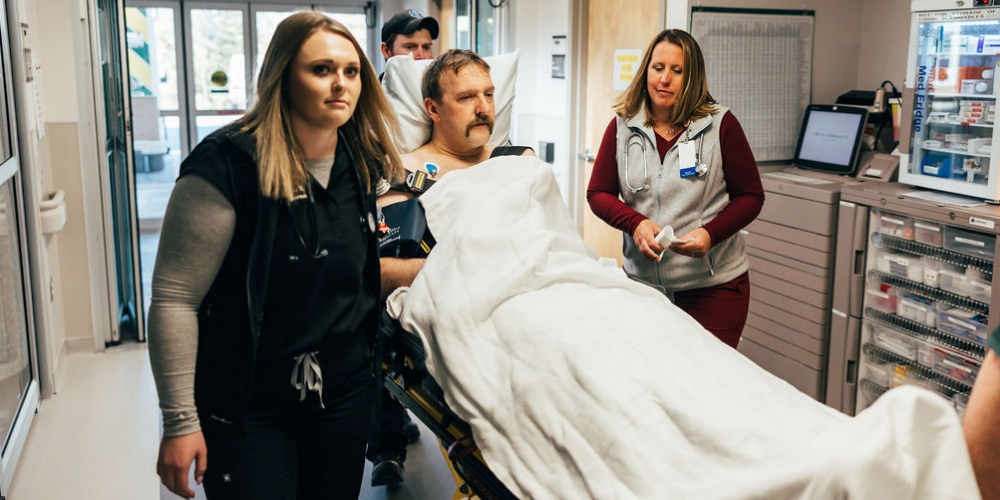
Members of the Upper Connecticut Valley Hospital care team transport a patient through the hospital. ( Photo Courtesy of North Country Healthcare)
Lauren Pearson, the executive director of the North Country Health Consortium, says the approach to reforming rural health care laid out in the state’s proposal is promising, signaling a shift from “reactive care” to a more “preventative and population-based” approach.
“It’s a structural redesign of rural health care. So, it’s moving care closer to home. It’s stabilizing some of our more fragile health care systems” she says, highlighting hospitals, federally-qualified health centers, and community mental health centers. “It’s building the local workforce instead of having to import one. It’s focusing simultaneously on stabilizing our maternal health care needs, our EMS and behavioral health.”
Some providers hope the funds can help address one of their biggest challenges—recruiting and retaining enough doctors, nurses, and other health care workers in more remote parts of the state.
North Country Healthcare, a health system with hospitals in Berlin, Lancaster and Colebrook and a home health care and hospice agency, expects to receive funding for the region’s first family medicine residency, which it’s launching in 2027. CEO Tom Mee says the goal is to produce a homegrown supply of primary care doctors, citing data that indicates most doctors practice within 100 miles of where they completed their residencies.
“It’s the most ambitious initiative we’ve undertaken as a system,” he says.
Recruitment and retention is also a major challenge for Northern Human Services, the community mental health center serving Coös, Carroll and upper Grafton counties. CEO Suzanne Gaetjens-Oleson says she’s optimistic about GO-NORTH’s plans to expand training and educational opportunities for local students who want to go into health care.
“Here in the north, it tends to be our locals who stay with us,” she says. “We do have people come in, transplants, and they tend to come and do a HRSA loan reimbursement,” a nationally recognized program with a two- or three-year commitment, “and then leave, because this isn’t their place.”
Patricia Carty, CEO of the Mental Health Center of Greater Manchester and vice president of the Community Behavioral Health Association (CBHA), says Rural Health Transformation grants will also support efforts to put the state’s chronically underfunded community mental health centers on more solid long-term footing. (The CBHA is one of several “hubs” working with the state’s GO-NORTH office to administer the funds.)
That includes investing in a unified electronic medical records system to improve efficiency and getting every center designated as a “certified community behavioral health clinic,” a federal designation that involves higher standards of care and better integration of physical and mental health care.
Importantly, it also comes with a more favorable Medicaid payment model that bases reimbursement on the actual cost of providing care, which Carty says will enhance the centers’ long-term financial sustainability. Her center already made that switch, allowing it to raise wages and cut its vacancies by 44%.
“Being able to build in [to Medicaid reimbursements] a market adjustment, a cost-of-living increase, is something that stabilizes the workforce for us,” she says.
‘It Doesn’t Impact Just Medicaid Patients’
Rural health care leaders say those initiatives, however, won’t be enough to offset the large losses from the One Big Beautiful Bill Act’s Medicaid cuts. And some raised questions about how sustainable Rural Health Transformation-backed projects will be once the funds run dry.
According to an analysis by the health policy organization KFF, rural communities stand to lose $137 billion in Medicaid funding over the next 10 years, nearly three times as much as they’ll receive in Rural Health Transformation grants.
“It doesn’t impact just Medicaid patients,” says Steve Ahnen, president of the NH Hospital Association. “It impacts everybody, because those resources are used to support the broader health
care system.”
Ahnen says NH’s hospitals are already under pressure from rising labor costs, workforce shortages and other challenges, even before factoring in the Medicaid cuts. And rural hospitals, with a patient mix that tends to be older and less well-off, are especially dependent on revenue from Medicaid and Medicare.
According to the hospital association’s most recent data, seven NH hospitals had negative operating margins in 2024, including four rural critical access hospitals.
The state’s nonprofit community health centers are also bracing for a rise in uncompensated care as more patients lose insurance due to the changes to both Medicaid and the Affordable Care Act premium subsidies, says Georgia Maheras, senior vice president for policy and strategy at the Bi-State Primary Care Association, a nonprofit that represents community health centers and safety-net providers serving more than 344,600 patients at 175 locations throughout NH and Vermont.
“Our health centers are community focused, are seeing people regardless of their ability to pay, and that gets increasingly hard if they don’t have enough revenue coming in the door,” she says. “You know the adage—‘no margin, no mission.’”
That impact is already being felt. Ammonoosuc Community Health Services, a health center with several locations in northern NH, closed its clinic in Franconia last year, citing the anticipated loss of about $500,000 annually in Medicaid revenue. Some 2,000 patients now must drive to locations in Whitefield or Littleton.
CEO Ed Shanshala says the decision was tough, but the organization had to cut expenses to offset the Big Beautiful Bill’s impact. “It changes the fabric of the community, and it’s a loss,” Shanshala says. “In rural areas, when businesses close, they often don’t come back—health care being the same.”
Carty worries mental health centers and other safety-net providers could be in for a replay of the so-called “Medicaid unwind” a few years back, when tens of thousands of Granite Staters lost Medicaid coverage after the expiration of pandemic-era rules that kept people enrolled. Some no longer qualified for Medicaid, but others fell through the cracks because of administrative hurdles. Carty says the mental health centers incurred $15.5 million in uncompensated care costs that year.
“That level of uncompensated care was unsustainable,” she says.
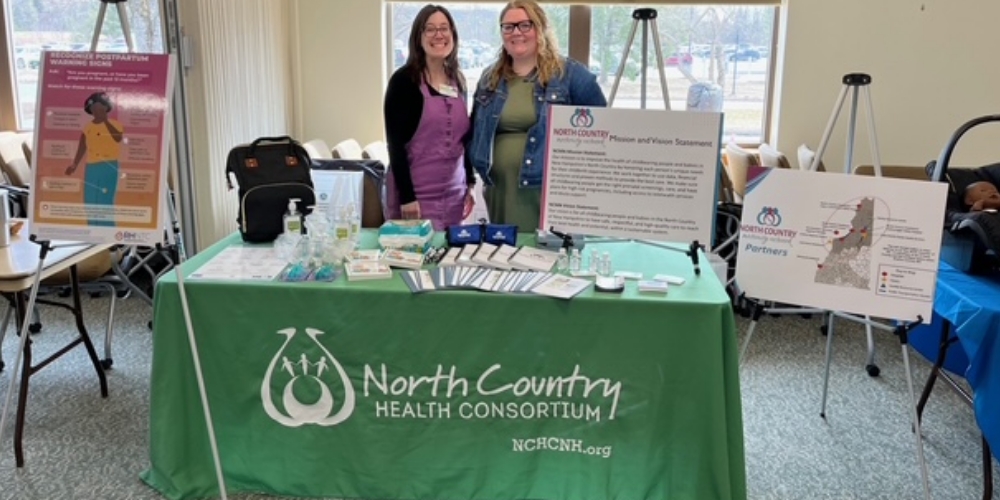
North Country Health Consortium members participating in a health fair. (Photo Courtesy of North Country Health Consortium)
Ultimately, says Pearson of North Country Health Consortium, the Rural Health Transformation funds are an important first step. But it’s going to take a lot more to fix a strained rural health care system that’s staring down a massive funding loss.
“While this [program] will make great progress in addressing and transforming the rural health care landscape, I don’t think the funds are sufficient, when you take all of those things into context, to cover the vast needs that exist,” she says.
Lozeau, from GO-NORTH, acknowledges those realities. That’s why she says sustainability is at the core of the state’s strategy for deploying these funds.
“Our focus is on investments that can leave lasting capacity behind,” she says. “That includes things like workforce development, technology and infrastructure improvements, stronger care coordination, better connections between clinical care and community supports, and helping providers move toward models that improve outcomes and make better use of available reimbursements.”
When possible, they’re also prioritizing support for programs that can sustain themselves through existing reimbursement streams, operational efficiencies or other ongoing mechanisms.
“At the same time, we want to be candid that this program is not intended to replace all other revenue sources,” she says. “It is a transformation investment. Our job is to use it in a way that helps rural providers and communities build a stronger foundation for the future.”