Six years after the COVID-19 pandemic led to a spike in office vacancies, real estate brokers say NH’s office market seems to be stabilizing, as companies adapt to more flexible work and vacant offices are turned into apartments.
Meanwhile, in the industrial market, demand remains strong for small and mid-size spaces like contractor bays, though interest in large warehouse spaces has weakened. New industrial development has also slowed amid rising construction costs.
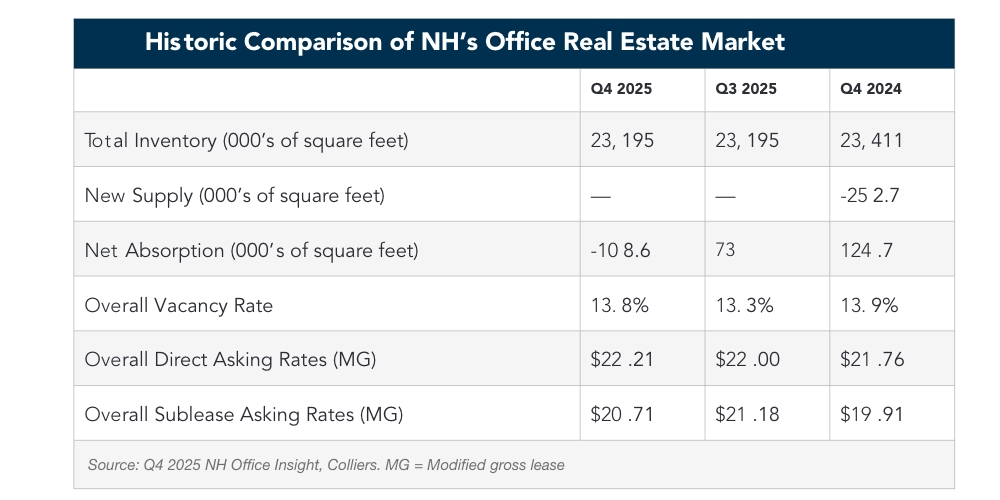
New Hampshire’s office vacancy rate stood at 11.7% at the end of Q1 of this year—still higher than before the pandemic, but down about 3 percentage points from the same time last year, according to research from Colliers. Average rents rose slightly in 2025.
The stabilizing vacancy rate is partly because companies have adjusted to post-COVID patterns of working, says Kent White, principal broker at the Boulos Company, who focuses on the Seacoast.
“In the years after COVID, there was a period of time where businesses were trying to figure out what they needed for offices,” he says. “And I think for
the most part, most businesses have decided on what their office looks like going forward.”
Another factor is the continued conversion of excess office space to apartments, which has taken some vacant office buildings off the market, says Kristie Russell, Colliers’ research director for NH and Maine.
“Manchester is one of the strongest office submarkets we have right now,” she says. “Part of that is from leasing activity, but part of that is also the conversion from office to multifamily.”
In 2025, around 216,000 square feet of office space was taken off the market to be redeveloped into housing—about 1% of the state’s total inventory, according to Colliers. That trend looks likely to continue with projects like Brady Sullivan’s planned conversion of the Liberty
Mutual campus in Dover to a mixed-
use development.
Much of the demand for office space right now is for smaller spaces, says Brian Dano, managing director of SVN The Masiello Group in Bedford and president of the NH Commercial Investment Board of Realtors.
“The demand for 10,000, 20,000 square feet of office has lessened, but we’re doing 5,000 and under pretty frequently,” he says.
Many of those companies are seeking space for medical uses. He thinks the office market is seeing a version of the ‘Amazonification’ that retail went through a decade ago.
“When you look at retail right now, it’s all experiential. It’s a trampoline park, it’s a ‘get your hair cut,’ it’s a ‘eat at this restaurant’—all those things you can’t do online,” he says. He sees a parallel in the demand for medical office space. “Dermatology seems to be popping up everywhere. We’ve done a lot of autism daycares, things of that nature.”
Chris Healey, a Manchester-based partner with The Boulos Company, says the “dust is still settling” as leases signed before the pandemic expire and companies reevaluate their office needs. But even as some companies look to shrink their office footprints, there’s been a “flight to quality” as tenants seek buildings with extra amenities.
“Companies are still definitely leery of the economics, and they want to make sure that the numbers work,” he says. “But they also want to create an environment that will attract and retain talent.”
Warehouse, Manufacturing a Mixed Picture
Several years ago, industrial space in NH was in high demand as companies rushed to respond to changes in consumer habits during the pandemic. This limited availability pushed up rents and also spurred a spate of new construction.
“What we’ve seen in the last two years is people like Amazon backing off a little bit from the rush to build,” says Bob Rohrer, managing director and principal for Colliers’ NH and Maine offices. “What followed from that was kind of a slowdown in the other markets as well.”
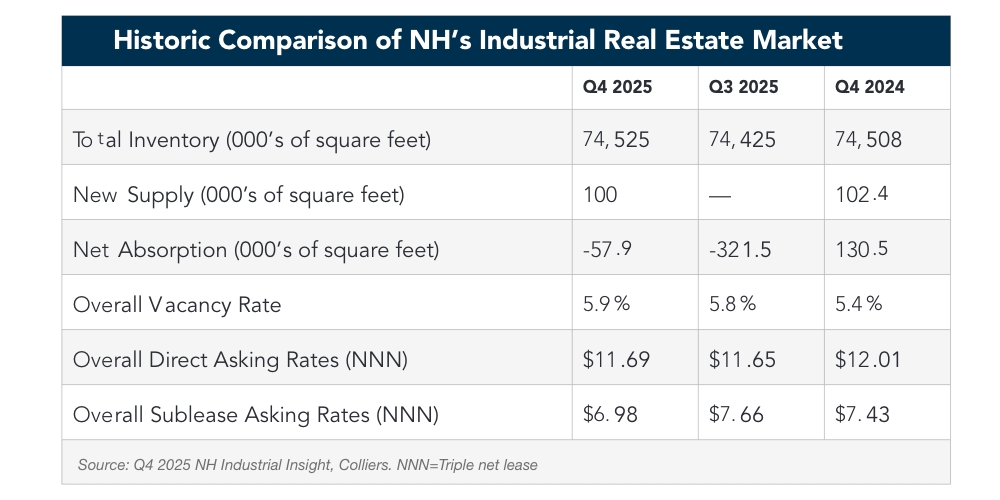
New Hampshire’s industrial vacancy rate stood at 6.5% at the end of Q1, up 1.2 percentage points from last year, according to Colliers. But the topline number doesn’t tell the whole story.
The warehouse sector performed the strongest in 2025, with the vacancy rate falling as more than 500,000 square feet were absorbed. Russell says that was driven by demand for small- to medium-size spaces.
“One of the things that we’re seeing is, again, the shift in demand from the larger blocks of spaces, the larger footprints, to more the medium and smaller sizes,”
she says.
By contrast, the vacancy rate for manufacturing spaces rose, but Russell’s research suggests that’s due more to company-specific decisions to close certain production facilities, like the Anheuser-Busch brewery in Merrimack, than broader market trends.
“We have seen a slowdown of new industrial construction as well,” she says.
She and others say rising construction costs have made developers more reluctant to build projects without a tenant already lined up, and a lot of projects were approved but are currently on hold.
“The only way you’re going to see new development is if a tenant has leased the entire building or close to the entire building, or they’re building a building for themselves,” White says. “It’s just too risky to build on spec.”
With less new industrial space entering the market, Healey says more existing inventory is being leased.
“More of the existing space that tenants may have seen on tours and elected to hold off on—whether they thought it was lacking something feature-wise, might have been a little obsolete in some fashion—those are now starting to get more activity and get spoken for,” he says. “So,
there’s more absorption of industrial square footage.”
While some bigger industrial sites are sitting vacant, Healey says smaller spaces tend to lease quickly, driven by demand from small operations like plumbers and HVAC contractors.
For example, a developer in Hudson recently built three buildings worth of industrial “flex” space that could be broken into smaller units of 2,000 to 3,000 square feet. The whole property was leased in 60 days, Healey says, “whereas if you had that square footage in the aggregate in one full building, you’re going to be sitting on that for a while.”
“It’d be great if we had more product that we could bring to the market for smaller size ranges, call it 20,000 feet and under,” he says. “Because it would go.”
White says that even though demand for industrial “softened considerably” around late 2024 or early 2025, it’s recently edged up again. One factor may be companies that put off major real estate decisions amid the economic uncertainty of the last year are finally having to pull the trigger.
“We’ve certainly seen an uptick in demand over the past few months,” he says.