To understand the current challenges in the construction industry, ask Developer Steve Duprey about his hypothetical $30 hamburger. Duprey Companies recently paused plans for a country-western-themed restaurant called Dukes in Concord.
“We’ve put Dukes on hold,” he says. “We got two [construction] bids, and they were so high you’d have to charge $30 for a hamburger to make it work.” Duprey says he hopes to start construction in late fall when he has a better idea of where the economy is headed and more specialty trades are looking for winter work.
During the low-interest-rate environment of the late 2010s, speculative development was common. Builders would start projects without a committed tenant, confident demand would follow. In a high-cost, higher-rate environment, projects are purpose built with a pre-determined end-user, an approach that is changing NH’s construction pipeline, says Joshua Reap, president and CEO of Associated Builders and Contractors NH/Vermont.
“That [speculative] model has largely faded,” Reap says. “Now things are being built more with purpose.”
According to the U.S. Census Bureau, total U.S. construction spending reached a seasonally adjusted annual rate of $2.19 trillion in January 2026, slightly down from the previous month but still above year-earlier levels. Public construction has remained a relative bright spot, rising modestly even as private sectors softened.
Meanwhile, construction input costs remain elevated. Since late 2020, material costs have risen more than 40%, according to the National Association of Home Builders, with tariffs adding an estimated $10,900 to the cost of a typical home.
More recent data shows continued pressure, with the Producer Price Index for construction materials rising 2.1% between January and March 2026.
“The question we keep getting is: Is it still busy in New Hampshire?” Reap says. “The answer is yes, but the type of project is different from what we’ve seen.”
End-user projects now drive much of the pipeline because organizations can justify higher upfront costs and longer return horizons, he says.
“A dental facility buildout might be a $5 million project with specialized infrastructure,” Reap says. “They’re going to pay a mortgage anyway. If it improves their operations, they’re willing to invest.”
A Stalled Pipeline
Gary Thomas, president and CEO of NorthPoint, a design-build firm with roughly 40 employees, offers a blunt assessment of the current environment. “We’re real busy with being busy right now,” Thomas says, describing a workload dominated by planning, preconstruction, and navigating local approvals, but not always breaking ground.
NorthPoint currently has roughly $160 million in its pipeline. But Thomas estimates that as much as half of that may never materialize. This can pose a problem in terms of cash flow to many subcontractors and suppliers in the industry forcing some firms to make calculated assessments of a project’s chances of completion.
“There are a lot of projects we’re working through planning and zoning board processes,” he says. “But by the time all that happens, people sometimes get cold feet due to price increases or interest rates going up.”
The projects that are moving forward tend to be what industry leaders call “end-user” developments. These are facilities built for the long-term operational needs of a specific business or organization such as gyms, dental clinics, churches, and commercial or industrial spaces.
By contrast, some speculative and even smaller multifamily residential projects have become harder to justify. “We’re having a hard time getting some multi-residential projects to pencil out for developers, the larger ones typically pencil out easier.” Thomas says.
“You’re still seeing a lot of multifamily go up,” Reap says. “But larger projects that might include 300 or 400 units are more likely to move than smaller 30- to 50-unit buildings.”
The reason is largely economic. Larger developments benefit from economies of scale, allowing developers to spread fixed costs across more units and keep rents competitive.
Still, caution is evident. Duprey says his firm is not building any new projects this year. “A lot of developers are definitely pulling in their horns,” he says, explaining that while permitting activity remains active, many projects stall before construction begins due to costs. “Architects are busy, permits are happening but then they’re holding.”
Chris Huston, executive vice president at ReArch Construction, a construction management firm in Vermont and NH, agrees. “In the past, financing would be lined up,” Huston says. “Today, we get the project, go out to bid, and then the client says, ‘We should hold off for a few months.’”
In response, firms are placing greater emphasis on preconstruction—detailed cost estimating, logistics planning, and risk analysis—to help clients navigate uncertainty before committing capital.
Duprey also notes a shift in contractor behavior. “A year ago, you might get two bids and be happy. Now you’re getting five or six,” Duprey says, noting the increased competition reflects a market where contractors are competing more aggressively for a smaller pool of viable projects.
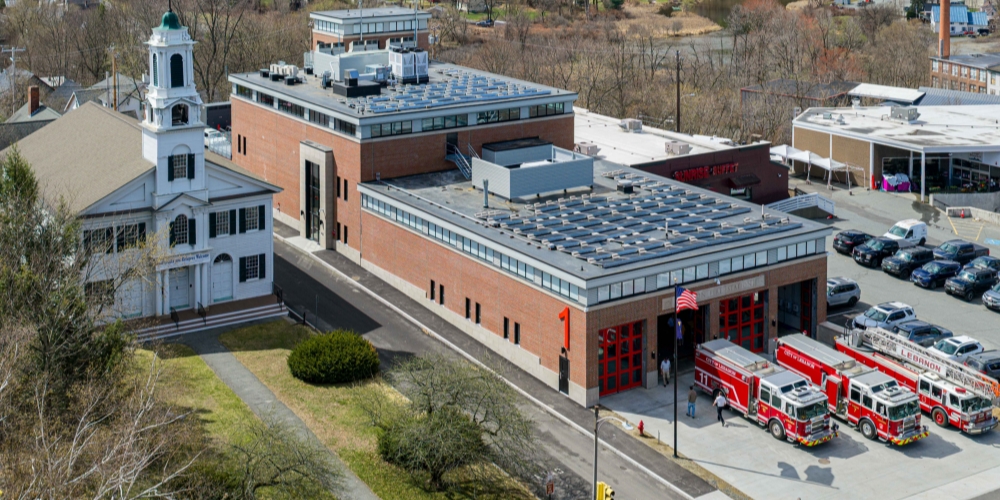
The City of Lebanon celebrated the decoupling of its new Central Fire Station on April 17. Designed by Lavallee Brensinger Architects with ReArch as construction manager,
the new facility replaces the original 1954 station and is built to support modern emergency response needs with improved safety, efficiency, and resilience. (Photo Courtesy of ReArch Construction)
Cautiously Optimistic
At the core of much of this hesitation is the cost of building combined with the cost of borrowing. Thomas sees little relief ahead this year. “Site work numbers, including diesel going up by $3 a gallon, have been tough,” he says.
Duprey agrees, pointing to global forces shaping local economics. “A couple of things need to happen,” he says. “First, energy prices need to come down.”
But even if geopolitical tensions ease, he adds, the effects will likely linger. “Commodity prices are going to be affected for six to nine months.”
Still, several sectors continue to anchor NH’s construction pipeline, though often under different conditions than in past cycles. Multifamily housing, for some developers, remains a core driver, particularly
at scale.
“There’s still a real need for multifamily,” says John Stebbins, CEO of Hooksett-based PROCON, whose company recently completed and is currently working on several major multifamily projects in NH, including the high-end 252-unit Liberty Lane Residential in Hampton and a 135-unit multi-family project in downtown Somersworth.
End user projects in industrial and manufacturing construction is also holding up, Stebbins says, supported in part by national demand for defense-related production. “We’re seeing continued strength in manufacturing,” Stebbins says. “There’s real pressure for those manufacturers
to produce.”
Reap echoes that, noting that NH’s role in the defense supply chain is helping stabilize demand for industrial construction.
Public sector and institutional work including schools, libraries, and public works facilities also continues to provide a steady baseline, though these projects fluctuate with local funding approvals. “There’s always some level of municipal work happening,” Huston says.
Other niche sectors are contributing targeted activity. Aviation infrastructure projects at Pease and Manchester-Boston Regional Airport, along with growing demand for smaller medical office buildings, such as outpatient medical facilities, are creating opportunities for specialized construction.
“I’ve heard a desire for multiple large institutional medical outfits to develop smaller outpatient facilities around the area, both in Southern Maine, New Hampshire, and Massachusetts,” Stebbins says.
At the same time, some widely discussed solutions, like converting vacant office space into housing, are proving more limited in practice. “We’ve looked at a lot of conversions because that idea is very popular,” Stebbins says. “But the ability to convert an office building is
fairly limited.”
The constraint, he explains, is largely structural. “Once you get past 70 to 75 feet in width, maybe 80, you get too far from an exterior wall,” he says. “There’s too much dead space in the middle of the building that you can’t lease.”
That makes many large office building conversions, some 120 to 150 feet wide, economically unfeasible, even as vacancy rates remain elevated.
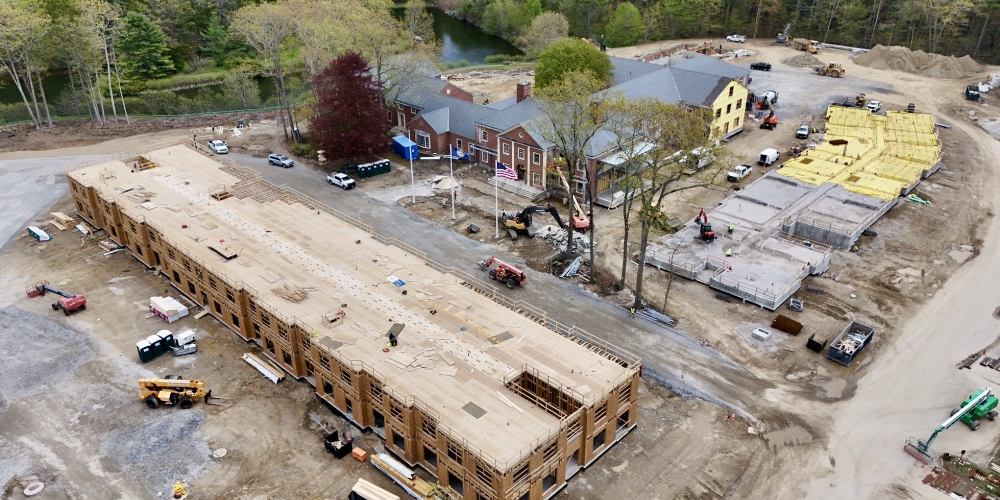
Liberty Lane Residential in Hampton progress as of May (Photo Courtesy of PROCON)
Hospitality Slowdown
Not all sectors are holding steady. Hospitality construction, once a major driver, has slowed sharply. Construction costs are up roughly 40% and financing costs are signific-
antly higher.
“Prior to the pandemic, we had about 25 hotels in our pipeline,” Stebbins says. “That got cut down to maybe four.”
But broader policy and market dynamics are also playing a role. “This isn’t a political statement, but federal policies have had a material effect on the business,” Stebbins says, pointing to reduced spending in key markets like Boston.
At the same time, international tensions and tariff policies have affected Canadian tourism, a critical driver of demand along the New England Seacoast. “That dramatically affects the number of Canadian tourists,” he says. “Those beach communities used to get filled every summer, and that would push demand into other markets. That hasn’t happened the last couple of years.”
Duprey is seeing those effects firsthand. “This could be the worst year since COVID,” he says, citing declines in both leisure and business travel.
Labor Constraints
Even as demand persists in certain sectors, workforce challenges remain. “The pipeline of young people entering the skilled trades still does not keep pace,” says Johnny Illick, CEO of ReArch.
According to a NH Department of Business and Economic Affairs report from 2022, and updated in 2023, the construction industry in NH has a high retirement risk, with 29% of the workforce aged 55 and over.
Training programs and workforce initiatives are helping, but demographic pressures—including an aging workforce, continue to limit labor availability.
Nationally, there are indications that efforts to recruit younger people to the trades is working. According to a report released last January by Associated Builders and Contractors (ABC), “the industrywide workforce has become significantly younger over the past several quarters, with the median construction worker now younger than 42 for the first time since 2011. As a result, the pace of retirements is expected to slow this year.”
However, that assessment is tempered by the construction industry, nationally, needing to attract an estimated 439,000 net new workers in 2025 to meet anticipated demand for construction services, according to the ABC report, and 499,000 new workers in 2026.
While activity remains steady, Reap says the industry continues to face structural challenges. Construction costs remain elevated, driven by labor shortages and lingering supply chain pressures. ABC’s Construction Confidence Index showed cautious optimism in early 2026, but contractors continue to cite workforce availability and input costs as
top concerns.
Construction leaders are keeping a close eye on policy debates as well, including ongoing discussions around project labor agreements and open-shop contracting, Reap says.
“There’s always a conversation about preserving open competition,” he says about legislation that could limit non-union contractors on certain public projects. “Our position is about maintaining flexibility and opportunity across the industry.”
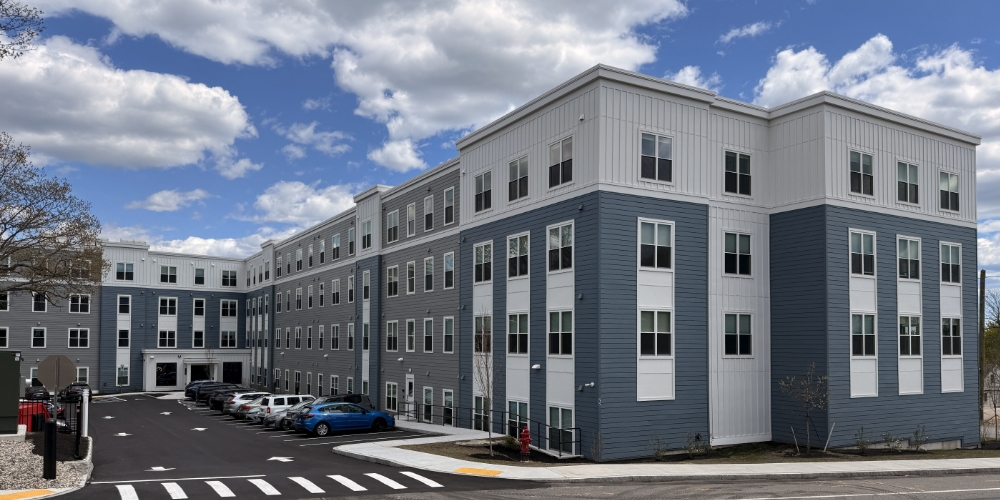
The Overlook, a multi-family project in downtown Somersworth (Photo Courtesy of PROCON)
A Cautious Path Forward
Taken together, the data and industry perspectives point to a construction sector that remains active, but more disciplined and risk-aware than in previous years. “There’s still work,” Duprey says. “But people are being more conservative.”
Thomas, who has spent 45 years in the industry, sees echoes of past cycles. “This is the third time I’ve seen this movie,” he says, referencing the recession of the late 1980s, the Great Recession of 2007 to 2009, and today’s uncertain economy.
In NH, projects are still moving forward, but more deliberately, more selectively, and with a sharper focus on risk than at any point in recent memory. “It’s really just the uncertainty,” Thomas says. “People are still spending. But for some, the uncertainty and the cost makes it difficult.”