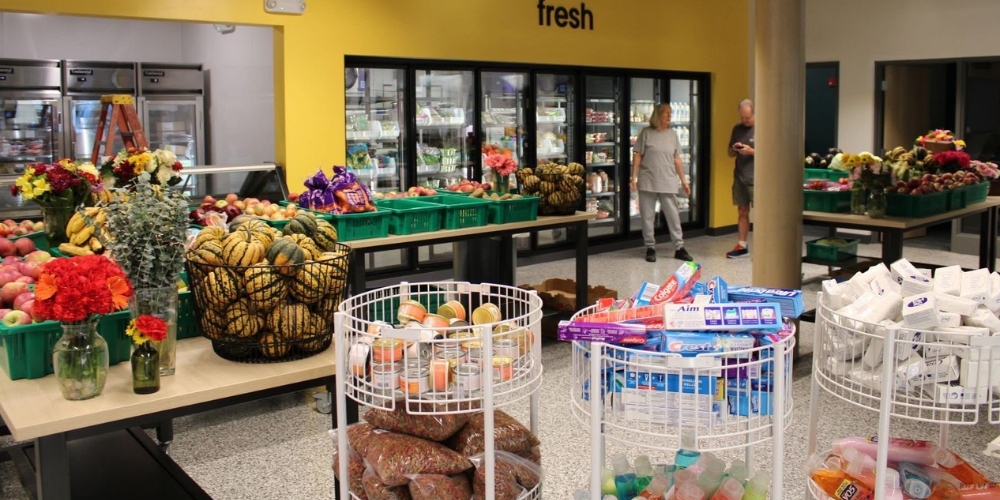
Gather’s new pantry market in Portsmouth (Photo Courtesy by Barbara MacLeod)
In Portsmouth, Gather has entered a new chapter defined by a sharper focus on its mission of ending hunger.
The nonprofit’s new 18,000-square-foot Community Food Center represents a significant evolution from its earlier, more limited spaces. With expanded capacity and purpose-built facilities, Gather can now integrate food access, education, and workforce development under one roof. For Executive Director Anne Hayes, that shift is intentional.
“We want to stay focused on the mission of creating a hunger-free community,” Hayes says. “We don’t want to get distracted.”
The new building enables exactly that. It includes a pantry market, a warehouse with a 1,100-square-foot walk-in cooler, a batch production kitchen, a teaching kitchen, and a flexible community gathering space that can host up to 100 people. The added infrastructure allows Gather to accept and distribute more fresh food—critical in a system where 38% of its nearly 1.8 million pounds of annual supply comes from grocery retail through Fresh Rescue. They also receive food from partners like the NH Food Bank and Seacoast Waste Not.
At peak operation, Gather serves an average of 25 households and distributes roughly 1,200 pounds of food per hour.
But Hayes emphasizes that the organization’s work goes far beyond food distribution. The Community Food Center model, built around the pillars of growing, cooking, sharing, and advocating, expands the focus to long-term solutions.
“Traditionally, food pantries meet an immediate need,” she says. “What we can do now is all of that and more.”
That includes programs like Fresh Start, a culinary workforce training initiative for individuals facing barriers to employment. “If we get people into a job, then they don’t need us,” Hayes says.
The new space also allows Gather to provide more “wraparound care,” bringing together partners to assist with housing, legal support, and other essential services. Community dinners, cooking classes, and nutrition education programs are now regular offerings, helping address food insecurity as well as social isolation and
health outcomes.
Hayes is seeing more requests for corporate groups to volunteer and from other agencies for cooking classes for their clients. At the same time, policy changes, such as new SNAP eligibility requirements for unhoused individuals, have added complexity, prompting Gather to work closely with agency partners to ensure access
for clients.
The facility strengthens Gather’s role as a regional convener. Its gathering space hosts groups like the Seacoast Impact Collaborative and provides room for community events, education programs, and volunteer-driven services such as tax preparation.
Support from corporate partners, including M&T Bank, Green & Company, and Novocure, has helped make the new center possible, while interest from organizations across the country underscores the model’s broader relevance.
“So much work has gone into this space,” Hayes says. “Now we have the luxury of being able to provide longer term solutions to food insecurity, staying centered on why we’re here.” For more information visit gathernh.org.