
Despite a host of financial and workforce challenges, NH hospitals are investing millions in facilities and machinery to serve clients now and in the future, from a $500,000 retail pharmacy to a $43 million central energy plant.
The advancements come despite a dramatic spike in the cost of providing care, says Steve Ahnen, president of the NH Hospital Association, who notes hospitals have seen a 44% increase in operating costs and a 36% hike in labor costs since the pandemic. Small, rural hospitals have been particularly hard hit.
“The operating environment is becoming even more challenging, so when hospitals make the kinds of investments they need to make, they do it even more thoughtfully,” he says.
Key to the extent of an individual hospital’s investments is its location and ownership.

Removal of the temporary Electrophysiology (EP) trailer due to the $2.7 million EP Lab renovation and to accommodate the central energy plant. (Photo Courtesy of HCA Healthcare)
HCA Invests in CMC
Tennessee-based HCA Healthcare, which acquired the financially distressed Catholic Medical Center in Manchester just over a year ago, has committed $157 million in capital improvement projects to CMC, according to CEO John Skevington.
“I’ve been in the state 15 years and this certainly seems like the most substantial investment in a hospital facility I have seen,”
he says.
Included are funds to expand and rebuild a freestanding emergency room in Nashua at a cost of $16 million, scheduled to open this summer with the goal to increase access to emergency care in an area with growing healthcare needs.
A $27 million infrastructure investment, to be phased in over five years, will upgrade electrical systems, improve the HVAC and energy systems, modernize nine elevators, extend fire safety improvements, and upgrade many windows and roofs.
CMC broke ground in February on a $43 million central energy plant meant to improve reliability, efficiency and patient comfort. The following month, it completed a $2.7 million electrophysiology (EP) lab renovation designed to support advanced EP procedures (the diagnosing and treating of heart rhythm disorders) with greater precision and allow patients to receive advanced cardiac care close to home.
Additional plans call for renovating the emergency department and expanding it from 24 bays to 31, and upgrading the pneumatic tube system so staff members will not have to walk far to retrieve items. HCA Healthcare also continues to invest in CMC’s core service lines, including cardiovascular care, emergency services and surgical capabilities.
“I don’t think this would be possible without the backing of HCA Healthcare,” Skevington says of the investments. “It’s the benefit of being part of a large organization … There are people I will never know who are going to benefit from this for a long time.”
HCA also owns Parkland Medical Center in Derry, Portsmouth Regional Hospital, and Frisbie Memorial Hospital in Rochester as well as freestanding ERs in Plaistow, Dover and Seabrook and an urgent care center in Bedford.
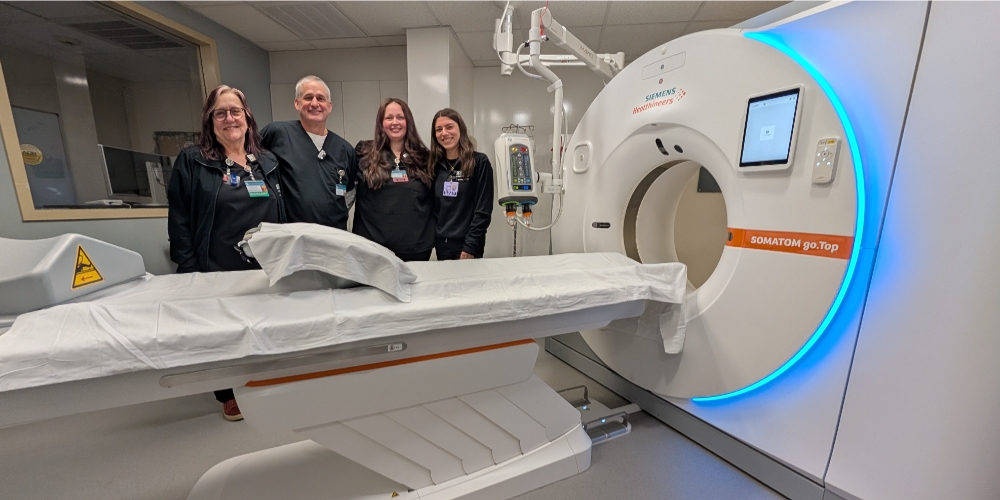
CT technologists pose with Concord Hospital Franklin’s new Siemens SOMATOM go.Top CT scanner in the renovated scan room and control area. (Photo Courtesy of Concord Hospital)
Concord Hospital
Since 2020, Concord Hospital Health System—which has hospitals in Concord, Franklin and Laconia—has invested more than $31 million in capital improvements at its Franklin and Laconia locations to modernize equipment and strengthen infrastructure. A new advanced CT scanner was installed at its Franklin location in April.
A $20 million renovation of the Laconia Medical Office Building is planned, as well as the introduction of infusion and ambulatory cancer care services in Laconia, expansion of the Skilled and Restorative Care Unit in Franklin, and renovation of some patient rooms in Franklin.
Concord Hospital Medical Group also opened a new walk-in primary care facility last year at Merchants Way in Concord to provide immediate non-emergency care.
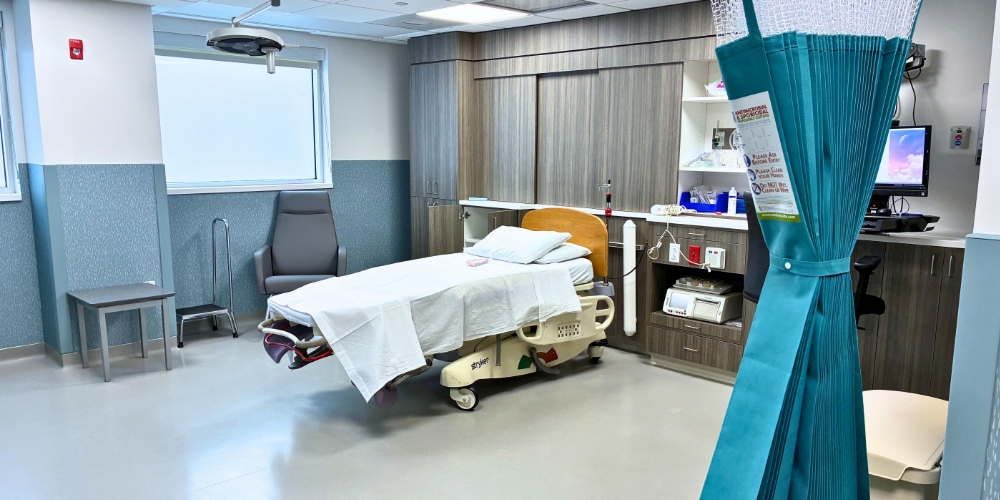
The newly renovated labor and delivery rooms at Elliot Hospital combine modern upgrades with a calm, welcoming atmosphere to support families through every stage of the birth experience. (Photo Courtesy of Elliot Health System)
Elliot Health System
Elliot Health System, based in Manchester, has made a series of investments, starting with an $18 million, 12-bed Adult Step-Down Unit, which opened in March. It is meant to fill “the gap between intensive care service, which is very specialized and has a nurse ratio of one to one, and a medical surgical floor, with a ratio of one to four,” explains Dr. Greg Baxter, president and CEO. The ratio in the Step-Down Unit is one to three.
In April, Elliot also opened a new $10 million, 1,000-square-foot cardiovascular operating room to provide surgeons with state-of-the-art tools for complex procedures like coronary artery bypass surgery and aortic and mitral valve replacement or repair. Surgeons were involved in planning the unit, according to Baxter, “to make sure the room was what they were looking for.”
Elliot is also expanding its 1-Day Surgery Center, an ambulatory surgery center within the Elliot at River’s Edge facility, and has renovated the Labor & Delivery Unit at Elliot Hospital, which delivers 3,000 babies annually and boasts a Level III Neonatal Intensive Care Unit.
Five-hundred staff members have been added “to support growth and demand for services” in the previous 14 months, says Baxter, who adds that “our biggest investment is our people.”
Baxter points out that Elliot is nonprofit and locally owned, which means its investments remain local. “We have a number of entrants into the market, but the economic value is not staying in New Hampshire,” he adds, pointing out that CMC’s owners are based in Tennessee and Wentworth-Douglass Hospital is part of Boston-based Partners Healthcare, with Mass General as its parent organization.
The investments Elliot is making are meant to maintain economic stability, develop high quality programs and “recruit the best and brightest,” he says, adding “We have a vision that we want to be your first choice to give and receive care.”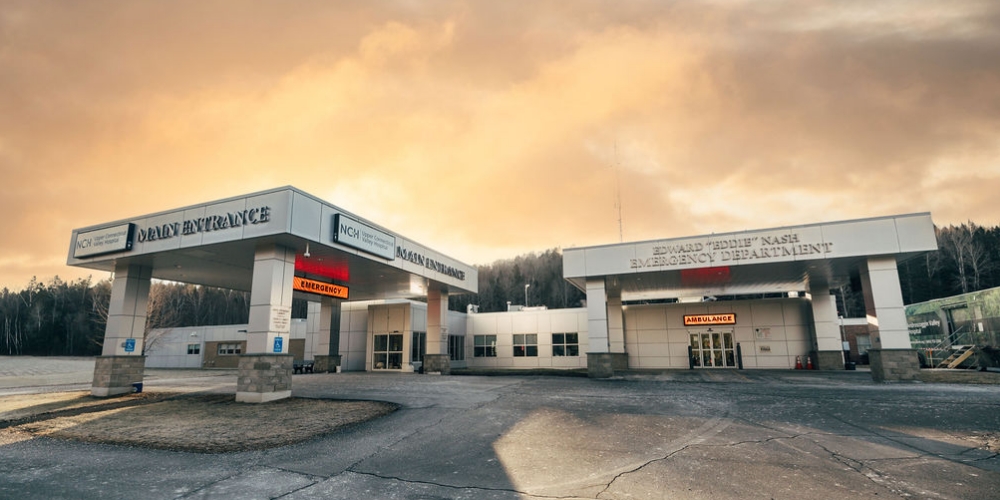
Upper Connecticut Valley Hospital in Colebrook serves patients and families across the northernmost region of the state. (Photo Courtesy of North Country Healthcare)
North Country Healthcare
North Country Healthcare, which includes Androscoggin Valley Hospital, North Country Home Health & Hospice Agency, Upper Connecticut Valley Hospital and Weeks Medical Center, has fewer capital investment projects. As a rural nonprofit health system, North Country Healthcare does not have the financial flexibility of larger urban health systems, explains Michael Peterson, president and CEO of Androscoggin Valley Hospital.
But a strategic facility plan now in the works could result in some major investments, he says.
The 10- to 15-year strategic facilities and feasibility plan has drawn eight proposals, according to Lauren Anderson, director of philanthropy and community relations for North Country Healthcare. It is meant to serve as a strategic roadmap and implementation tool for facility investments. Final selections were expected June 1, with work to begin in the next budget year.
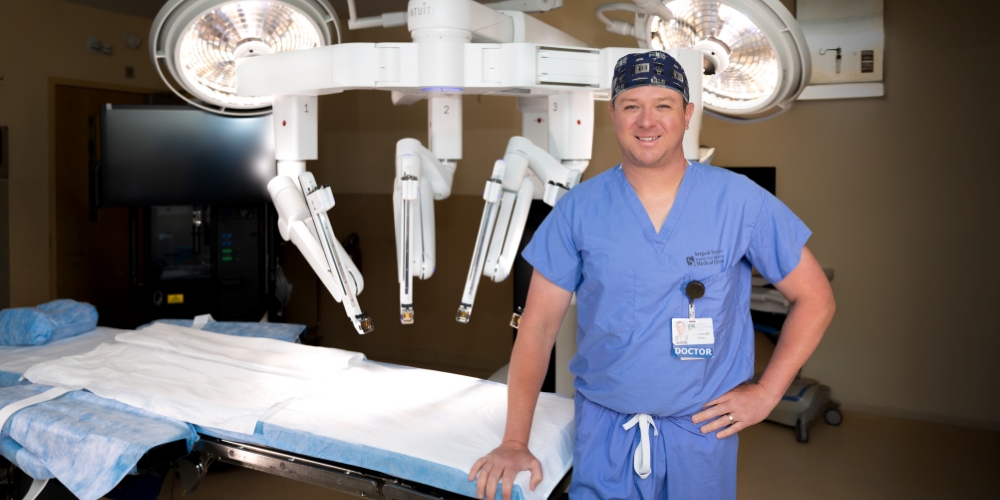
da?Vinci 5 surgical robot and Dr. Brett M. Baker of Foundation Surgery and Southern NH Weight Management (Photo Courtesy of Southern NH Health)
Southern NH Health
Southern NH Health, a nonprofit system based in Nashua that includes Southern NH Medical Center in Nashua, Foundation Medical Partners and five walk-in immediate care locations in southern NH and northern Massachusetts, is building for the future.
“We’ve been on a very exciting path for the last year or so,” says President and CEO Colin T. McHugh.
Southern NH Health is building a new $25 million heart and vascular center within the hospital to provide advanced cardiovascular care, scheduled to open in December. A retrofitted $500,000 retail pharmacy, set to open in June, will provide “meds to beds” so patients no longer need to go outside the hospital to get a prescription filled, regardless of their ability to pay.
The system has 17 physical locations and is planning major improvements in chilling systems at its sites.
That comes in addition to other investments made over the last few years, including an Intuitive da Vinci 5 surgical system, the latest in robotic-assisted surgical technology, at Southern NH Medical Center. An AI-powered GI Genius module, which helps physicians find polyps during colonoscopies, was added
in 2023.
A new listening program called DAX Copilot allows physicians to better focus on their patients by creating notes of conversations between patients and providers to reduce documentation time.
McHugh says Southern NH Health will focus future investment dollars on building out its ambulatory footprint and creating more high acuity beds.
After four years of financial losses, the system has seen a $45 million turnaround over the last couple of years due to efficiencies like monthly operating reviews that examine key performance indicators and the appropriateness of staffing. Not a single layoff has resulted, McHugh says.
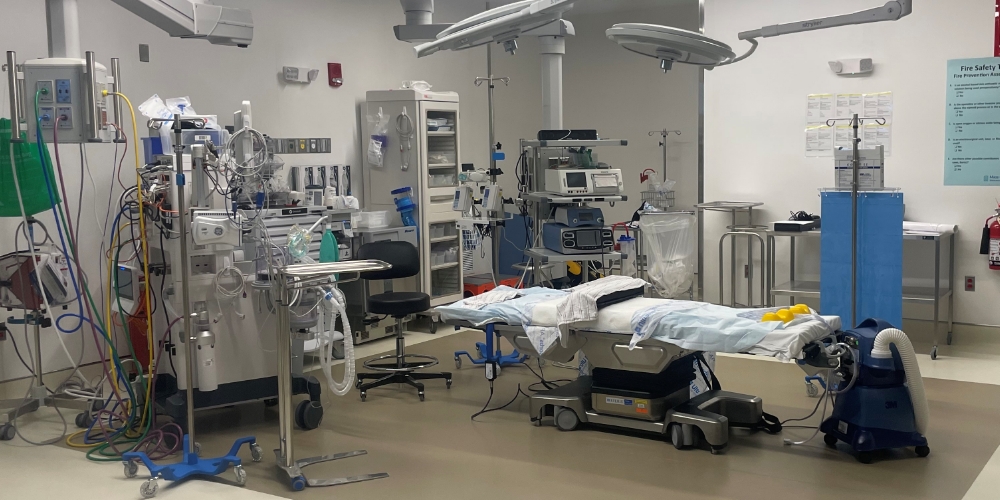
Specialized ob/gyn operating room in Dover provides advanced surgical care (Photo Courtesy of Wentworth-Douglass Hospital)
Wentworth-Douglass Hospital
Earlier this year, Wentworth-Douglass Hospital in Dover opened a second specialized ob/gyn operating room to expand its ability to provide advanced surgical care for pregnant and postpartum women and their babies.
The cost was roughly $3.3 million, according to President and CEO Darin Roark, with all of it coming from philanthropic contributions and a $100,000 grant from the Greater Rochester Community Health Foundation.
A new MRI machine was added at the hospital’s Lee campus in April to meet the demand for diagnostic imaging.
Wentworth-Douglass also recently installed a new interventional radiology suite that includes five pre- and post-care bays, two procedure rooms, and a new Canon Alphenix 4D imaging system. “It’s a higher level of technology that incorporates regular interventional radiology with a CT scan system” that provides more accurate examination and treatment, according to Roark.
The $5.2 million cost came from “our capital dollars through Mass General Brigham,” Roark says. “The good news is, we’re part of a much bigger health system which enables us to have access to capital dollars that we wouldn’t if we were a stand-alone hospital,” he says. “It allows us to reinvest in our community.”