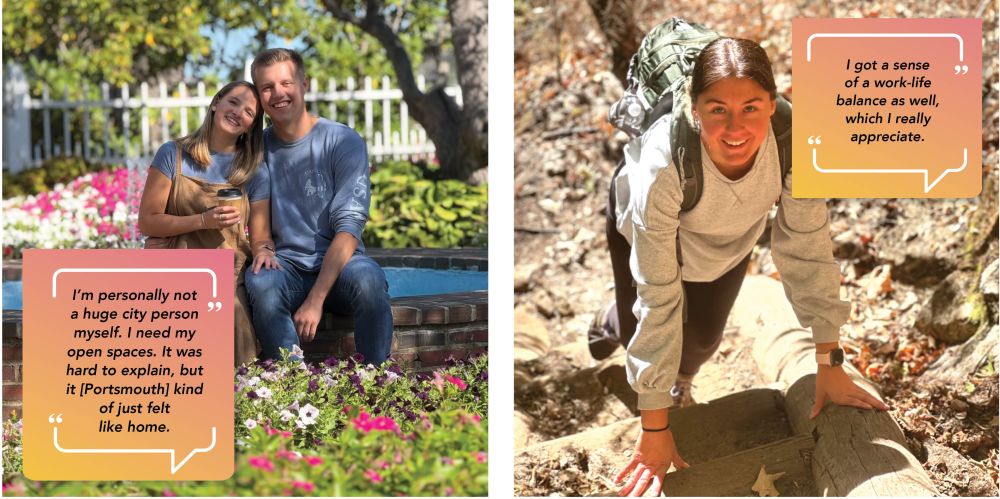
Left: Joshua Schibi, financial adviser at Rise Private Wealth Management, with his fiance Ariana Scharff in Prescott Park in Portsmouth, Right:
Elizabeth Brousseau, employee at Absolute Title, enjoying a hike
When Joshua Schibi was a college athlete in Massachusetts, his team climbed Mount Monadnock. Schibi grew up in a part of Connecticut with some nice hiking trails, but nothing like the 360-degree views from southwest NH’s iconic, solitary peak.
“I talked to one of the other climbers there and I was like, ‘Do you ever get sick of this?’” Schibi recalls. “And they were like, ‘Oh, this is nothing.’ They’re like, ‘This is our everyday. Just wait till you go up to the White Mountains.’”
Today, Schibi works as a financial adviser at Rise Private Wealth Management in Bedford. Though he’s temporarily living in Massachusetts while his fiancé finishes school, they plan to settle in NH once she’s done.
Schibi says the state’s natural beauty is a big draw, along with the opportunity for work-life balance. His fiancé grew up in the Portsmouth area, and he quickly fell for the city when he visited.
“Yes, Portsmouth is a city, but it also has that small-town-vibe feel,” he says. “I’m personally not a huge city person myself. I need my open spaces. It was hard to explain, but it kind of just felt like home.”
As NH’s workforce continues to age, employers and business leaders say the state will need to attract more workers in their 20s and 30s, and, crucially, keep them here. New Hampshire has a lot going for it, including its great outdoors, sense of community, and balance of urban and rural lifestyles. But there are also challenges that push some young workers away, including skyrocketing housing costs, limited career opportunities, social isolation, and a lack
of diversity.
The cost of housing is one of the biggest issues right now, says Corinne Benfield, executive director of Stay Work Play NH, a nonprofit that works to attract and retain young people to the state. She says many people reach their mid 20s and question if they’ll ever be able to buy a home here.
“There is a very real moment where young people say, will New Hampshire support me as I go through my adulthood—or do I need to find another community that fits my goals?” she says.
Cost of Living Concerns
According to Stay Work Play’s latest quality-of-life survey released last November, young professionals in NH tend to rate it better than other states on safety, environment, and taxes. It also earned high marks for outdoors and recreation, local stores and restaurants.
But the survey respondents—roughly 500 NH residents between the ages of 18 and 40—said NH is worse in regards to diversity, public transportation, career opportunities and in particular, affordable housing. When it comes to finding quality jobs and career opportunities, half of people said NH is worse than other places, compared to just 30% who said it was better. And half or more of respondents said the social life, nightlife, and arts and culture are better elsewhere.
“The young people that want to be in New Hampshire want to be here for the right reasons,” Benfield says. “They are attracted to the quality of life that we have, citing specifically integration of natural landscape and how beautiful the state is, and how you can play outside, whether that’s skiing or wakeboarding or going to the beach.”
But she worries that high living expenses are eroding NH’s edge. When Benfield moved back to NH after college in 2015, it was more affordable than Boston. But as rents have climbed, she says some young people are finding Boston makes more sense due to higher salaries.
“It’s kind of an easy sell to say, you know, ‘I’m commuting to Boston anyway every other weekend to see a Red Sox game or to see a concert. I could make $100,000 doing the same thing that I’m doing here and all I’d have to do is find housing—and add one more roommate to the mix and I could be saving money on housing,’” she says.
Employers like Matthew Neuman, the owner of Bedford-based title insurance company Absolute Title, say housing costs are a top concern. “One of the big reasons why we lose people is the rents have gone through the roof,” he says. “So, forget trying to buy a house at 23, 24, 25. I mean, you can barely afford to rent at those ages, which I know is resulting in a lot of people at that age still living with their parents.”
Absolute Title employee Olivia Schofield of Manchester says she and her fiancé bought a place with help from family. Before that, they could barely afford to rent. Schofield grew up in small-town NH— Bridgewater, a town with a population of about 1,200 in Grafton County—and after a year of college in New York City realized she didn’t like it. Manchester felt like a good in-between. She’s not sure if she wants to stay in NH forever.
“The pricing is really what would make me consider living somewhere else,” she says. In other parts of the country, “houses don’t seem to be as expensive and scarce as they are here.”
Breton-Benfield says when you drill down, there’s a notable difference between people ages 18 to 25, compared to those in their late 20s and 30s. The younger cohort tends to be more optimistic about the quality of life in NH. But once they get a few years older and start looking ahead to major milestones like buying a house, that optimism starts to fade.
Often, those in their early 20s are living at home or with multiple roommates. “So the optimism might also be a little bit about not having a full understanding of what it costs to be on your own, starting a life in New Hampshire,” she says.
Breton-Benfield says NH’s lack of diversity is another barrier to attracting a younger workforce, particularly for companies trying to recruit from more diverse areas of the country. “We hear a lot of stories about young people of color who come to the state and love New Hampshire—you know, want to ski or be a part of this community, have a great job opportunity with one of our great businesses,” she says. “But they don’t see themselves reflected in the community, and so they choose not to make that move.”
Rural Realities
When Stay Work Play asked Granite Staters in their 20s and 30s what kind of neighborhood they wanted to live in, rural was the top response at 37%.
At the same time, young professionals in more rural parts of the state were less likely to say they were satisfied with the overall quality of life in NH. Just 63% of survey respondents from the North Country/Lakes Regions and 66% from the Monadnock/Upper Valley Regions answered yes to that, compared to 79% in the Merrimack Valley and 85% on the Seacoast.
“What we’re hearing directly from young people on the ground in those areas is that it’s not the rurality that is hindering their quality of life,” Breton-Benfield says, explaining many of them want to live in a close-knit community with more space and access to the outdoors. “It’s the connection. It’s the connection point to opportunity. It’s the connection point to other young people.” In those areas, “you have to work really hard to find your community.”
Elizabeth Brousseau, 26, recently moved from Rhode Island to North Conway. “I used to take tons of vacations in New Hampshire in general, mostly North Conway, and just fell in love with the area and thought it would be really nice to start a family and start a career here,” she says.
Along with the area’s natural beauty, “I got a sense of a work-life balance as well, which I really appreciate.” Brousseau says she loves it so far and sees herself staying long term. But she notes that the tourism-heavy area isn’t without challenges. Housing is scarce, and the prevalence of short-term rentals makes it harder for locals. Brousseau was lucky to have friends and family in the area who offered her a place to rent.
Good jobs are also harder to find, she says. Brousseau landed a position with Absolute Title’s office in Conway that she feels offers growth potential, but jobs like hers are few and far between in the White Mountains.
“I do think the [lack of] job opportunities scare a lot of people away as well,” she says. “There’s not much entry-level, and I feel like you kind of have to know someone in the area or in the industry you want to work in.”
Brousseau’s coworker at Absolute Title, McKayla Burnell, grew up in North Conway. Like Brousseau, she says housing can be hard to find without luck or local connections. She and her boyfriend rent from someone he used to work for.
“I would say most of the people that I knew and grew up with that are around here do have family help or had property left to them or, in my case, just knowing somebody local that has property that would like to keep renting to local [people], instead of turning it into a short-term rental, [an] Airbnb,” she says.
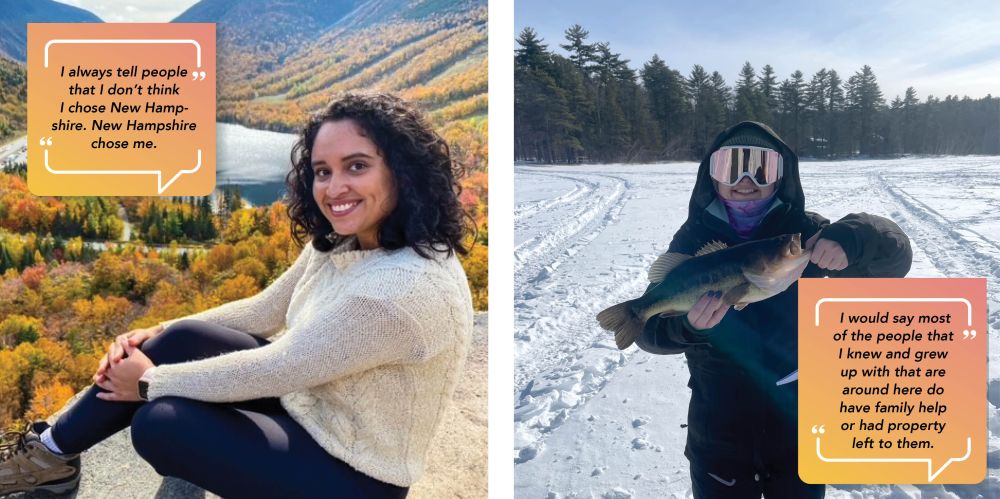
Left: Paula Viana, a program manager for Dartmouth Health’s learning and leadership development team, hiking on Artist Bluff in Franconia, Right:
McKayla Burnell, an employee at Absolute Tile, ice fishing in Conway
Along with more affordable housing, Burnell says she’d like to see more social opportunities for people in their 20s and 30s. “There’s plenty of, you know, rotary clubs and things like that, but that is more focused toward the middle-aged to older community side here,” she says. “I could definitely see a lack of community as far as young professionals being able to come together.”
In the southwestern corner of the state, attracting young talent is a top priority for large employers in the Monadnock Region, says Julie Schoelzel, president and CEO of the Greater Monadnock Collaborative, the region’s chamber of commerce.
“The thing I hear about the most is, ‘We have dozens, if not hundreds, of positions open that we’re trying to fill,’” she says. “And that’s sort of the ‘now’ problem. And then I have employers talking about the fact that many of their employees will retire in the next seven to 10 years.”
The chamber has launched a campaign called Build a Rich Life, with the aim of bringing more people to the region to work or study. Featuring Keene State College’s manufacturing programs and local manufacturers that are hiring, the landing page allows people to submit their resumes simultaneously to every employer on the website. Schoelzel says they got more than 120 resumes between its launch in December and late February. “People want to come here,” she says. “We could fill these jobs. There’s been a lot of excitement and interest in coming to work here.”
But, as in other parts of the state, the availability and affordability of housing is a major barrier. “There’s just nowhere near enough housing to put the people that we need to attract,” she says.
Schoelzel would like to see more creative thinking around housing for young professionals. For example, a complex or “cottage court” designed with young people in mind that has a storage area for bikes, kayaks, and other bulky outdoor gear.
“We know that people want to take advantage of the outdoors, but they might not necessarily need to buy a 3,000-square-foot house in order to make that possible,” she says.
A Sense of Meaning
As CEO of Mainstay Technologies, a Manchester-based company providing IT services to other firms, Jason Golden thinks a lot about how to recruit young workers and keep them happy. “I would say the most common thing is the sort of professional autonomy and flexibility,” he says.
Among other things, Mainstay has flexible work policies, an employee stock ownership program, and the opportunity to take sabbaticals after reaching certain milestones.
“When I was working up through the ranks, society was a little different. It was like, five or 10 years go by and then maybe you receive some kind of perk or a promotion or something like that,” he says. “I think with younger generations, there’s a little bit more of an expectation of a little bit more as we go. So, we try to really recognize that and honor that.”
Golden says Mainstay, which was twice named Stay Work Play’s “Coolest Employer for Young People” and has been a repeat winner of the Best Companies to Work For in NH competition, also prioritizes culture and continuity. “There’s a lot of people that go to workplaces and they think that it’s going to be their home, their career, their second family, whatever—and then they [the company] sell,” he says. “They get bought up, and it’s never good. We’re always very clear [that] our intention is to be a hundred-year company. We want to be a generational workforce.”
Recruiting young workers is also a top priority for Dartmouth Health, the state’s largest private employer, says Paula Viana, a program manager for the health system’s learning and leadership development team.
“One of the topics that we usually hear from our employees, especially our young generation, is they want to do meaningful work,” she says. “They don’t want to just come to work, work the hours that they need and leave. No, they want to be part of the change. They want to be part of the future that we are building.”
Dartmouth Health, based in one of the state’s most expensive housing markets, also has programs to help employees find housing, including leasing apartments that it subleases to new hires from outside the area.
A young professional herself, Viana lived in Boston before moving to the Upper Valley. She was initially nervous about leaving the city for such a rural area but quickly fell in love with NH’s quality of life and natural beauty. She often hears similar stories from other new hires.
“I always tell people that I don’t think I chose New Hampshire,” she says. “New Hampshire chose me.”
Schibi, the financial adviser in Bedford, says he values the professional development opportunities and recognition his employer offers, as well as the sense that employees are listened to. He also appreciates the personalized management style.
During one-on-one check-ins with his manager they talk about “what do you want for yourself,” including both professional objectives and personal goals. In Schibi’s case, that includes saving for a wedding.
“Obviously, he wants me to perform well at work, but he also has my best interests at heart outside of work as well,” Schibi says. “And so that kind of personalized experience is really huge to me, and I think it’s also a huge component of what my generation is looking for.”