The Rolling Stones song, “You Can’t Always Get What You Want,” may as well be the anthem for those desperately searching for affordable housing. Housing costs for renters and prospective homebuyers exceed incomes, while housing costs and regulations for builders make it hard to build profitable homes that buyers can afford.
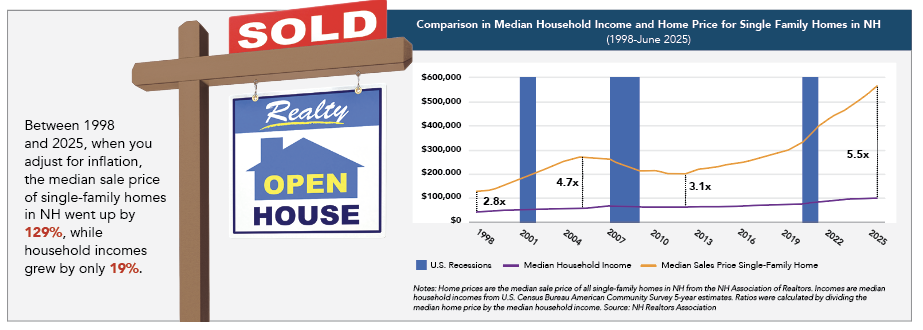
For those looking for a place to live, the math doesn’t work. The median single-family home price in 2025 was $535,000 and rose slightly to $540,000 in January 2026, according to the NH Association of REALTORS. In February 2026, the Association reported an affordability index of 61, meaning median household income is 61% of what is needed to qualify for a median-priced home at existing interest rates. Median rent is $2,000 per month as of December 2025 for units of any size, according to realtor.com
For homebuilders and policymakers, there are multiple challenges, including rising costs and zoning. Tariffs on building materials and restrictive zoning that requires larger lot size increase costs for builders. Debate at the Statehouse and in town halls across the state increasingly center on how to accelerate housing supply without eroding local control or community character. Lawmakers are grappling with whether to pursue statewide zoning mandates, emphasize incentives and infrastructure investment, or adopt a calibrated blend of deregulation, subsidy, and long-term capital planning.
While NH’s challenges are being felt regionally and nationally, the demographic situation here is unique, says Rob Dapice, executive director and CEO of NH Housing. New Hampshire is the nation’s second-oldest state, and Dapice?emphasizes the need for increased housing diversity as median home prices have surged over 275% in two decades, creating a mismatch between housing supply, demand, and income levels.
“There are people whose kids would like to either move out of the basement or come back to New Hampshire, and there’s just no way they can afford a house,” Dapice says. “I think demographics, coupled with our strong economy, has really exacerbated the problem so the increase in costs relative to incomes has been worse in New Hampshire than in a lot of other states.”
In the meantime, many young people and the businesses who rely on them are wondering when the crisis will subside, says Corinne Benfield, executive director of Stay Work Play NH, a nonprofit dedicated to attracting and retaining young people in the state. Stay Work Play’s pop up series, Policy & Pints, recently found housing to be a top issue on the minds of attendees.
“These conversations were about unprecedented tradeoffs young people are making just to afford to choose to live in New Hampshire,” Benfield says of those under the age of 40.
“People are moving here because they want to live in a place where they can be in nature, where they can live in charming quintessential towns,” she says, but high housing and childcare costs make that difficult.
A Crisis Years in the Making
Dapice says the current housing crunch is the predictable outcome of two decades of underbuilding. “Understanding how we got here is a key to figuring out how we’re going to get out of it,” he says. “It is a big question but an important one.”
After the 2008 financial crisis, housing production “bottomed out,” and never fully rebounded, Dapice explains. Unlike regions that had overbuilt before the recession, NH entered the downturn without excess inventory but still experienced the same credit freeze and construction pullback. Builders left the industry, skilled tradespeople retired or changed careers, and financing tightened. “The number of building permits over the last 20 or so years is staggeringly low,” Dapice adds.
At the same time, household formation increased even as overall population growth remained modest. Smaller household sizes caused by people choosing to marry later and aging residents remaining in larger homes reduced housing turnover. Many older homeowners occupy three- or four-bedroom houses but cannot find smaller affordable options, particularly in high-demand areas such as the Seacoast, Dapice says.
The result is a supply bottleneck that ripples across generations. Entry-level buyers struggle to find starter homes. Renters remain in rentals. Young professionals consider leaving the state.
“There’s a near direct link between increased housing supply and more affordable rents,” Dapice says, pointing to national examples where robust production has moderated prices. But in NH, he argues, the market has not been allowed to respond fluidly to price signals. “If the market were functioning properly, higher prices would have triggered a stronger supply response.”
Instead, zoning constraints, infrastructure gaps, and regulatory complexity have slowed that response. Some progress has been made recently, but it isn’t enough.
Between 2020 and 2024, NH added 25,688 housing units, bringing the statewide total to roughly 664,000, or about 78.5% of the state’s 2025 housing goal. Permitting activity in 2024 reached its highest level in nearly two decades, and multi-unit developments accounted for 62% of permitted units, the largest share in more than 50 years, according to a January report by the NH Department of Business and Economic Affairs.
This production remains geographically concentrated. Twenty-three communities, representing roughly 43.5% of the population, accounted for 63% of housing built in 2025. On the rental side, vacancy rates in many regions remain below 1%, and affordability is deeply strained.
Dapice notes that most of NH Housing’s financing tools are federal and tend to work best for multifamily development. “That is mostly what we do,” he says, emphasizing that this does not diminish the need for more single-family homes. He finds encouragement in projects such as Vose Farm Phase II in Peterborough where 64 affordable apartments were developed by Catholic Charities.
Residents who formed an affordable housing committee nearly a decade ago attended the recent ribbon cutting. “Intent turned into action,” Dapice says, describing a community that recognized the need for housing for people who work locally but could not afford to remain in town.
Zoning Battlegrounds
Zoning debates sit at the center of a widening philosophical divide around housing solutions. In 2025, the legislative session produced 39 housing-related bills and lawmakers passed 15 housing reform bills, many expanding accessory dwelling unit allowances and requiring certain commercial zones to permit mixed-use housing.
“In 2025 the Legislature decided to focus almost entirely on zoning as a means to produce more affordable housing and there was a massive increase in legislation that would preempt local zoning,” says Margaret Byrnes, executive director of the NH Municipal Association.
Local zoning came under attack because it tends to restrict the development of denser single-family homes, multifamily units, condominiums, and apartments. These restrictions mean that most communities continue to prohibit single-family homes on small lots under an acre or with less than 200 feet of frontage. Only 13% of the state’s buildable area allows that type of development. (Excluding towns without zoning codes, the figure drops to 7%.)
But Byrnes cautions against framing zoning as the singular culprit. She argues that macroeconomic forces, including labor shortages, material costs, mortgage rates, and tariffs, affect housing construction. “Those are not things municipalities control,” Byrnes says. “Municipalities have always been an easy target.”
Public opinion, however, has shifted. NIMBYism, or not in my backyard, is on the decline. In 2020, only 28.7% of voters surveyed by St. Anselm College supported relaxing local planning and zoning rules to support more housing. By 2025, that number had climbed to 61%.
Data from St. Anselm College’s Initiative for Housing Policy and Practice shows municipalities collectively made 59 liberalizing zoning changes between June 2024 and May 2025, compared with 13 restrictive changes. But overall, these changes affected a small percentage of the state’s buildable land.
Heather Shank, director of the Division of Planning and Community Development at the NH Department of Business and Economic Affairs, says accessing the expertise needed to effectively implement such policies is a hurdle. Regional planning commissions, which help towns align local zoning with changing needs for housing and infrastructure, recently lost modest state funding.
“You need planners to help you implement zoning changes, and that’s something that I think is a missing piece right now,” she says. “Planners understand what new statutes mean. They understand how to implement new codes to meet the needs of the community and protect local character.”
Byrnes points to mismatches between infrastructure and zoning. Homes on lot that are one-acre-or-less that already have water and sewer are better candidates from an economic perspective for creating density than large lots with no water and sewer, she says.
As an example of an effective solution, Byrnes highlights the voluntary Housing Champions program, a $5 million initiative created by the Legislature in 2023 that provides infrastructure grants and incentives to municipalities that proactively revise zoning. Communities designated as Housing Champions accounted for roughly 45% of permitted housing units in 2025. In total, there were 28 municipalities named housing champions in 2024 and 2025 and over half of them already allowed multifamily housing, including the seven largest municipalities in the state.
Byrnes notes the program was defunded in 2025 and Republicans are looking to repeal it in 2026. “If housing is truly the top priority, then what are [people] doing to invest in it?”
The Cost Equation
Beyond zoning, another major challenge is the high costs of housing. Shank recalls that when she arrived in NH 12 years ago as Concord’s city planner, housing scarcity was not widely recognized. That changed rapidly during the pandemic, when in-migration from metropolitan areas accelerated.
“People were coming up from Boston and other cities like New York City, relocating to less dense areas,” she says. “Half a million dollars [for a house] maybe is not a lot to them. It becomes very difficult to buy a house when you’re competing with buyers who don’t even need inspections.”
In tourism-heavy regions, nearly two-thirds of new construction is for seasonal or second homes, further limiting year-round supply, she adds, citing U.S. Census data. And even when zoning permits greater density, financing remains difficult. “Affordable housing hasn’t been done without funding assistance,” Shank says. “And construction costs are prohibitively high.”
Through InvestNH and related programs, the state has deployed roughly $64 million in gap financing, catalyzing hundreds of millions in development and supporting nearly 5,000 housing units statewide. Another $16 million in demolition grants has helped clear blighted or contaminated sites. Infrastructure grants under Housing Champions, totaling about $3.5 million, are projected to support around 2,000 units.
Workforce Pressures
For Natch Greyes, vice president of public policy for the Business and Industry Association, housing is inseparable from labor force participation.
“Employers need employees and they need somewhere to live,” he says. “We hear from C-suite executives down to entry-level hiring managers. They’re trying to hire and prospective employees can’t find housing. I’m not even talking about affordable housing, just no housing.”
He cites recruitment challenges at major institutions such as Dartmouth Health, which created housing search support teams. Benfield of Stay Work Play notes that Dartmouth Health has also developed workforce housing to retain employees.
“What they’re seeing when they try to attract doctors from other parts of the country is a lot of pushback because of a lack of housing,” she says. “The name of the game is creativity.”
Stay Work Play’s most recent Quality of Life Survey identified housing as a top concern among residents ages 18 to 40. “Young people want to stay in New Hampshire,” Benfield says. “They just need a fair shot to do so.”
Eighty-five percent of respondents in the survey said career opportunities lag behind other states, intensifying pressure. While people desire to live in NH, high housing costs and comparatively lower wages force younger workers to make “unprecedented tradeoffs,” Benfield says.
“In a 50-state competition for talent, every pain point elevated should be a red flag,” she says, noting NH also faces high childcare costs as well as a highly competitive housing market.
Despite differing views on whether mandates or incentives are more effective, leaders agree developing more affordable housing is vital to economic vitality. “When you ask why housing is important to the economy, what you’re really asking is why workforce is important,” Shank says. “Without housing, you don’t have a workforce. And without workforce, you can’t grow businesses.”
The data suggests that incremental progress is being made. More permits, more multifamily units, and thousands of homes have been added since 2020. But demographic pressures, decades of underproduction and persistent cost barriers continue to outpace gains.
As lawmakers debate repeal bills, zoning expansions and funding proposals, the state faces a strategic choice to rely primarily on deregulation, double down on infrastructure investment and subsidy, or weave the two into a coordinated long-term framework.
“We’re still at a critical juncture,” Benfield says. “I feel like we’re in a good place as a state as far as the narrative goes, but the issue is really challenging. We’re balancing a need for state-led strategies and local control.”