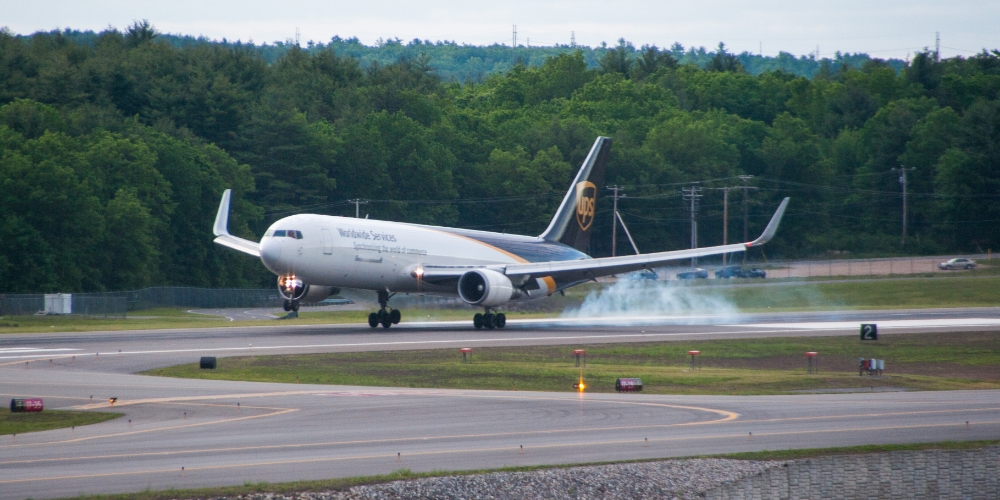
UPS plane on the runway at Manchester-Boston Regional Airport (Courtesy of manchester-Boston Regional Airport)
When it comes to handling air cargo, Manchester-Boston Regional Airport punches above its weight class. In 2025, Boston Logan International Airport handled nearly 44 million passengers, while Manchester served approximately 1.4 million, making Logan’s passenger volume more than 30 times greater.
The story on cargo handling is much different. Logan handled 265,774 tons in 2024 (the last year of available statistics), while in 2025, Manchester handled over 119,000 tons, as reported by the airport on Feb. 11.
So, while Manchester gets only 3% of the passenger traffic that runs through Logan, its cargo load is nearly 45% of what moves through the much larger airport.
“That number for 2025 was a record year for us,” says Manchester-Boston Regional Airport Director Thomas J. Malafronte, explaining much of it is driven by changes in consumer habits post-COVID. “Ordering a lot of e-commerce, ordering things online, basically a reaction to a change in human behavior. Now we’re starting to see that e-commerce has just become a way of life, and cargo has continued to expand. As long as the economy is strong, cargo will continue to be one of our leading segments here,” he says.
Multi-Tenant Cargo Facility
All that online ordering is a boon for the giants of private delivery service— Amazon Air, FedEx, and UPS—all of which have terminals in Manchester.
Amazon Air operates a 65,000-square-foot, multi-tenant cargo facility at Manchester that launched in 2022 to support New England logistics. The facility features three widebody aircraft parking spots (with capacity for a fourth) next to a warehouse.
“Amazon Air flies packages directly to their facility, and they get transported from their facility onto trucks to get distributed throughout the region and vice versa on the way out,” says Malafronte. “For FedEx, it’s the same type of situation.” FedEx has occupied a significant portion of the airport’s dedicated cargo terminal since 2005.
“UPS is a little bit different in that UPS has a pretty significant feeder fleet. That feeder fleet flies to small cargo destinations throughout northern New England, as far as Presque Isle, Maine, and Rutland, Vermont, some of those smaller outlying markets,” says Malafronte. “Those feeders will go to those markets in the morning; they will return in the evening. They all meetup with the large, heavy aircraft that go down to their facility in Louisville and other hubs. That’s where they kind of get sorted and distributed to go throughout
the country.”
In addition to the presence of major cargo carriers, Manchester benefits from the development of land surrounding the airport, most significantly the Pettengill Road industrial park.
Impact of Pettengill Road
Located adjacent to the airport in nearby Londonderry, the Pettengill Road property has been in development since 2015, attracting major tenants like UPS, FedEx, Milton CAT, and a New Balance manufacturing plant. “It’s had a significant impact. Anytime you bring in jobs and more people, whether it’s business or leisure travel, they’re always going to be looking for travel options,” says Malafronte. “So, I think that industrial park has led to a lot of positive developments and probably has a lot to do with the increase that we’re seeing in our cargo numbers.”
The goods going through the airport’s cargo terminals runs the gamut, from medical equipment and pharmaceuticals to legal and financial documents, small freight, and perishables.
“It kind of encompasses everything happening here in our region,” says Malafronte, “and because we have good highway access and good airport infrastructure, there’s no reason cargo can’t continue to expand and serve the region.”
While “everything under the sun” ships through Manchester in small boxes via Fed Ex and Amazon, cargo traffic at Portsmouth International Airport is more likely to consist of very large industrial components or heavy equipment. Paul Brean, Executive Director of Pease Development Authority which operates Portsmouth International Airport at Pease, says it has also experienced growth in cargo.
When establishing distribution centers, companies like Amazon factor geography into their decision making. For instance, at Manchester Regional Airport, a 25-mile radius reaches developed areas that would be a final destination for a shipment. “That is not the case at Portsmouth International Airport, where half of our radius would be in the Atlantic Ocean,” Brean says. “Conventional packages are not the best fit for us. Where we have grown, and where we are very unique, is that we can accommodate some of the largest cargo operations as far as what’s on that aircraft.”
He explains, “We’ve become very niched to moving very large things on very large aircraft, specifically satellites. Raytheon uses the airport for Patriot missile battery deliveries and exports. So, we don’t have a lot of airplanes flying a lot of cardboard boxes. We have a few big planes taking very large pieces of equipment in and out.”
According to FAA reports, the volume of cargo moved through Portsmouth nearly doubled between 2023 to 2024 from 7.8 million pounds (3,900 tons) to 13 million pounds (6,500 tons).
Those may be small numbers compared to Manchester, but Portsmouth’s capacity to handle oversized cargo makes a big difference for New England manufacturers, military subcontractors, and utilities.
Manchester has solidified its role as a major regional logistics hub and emerged as the third largest cargo destination in New England, after Logan and Bradley International Airport in Connecticut.
While cargo transport is not as lucrative as passenger travel, it has become a significant source of income, given the number of flights involved. “As cargo volume increases, the fleet mix and flight frequency may also change,” says Malafronte. “We get a fuel flowage fee, which is a small percentage of every gallon pumped into those cargo airplanes. And we also get landing fees. Landing fees are the number two source of revenue for the airport after parking, followed by rental properties.”