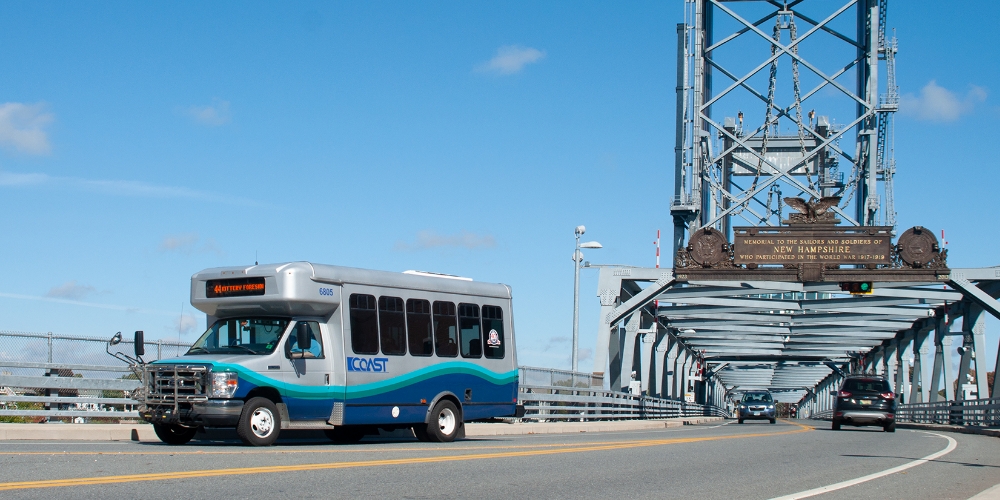
COAST bus on bridge (Photo by Erin Thomas)
In cities across the country, public transportation is ubiquitous, including subways, buses, and trains that run on specific schedules. But in an aging and largely rural state, it is not easy to get around without a car. Here, public transportation is harder to come by and is more individualized to include van services that pick people up at their homes and take them to medical appointments and to run errands.
Geography and financial constraints challenge the viability and reach of public transportation in the Granite State, where state matching funds are low and the need is great.
New Hampshire has historically ranked near the bottom nationally in per capita state public transit funding, spending about 59 cents per resident compared to a national median of $5.94 in 2020. Prior to fiscal year 2024, the state contributed roughly $200,000 annually for operating support, enough, advocates said at the time, to cover just a few days of service statewide. That funding has increased in the past couple of years. State funding rose to $600,000 in FY 2024 and $1.68 million in FY 2025, before settling at $1.5 million for the current biennium. “We would consider that a win,” says Fred Butler, public transportation administrator at the NH Department of Transportation. Still, he adds, the state allocation covers only about 8% of the required non-federal match needed to fully access federal funds.
“For every dollar of federal funds agencies are looking to use, they need that extra dollar of non-federal match,” Butler says, explaining that unmatched federal dollars can’t be used. “Sometimes it’s a matter of, ‘we thank you, but we can’t actually spend it because we can’t match it.’”
That makes it hard to serve people without cars living in areas of the state that lack public transportation such as “Bob’s Road,” a dirt road off Route 3 in Pittsburg near the Canadian border. Dispatchers at Tri-County Transit, a service program of Tri-County Community Action Program (TCCAP), call it Bob’s Road because of the man who lives at the end of the street and depends on public transportation about once a week to buy groceries, run errands, and stay connected.
“Places like Bob’s Road show how important transportation services are,” says Brenda Gagne, chief programs officer for TCCAP, which operates transit services across Coös, Grafton, and Carroll counties. “For many of our riders, we’re all they’ve got.”
Across NH, public transportation is provided by a patchwork of nonprofit agencies, municipal systems, and private operators stitched together primarily by federal grants, modest state support, and local contributions.
There are 12 public bus and shuttle systems statewide, along with demand-response and volunteer driver programs. In fiscal year 2025, more than 2.7 million trips were taken on public transit and community transportation, an 8.5% increase over the previous year, according to the NH Transportation Association (NHTA). To underscore how vital those services are to the people using them in their daily lives, those trips far outstrip the entire population of the state, which is 1.4 million.
Public transit is also essential to the overall economic health of the state. Public transit’s annual economic impact is estimated at more than $110 million, according to NHTA, and providers directly employ more than 300 people statewide.
The Challenges of Geography
Services vary by geography. On the Seacoast, Cooperative Alliance for Seacoast Transportation (COAST) operates fixed routes linking Dover, Portsmouth, and surrounding communities. In Manchester and Nashua, municipal systems serve dense urban corridors. In southern NH, CART vans provide curb-to-curb service for people needing rides to medical appointments and to run errands.
In the North Country, a 2024 community needs assessment by TCCAP ranked transportation as the top unmet need. In rural areas, access to transportation is vital as many people are not within a walkable distance to stores and services.
“We’re the only game in town and up here it’s geography, geography, geography,” says Jeanne Robillard, CEO of TCCAP. “Everything is so spread out and far away. There are no major thoroughfares. It’s not like a city where you can just hop on and off a bus.”
Transit services in rural communities, particularly in the North, face unique logistical issues. “Someone down south might drive a block and pick up three people,” Gagne says. “We might drive 25 miles to pick up one.”
Tri-County Transit covers more than half the state geographically, logging over 270,000 miles a year and providing roughly 55,000 to 58,000 rides annually on a $1.7 million budget. Most routes are flex or door-to-door because fixed routes—like traditional point A to point B bus routes—don’t make sense across vast distances.
Medical transportation is the highest need. Two buses are stationed in Colebrook to bring residents to regional hospitals like Upper Valley Medical Center, and other routes cover Littleton Regional Healthcare and other medical facilities across the region.
People without cars living in bedroom communities throughout NH are dependent on public transportation that is not readily available as it is in urban centers like Manchester and Nashua. Demand-response and ADA-compliant paratransit services offered through regional coordinating councils statewide often represent the only option for older adults and people with disabilities. “For many folks, these services are how people get out of their homes,” says Rad Nichols, executive director at COAST, chair of the New Hampshire Transit Association and member of the State Coordinating Council for Community Transportation.
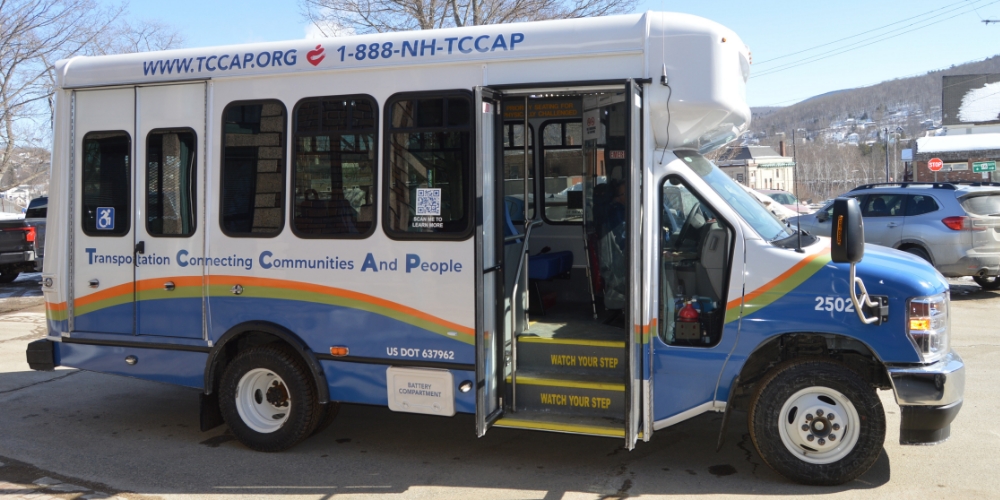
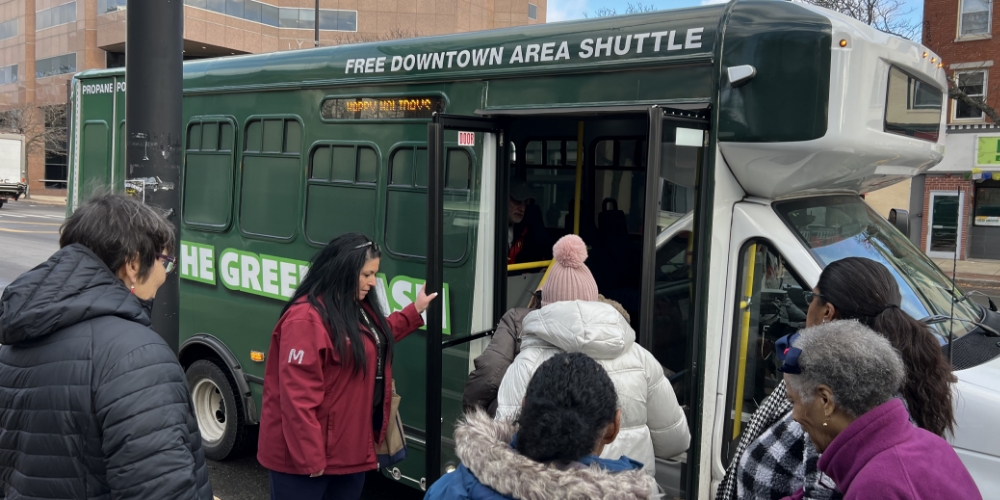
A new bus just put into service by Tri-County Transit (Photo by Scott Merrill)
A Financial Quandary
Nearly all of NH’s public transit system rests on federal funding administered through the Federal Transit Administration.
Butler’s office at the NH Department of Transportation distributes federal formula funds under a state management plan in conjunction with the State Coordinating Council for Transportation and various Regional Coordinating Councils that develop needs assessments for individual regions. The rural 5311 program is the “bread and butter,” supporting five rural transit agencies, including Tri-County, Butler says.
Urban systems such as the Cooperative Alliance For Seacoast Transportation (COAST), Manchester Transit Authority, and Nashua Transit System receive 5307 funds directly as designated recipients based on federal population thresholds.
Federal dollars, however, come with strings, Butler explains. Capital expenses, which include the cost of buses and preventive maintenance, are funded at 80% federal with a 20% local match. Operating costs, including fuel, dispatchers, and drivers’ wages, require a 50-50 split.
“That’s the most expensive part of running our service,” Gagne of TCCAP says. “We have to come up with the other 50 percent.”
The Infrastructure Investment and Jobs Act increased federal transit allocations by 20% to 30%, but without a sufficient local match, some rural providers have been forced to leave funds unused, Butler explains, adding that volunteer drivers can provide critical leverage. Their hours could be valued at up to $34 per hour and counted as an in-kind match, effectively stretching federal dollars further.
Improving NH’s public transportation system makes financial sense, experts say. More riders and routes equal more economic activity and a greater return on the state’s investment. Nichols at COAST says until recently, state lawmakers had been hard to convince of this argument.
COAST operates on an $8.2 million annual budget, with about $2.3 million from annually appropriated federal formula funds, and another $1.3 million of carryover federal funds. During the pandemic, emergency federal relief temporarily covered nearly all operating costs and the federal relief packages allowed agencies like COAST to “bank” some of their regular federal allocations. But post-COVID inflation for parts, professional services, insurance, and wages has far outpaced growth of the annual funding appropriations being made for public transportation across the country. “At some point you simply can’t do more with less,” Nichols says.
Nichols of the NH Transit Association and the State Coordinating Council for Community Transportation advocated for $6.8 million for public transportation funding during the state’s biennium budget process last year but received $3 million for FY26 and FY27. If the state had funded the $6.8 million, it would have matched an equivalent amount in federal transit funds and generated more than $54 million in total economic activity, he says.
“I’ve been at COAST for over 29 years and for most of that time the state has not contributed much toward the operating costs for any transit system in the state,” Nichols says, noting the past two budget cycles have seen notable increases in state contributions that have significantly increased the number of people served and what providers can offer. “The investments made by the state have had tremendous positive impacts. Still, the state lags far behind other states like Maine and Vermont.”
In written testimony to the Governor’s Advisory Commission on Intermodal Transportation last year, Nichols proposed increasing the state gas tax by six cents and dedicating one penny to public transit. For the average resident using 20 gallons of gas per week, he estimates the increase would amount to about $1.20 weekly.
“That would fund public transit at a whole new level in this state,” he says, arguing it would help meet workforce needs and serve an aging population. “For our road and bridge programs, we would be able to fund all the projects included in the state’s 10-Year Transportation Plan, and for public transit, it could raise $8 million in matching dollars.”
Sylvia von Aulock, executive director of Southern NH Planning Commission, and Tracey Whitehead, regional service coordinator at Manchester Transit Authority, provide travel training for members of the public who want to learn how to ride the bus system. (Photo Courtesy of Southern NH Regional Planning Commission (SNHRPC).
Financial Match and Mismatch
One notable exception when it comes to matching federal funds is Advance Transit in the Upper Valley. Serving six municipalities along the Connecticut River, the fare-free nonprofit delivered more than 800,000 rides last year with 32 vehicles. Long-standing financial partnerships with Dartmouth Health and Dartmouth College provide reliable local matching funds, allowing Advance Transit to draw down roughly 62% of the state’s rural 5311 allocation.
Advance Transit’s fleet includes smaller buses and larger 35-foot vehicles used on fixed routes. The agency also provides ADA-compliant paratransit and the downtown Dartmouth shuttle connecting to the region’s largest employer and health care hub, Dartmouth Hitchcock Medical Center.
Advance Transit participates in the Region One Regional Coordinating Council, covering Grafton and Coös counties, to align services, pursue funding, and address workforce challenges.
Teri Palmer, who was appointed executive director in January after serving as the state’s mobility manager, says collaboration is central to the agency’s fare-free model. She says Advanced Transit would like to work with Tri-Valley Transit in Vermont, along with Tri-County Transit in Coos County, New Hampshire, and Grafton County Senior Citizens Council, to better coordinate transportation for NH residents to get to medical appointments at Dartmouth Health Medical Center. Rather than operating routes along Route 10 in New Hampshire, Tri-Valley Transit in Vermont operates the “89er” in the I-89 area and might be able to meet NH buses and connect riders directly to Dartmouth Hitchcock. “We’re all struggling for funding,” Palmer says. “If someone else is already providing service, why duplicate it when we could coordinate?”
If additional state matching funds become available or if Congress reduces rural match requirements in the next transportation authorization bill that is set to expire in October, Butler says NHDOT would revisit how funds are distributed to ensure greater equity among rural providers.
Health Care Transportation
The federal Rural Health Transformation Grant created through the Centers for Medicare & Medicaid Services intends to offset cuts in rural health funding. Administered through the Department of Health and Human Services under the governor’s GO-North initiative, the grant allows states to pursue structural reforms that improve access to care. New Hampshire secured an award totaling roughly $204 million annually for five years, according to Steve Workman, director of Transport NH, a nonprofit transportation advocacy organization, and secretary of the State Coordinating Council for Community Transportation.
Butler of NHDOT explains that while details on how the funding will be used are still emerging, transportation officials hope some of those funds could support vehicle purchases or volunteer driver programs, and possibly count as non-federal match.
If that is allowed, this would help residents statewide, especially older residents who depend on public transportation to get to health care appointments. “If someone is on dialysis or undergoing chemotherapy, and we’re telling them it’s their job to figure out how to navigate the health care system and find a ride, we’re shifting the burden onto the most vulnerable,” says Workman. “Missed appointments can lead to deteriorating health and higher long-term costs.”
Workman facilitates the State Coordinating Council for Community Transportation’s Healthcare Transportation Taskforce. He says transportation is foundational and needs to be considered as part of any larger plan.
COAST’s demand response services— a flexible, non-fixed route service that takes passengers to requested locations based on advanced bookings commonly used for ADA paratransit, seniors, and low-density, rural, or suburban areas—saw ridership gains in FY2024. Older adults and individuals living with disabilities who use these services took 24,797 trips to work, classes, medical services, shopping, and social activities (up 7.8% over FY 2023), according to a fact sheet by the city of Dover.?Other agencies providing services in the southeast region of the state alone accounted for another 48,000 trips and 370,000 service miles, according to a 2023 report by the Rockingham Planning and Strafford Regional Planning Commissions.
Workman believes the $204 million annual rural transportation grant presents a rare opportunity to redesign systems rather than patch holes. A health care task force under the State Coordinating Council has advanced transportation strategies, though he worries about delays with implementation details. “The clock is ticking,” he says, noting that unspent funds can reduce future allocations.
Under the grant, each budget period’s funds must be used by the end of the following fiscal year. The deadline for the first cycle is Sept. 30, 2026, according to the U.S. Chamber of Commerce.
Transportation as Foundational Infrastructure
The NH Transportation Association is wrapping up a statewide community transportation needs assessment, a data-driven effort conducted by numerous organizations. One big goal of the assessment, expected to be released later this spring, is to quantify what advocates like Workman have long known anecdotally. “Seniors, veterans and people with disabilities face persistent mobility barriers,” he says, adding, “Stories resonate with people, but policymakers need this data.”
Survey findings so far reinforce a concern that transportation policy in NH often remains siloed, Workman says. Housing development reviews often focus heavily on road capacity, while public transit, which Workman views as essential infrastructure, receives less systematic consideration. “Silos don’t work,” he says. “If public transportation isn’t at the table when we’re talking about housing development, health care or workforce development, we’re not going to solve the larger problems.”
Transport NH’s mission, Workman says, is to focus on upstream issues, which include addressing barriers that residents face when it comes to their transportation needs.
“You can’t have a conversation about jobs, the economy, or affordable housing without talking about how people access connections,” Workman says.
A Circulatory System
For Butler, the path forward depends largely on legislative decisions at both the state and federal levels. “Transportation has always been a barrier for some people,” he says. “I think legislators and policymakers are understanding that.”
Whether that understanding translates into sustained investment will determine whether NH’s public transit network remains a fragile patchwork or evolves into what Workman calls the state’s “circulatory system,” carrying workers to jobs, patients to medical care and increasing economic opportunity across a largely rural landscape. “I will not stop standing up for the most vulnerable,” Workman says. “We really have to ask what kind of state we want to be.”
Nichols says funding needs are a vital lifeline dependent in large part on state funding. “We hear from residents about the need,” he says. “We just can’t meet it without the financial support to do so.”
In the North Country, Gagne says TCCAP’s transit coverage, like other rural service providers, requires a lot of energy and time spent on locating funds. “We could put a million buses on the road tomorrow if we had the funding,” she says. “But in rural New Hampshire, you have to be creative. And you have to be committed.”