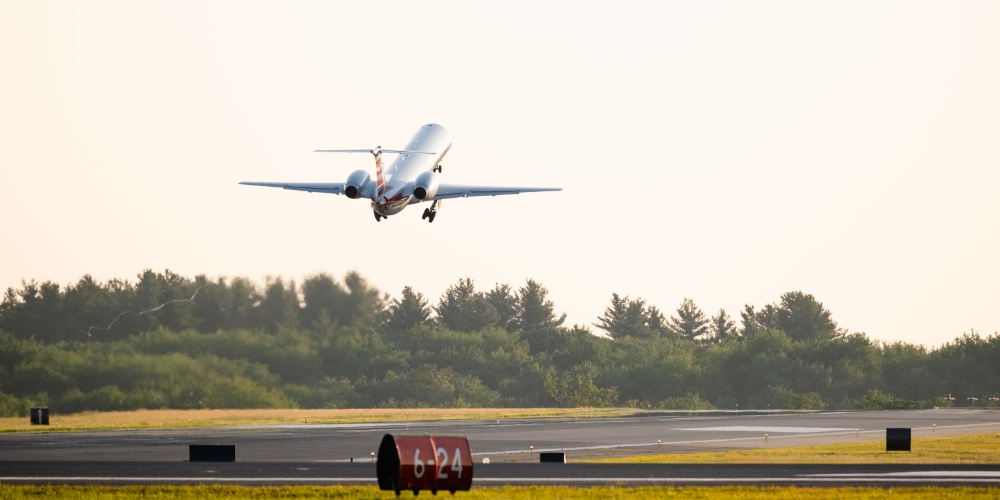
Airplane taking off from Manchester-Boston Regional Airport (Courtesy of Manchester-Boston Regional Airport)
New Hampshire’s two commercial airports in Manchester and Portsmouth grew cargo and passenger traffic significantly in the past year, setting the stage for a revival of commercial aviation in the state after years of challenging headwinds.
More than 1.38 million passengers flew in and out of Manchester-Boston Regional Airport in 2025, an almost 9% increase in passenger activity over 2024 and the best year since pre-pandemic 2019. The airport averaged 115,000 to 116,000 passengers per month according to a report released in February.
Also in February, the airport announced that its largest carrier, Southwest Airlines, was adding routes to Nashville, in addition to existing nonstop service to Orlando, Baltimore, Chicago, and Tampa.
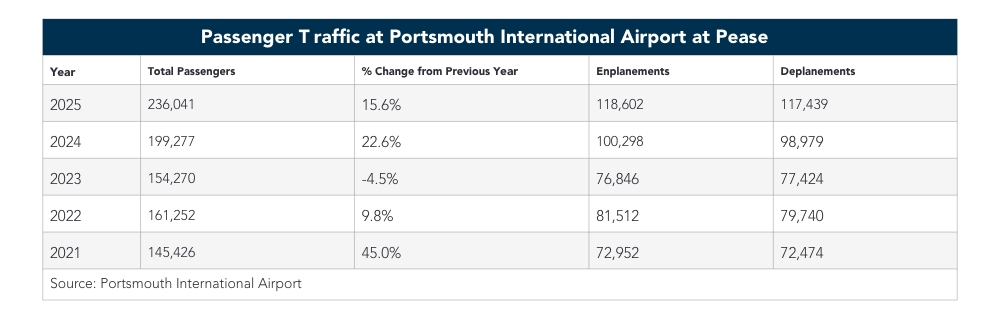
Portsmouth International Airport at Pease is experiencing exponential growth with April 2025 passenger traffic up 84% over April 2024. Total flights nearly doubled, increasing from 53 in April 2024 to 101 in April 2025, driven by the two commercial airlines—legacy carrier Allegiant Air and newcomer Breeze Airways, which began service at the airport in October 2024.
Growth in Manchester was also driven by the arrival of new carriers like Breeze in June 2024 and JetBlue in January 2025, along with expanded service from legacy carriers like Southwest, American, and United, which account for most of
Manchester’s passenger traffic.
“We knew that passenger activity was going to be up as a result of the increase in seats that the new carriers brought in,” says Manchester-Boston Regional Airport Director Thomas J. Malafronte. “And at the end of the year, when we compiled the numbers, that translated into a 9% increase in passenger activity in 2025 versus 2024, so that was certainly great news.”
February featured one major announcement after another. “As soon as we were done compiling those numbers, we launched new service from Breeze Airways to Myrtle Beach on Feb. 6, and we filled about 127 of the 130 seats on the airplane. So that was a solid start,”
says Malafronte.
A week later, Southwest announced its new service to Nashville. “That’s a market that we’ve been talking with Southwest about for a number of years now, one of the popular markets that travelers have been asking for,” says Malafronte. “The Southwest announcement and increasing capacity from others get 2026 off to a solid start.”
A Changing Market
Today’s numbers are a far cry from 2005, when passenger traffic through Manchester peaked at 4.3 million. That was a time when Logan did not serve low-price carriers like JetBlue or Southwest, and state-subsidized bus service to Logan from NH was still a year away.
Even though 85% of air travelers from NH still head for Boston, numbers are growing in Manchester and Portsmouth thanks largely to growing demand for vacation travel.
“Number one, our local and regional economy are very strong, so there is the propensity to travel. People do have very high disposable income in this area, and they do travel a lot,” says Malafronte.
He stills sees plenty of room for growth if NH airports can chisel away at that 85% of Boston-bound ticketholders, maybe not back to the heyday of the early 2000s, but somewhere between. “Two million [passenger flights] would be a sweet spot for us,” he says.
“People are filling up the airplanes. And as long as that continues to happen, the airlines will continue to invest in the airport,” he says. “Every time someone elects to support an airline in Manchester, it drives down the operating costs of all of the other airlines.”
An economic impact study completed in 2025 shows how important that growth could be to the NH economy. In 2024, Manchester-Boston Regional Airport (MHT) supported 5,300 jobs statewide, earned $350 million and generated $708 million in total economic activity, according to research by global infrastructure consulting firm AECOM (Architecture, Engineering, Construction, Operations, and Management).
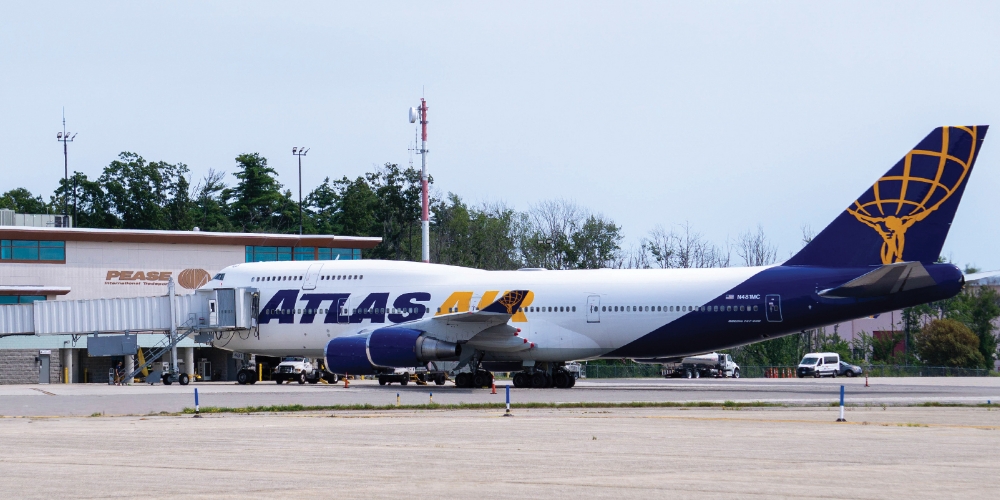
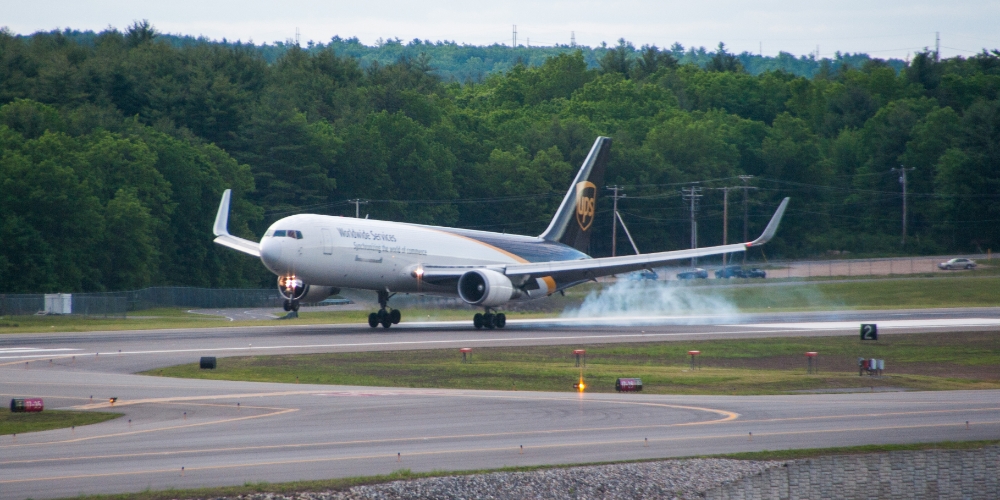
Atlas Airplane on the runway at Portsmouth International Airport at Pease (Courtesy of Portsmouth International Airport)
Room for Growth
Market demographics suggest the airport could be doing even better, according to the AECOM analysis. “MHT’s passenger levels are weak relative to New Hampshire’s otherwise strong economy,” according to the study’s authors.
AECOM identified several state policy choices contributing to existing passenger levels including:
• State-subsidized bus service from key NH locations to Logan;
• Federal and state designations that understate Manchester-Boston’s true catchment area;
• State infrastructure investment priorities favoring highways to out-of-state hubs over MHT incentives; and
• A lack of a cohesive state strategy to incentivize using Manchester-Boston Regional Airport for tourism arrivals in state marketing efforts.
“In 2026, the mismatch between official designations and the actual market reach of Manchester-Boston Regional Airport (MHT) continues to create a competitive disadvantage compared to Boston Logan International (BOS),” according to the 2025 study.
“Federal and state designations often categorize MHT based on rigid geographic or population boundaries (such as its “Small Hub” classification by the FAA) rather than its behavioral catchment area, which extends into northern Massachusetts, southern Maine,
and Vermont.”
A similar economic impact study is now under way for the Pease International Tradeport and Airport. “We anticipate that we’ll be getting our hands on that study in May or June, and I look forward to publishing it, because I think people are going to be quite impressed,” says Pease Airport Director Paul Brean, who also serves as executive director of the Pease Development Authority. (The last economic impact study for Pease Airport was conducted as part of the NH State Airport System Plan in 2013-2014.)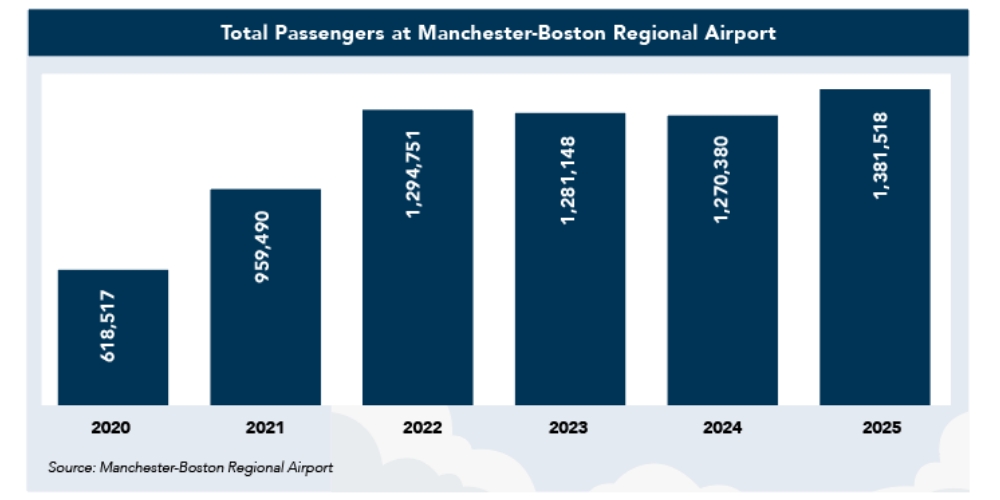
Carving Out a Niche
While Manchester has both recreational and business travelers, the much smaller Portsmouth airport is carving out a niche as a low-cost carrier for leisure travelers headed to Florida.
Brean says Manchester and Portsmouth are collaborators, not competitors, as both are trying to cut into the share of Granite State air travelers who head for Boston.
“In New Hampshire, there’s a synergy between Manchester Regional, Lebanon Airport and Pease in that we don’t cannibalize each other. We really work collectively to try to figure out what’s going to work for the good of New Hampshire, particularly regarding the Department of Transportation grant programs,” says Brean. The airports coordinate, he says, to make sure they aren’t competing for the same grants. Lebanon Airport offers daily commercial service that connects passengers to Boston and White Plains, New York.
The commercial airline service operating out of Pease with Breeze or Allegiant combines with general aviation, charter services, and military presence to make for a busy airport. PlaneSense, a major charter tenant at Pease, manages a fleet of over
60 aircraft.
Pease served 13,398 passengers in April 2025, an 84% increase over April 2024, driven by the addition of Breeze alongside Allegiant. The growth has been supported by several capital improvement projects, including a $24 million reconstruction of the primary runway in 2020 and a $19 million terminal renovation in 2021. An RFP for a parking lot expansion was issued earlier this year with bids closing on Feb. 26.
Brean and his tradeport team are keenly aware that the Portsmouth airport derives many benefits from its role as an Air National Guard refueling site. It is home to the NH Air National Guard’s 133rd Air Refueling Squadron, and the U.S. Air Force 64th Air Refueling Squadron, a legacy from its days as Pease Air Force Base.
The affiliation assures world-class air traffic control and runways that can accommodate the largest cargo and troop transports, all of which works to the advantage of the airport’s cargo and passenger activity.
“A top priority at Portsmouth is making sure that we meet our obligations to the New Hampshire Air National Guard and the Department of Defense,” says Brean. “We want to keep the refueling squadrons and the folks associated with that able to operate efficiently and safely at all times.”