The endless procession of brake lights that marks the weekday morning drive into Boston is no one’s idea of a good time. So, when Trevor Deane moved from the city back to his native NH, he knew he wanted to be on a train line. He decided to settle in Dover.
“A big reason for that decision—rather than, say, moving to Nashua or Manchester—was because of the Amtrak line and it giving me the ability to get down into the city without needing a car,” he says.
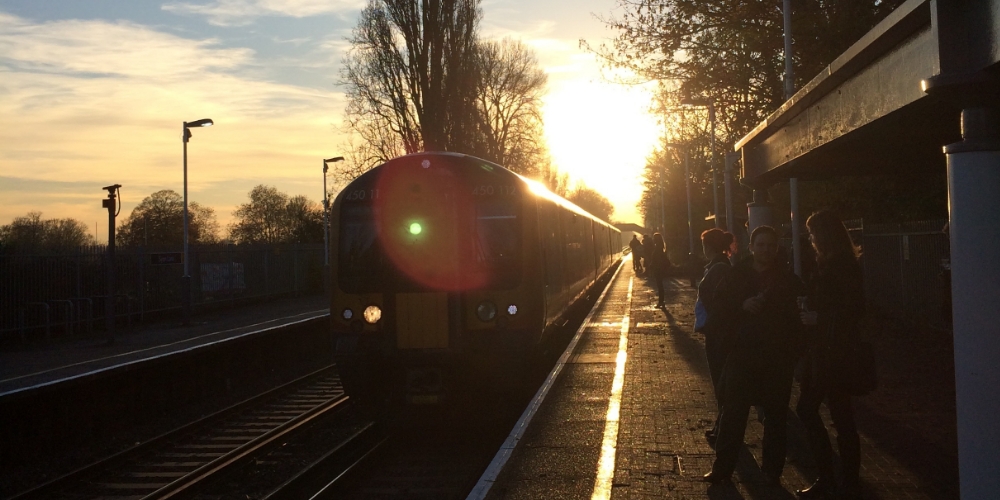
Instead, he can walk to a train station 20 minutes from his house and hop on Amtrak’s Downeaster, arriving in Boston about 90 minutes later.
“Driving into Boston is super stressful,” he says. “With the train, that’s not the case at all.”
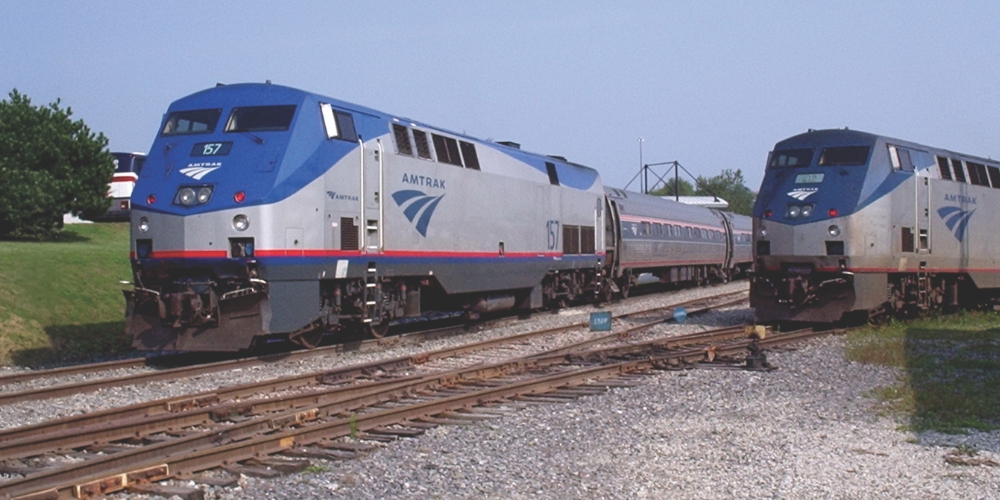
But what Deane is describing is a rarity in NH. The Downeaster, which also stops in Durham and Exeter, is the only passenger train linking NH to Boston, and one of just two in the state. (The other, Amtrak’s Vermonter, stops in Claremont.)
Rail advocates have long called for expanding access. In particular, the idea of linking the “Capitol Corridor” of Nashua, Manchester and Concord to Greater Boston has been floated and debated for decades.
But the project stalled at the state level in recent years. Local officials in Nashua are now working on their own effort to bring commuter rail to the Gate City. But the question remains: Can efforts to expand passenger rail in NH ever get back on track?
A Project Derailed
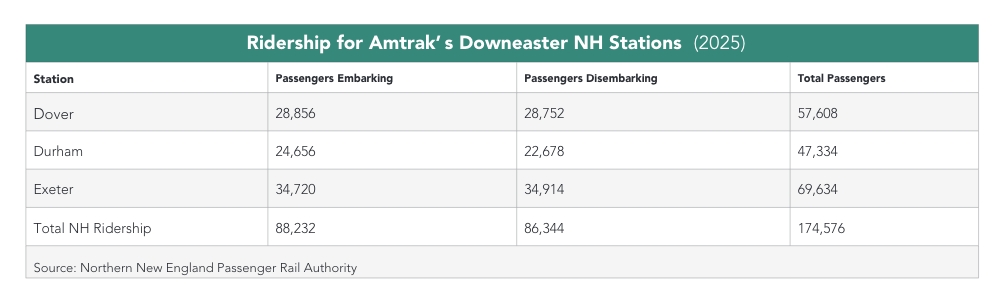
The Downeaster launched in 2001 and now serves about 500,000 riders annually. In 2025, more than 174,000 of those trips started or ended at one of the train’s NH stops, according to the Northern New England Passenger Rail Authority, which manages the service.
Erik Mason, a marketing and communications professional who lives in Durham, takes the train two or three times a week into Boston, where many of his clients are based. He’s also used the train to get to medical appointments or to catch a concert or ball game in the city.
Despite occasional delays, he says access to Boston—without spending four or five hours a day on the road—has been crucial for his career opportunities and earning potential.
“You actually get home and are much more relaxed and able to enjoy being home,” he says. “But also getting into the city, it’s not as hectic and stressful. So, you’re able to actually, I think, have a much more productive work day.”
The Downeaster owes its existence to the state of Maine, which created the Northern New England Passenger Rail Authority in response to citizens’ calls for restoring rail service between Portland and Boston. The Authority continues to partially subsidize it, in combination with federal grants and revenue from ticket sales.
In FY 2025, the Downeaster brought in $13 million from ticket sales as well as about $1 million from food service and $700,000 from parking revenues for total operating revenue of $14.6 million. That is against operating expenses of $26.5 million. It also received $12.7 million from a federal DOT grant and $3.15 million from State of Maine grants.
But other recent efforts to expand passenger rail into NH have run into roadblocks. A planned extension of Massachusetts Bay Transportation Authority (MBTA) commuter rail to Plaistow stalled in 2015, after residents and town officials voiced opposition to a train layover facility, citing noise and pollution concerns.
The Capitol Corridor project, meanwhile, has seen its fortunes rise and fall with the shifting political winds in Concord.
A 2014 study by the NH Department of Transportation recommended extending MBTA’s Boston-Lowell commuter rail line north to Nashua and Manchester, saying it would ease congestion, boost economic development and tourism, and connect people with high-paying jobs in a part of the state that’s increasingly drawn into the economic orbit of Boston.
Critics called it a boondoggle that would cost too much and serve too few riders. But the project picked up steam in 2019, when the state Legislature—then in Democratic hands—allowed the department to seek federal funds for preliminary design and environmental work and a financial analysis.
Completing that work would have allowed the state to apply for federal funds to start building what could have been a $780 million project, serving an estimated 850,000 to 1.3 million riders annually. But the Republican-controlled Executive Council effectively put a halt to the project in late 2022 when it declined to extend the contract of the DOT’s consultant.
Observers say the state is unlikely to revive the project any time soon.
“I think right now the Republican majority probably is not interested, because they wouldn’t even spend the non-state funds to finish the feasibility study,” says State Sen. Cindy Rosenwald, a Nashua Democrat.
Nashua Initiative Chugs Along
But local stakeholders in Nashua say the dream of commuter rail isn’t dead yet. After the state project ground to a halt three years ago, the city of Nashua decided to appropriate some of its own funds to explore the feasibility of a scaled-down version—an initial extension of commuter rail from Lowell to Nashua, without going all the way to Manchester.
“There was a sense that we don’t want to lose momentum at this point, we’re too far. Can we find some alternate way of moving this project forward?” says Jay Minkarah, executive director of the Nashua Regional Planning Commission, who also chairs the city’s rail transit committee.
The city hired the same consultant the state used, AECOM, to look into the possibility. Matt Sullivan, Nashua’s community development director, says the results are preliminary, but promising.
Initial estimates, based on AECOM’s prior work for the state, suggest a Nashua-only extension would serve around 1,600 to 2,000 passengers per weekday, with passenger fares covering most of the $9 million to $11 million in annual operating costs. Those estimates would need to be updated, but Sullivan says it’s unusual for commuter rail to come close to breaking even.
“Extension to Nashua actually makes a great deal of financial sense,” he says. “The ridership and financial model for commuter rail extension to Nashua is viable.”
As for construction costs, Sullivan estimates the Nashua-only segment would be in the ballpark of $250 million to $300 million, though that could rise. He says the bulk of that funding would have to come from federal sources if the project gets that far.
“This is not going to be the kind of thing where the city of Nashua, or frankly, any of the other project partners can alone fund this,” he says. “Nor can the operational revenues alone fund this. We will ultimately have to partner with the federal government, and potentially New Hampshire Department of Transportation, if this capital build-out is ever to happen.”
Not everyone is convinced it’s a good idea. “The bottom line with commuter rail to New Hampshire is density. Density, density, density,” says Drew Cline, president of the Josiah Bartlett Center, a free-market think tank. “The only way commuter rail ever works is when you have very dense population centers, and New Hampshire has none of them.”
Cline says that even in more densely populated areas, commuter rail requires massive taxpayer subsidies to build and sustain, pointing to MBTA as an example. About 20% of its operating expenses are covered by fares, according to its most recent budget.
Cline argues the ridership numbers from NH would be too low to make commuter rail financially sustainable or make much of a dent in congestion on I-93, which sees more than 100,000 cars on an average weekday.
“I’m not opposed to rail transit. It’s a nice quality of life enhancement if you can make it work. And in very limited circumstances, with very high population densities, it can make sense,” Cline says. “But it just doesn’t make sense for New Hampshire.”
Gov. Kelly Ayotte has also been a skeptic of extending commuter rail, saying during her 2024 campaign that it would be too expensive and hard to sustain financially.
Sullivan disagrees, comparing passenger rail to other major infrastructure investments, like widening I-93, that require some taxpayer money but bring economic benefits to the region. And in his view, the case for commuter rail has never been stronger. With the post-COVID shift to more hybrid forms of work, he says, many people from Massachusetts are relocating to NH for tax or lifestyle reasons but still need to get to the city on a weekly or monthly basis.
“They are seeking jobs where they are not required to travel into the city of Boston or to the surrounding area as often,” he says. “And we think that means that there are going to be more commuter rail riders, less folks interested in taking their car onto the highway.”
But that vision, if it ever happens, is a long way off. Sullivan says it will take incremental steps over the coming years—refining the ridership and financial analysis, engaging with regional stakeholders, seeking additional funding for design work, and then getting that design to a point where the project is competitive for federal construction grants.
“It is possible that we could be applying for construction funds within the next five years,” Sullivan says. “But it will still be some time before the rail line actually is available to those living in the city of Nashua. But it’s possible over the coming decades, absolutely.”