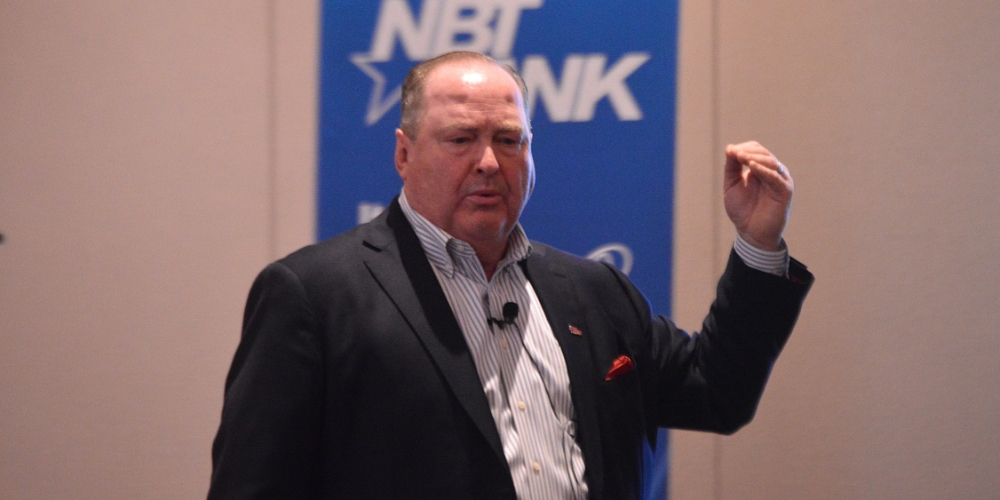
Kenneth Entenmann speaks at an economic forum in Manchester. (Scott Merrill)
The chief economist at NBT Bank, Kenneth Entenmann, delivered a cautiously optimistic forecast for 2026 at a March 11 economic forum held in Manchester, emphasizing resilience in the U.S. economy despite mounting geopolitical and policy uncertainty.
Entenmann, who oversees billions in assets through NBT’s wealth management division and holds a chartered financial analyst designation, framed his outlook around a familiar theme: uncertainty is constant, but the economy continues to perform.
He pointed to key indicators, including unemployment hovering near 4.4% and inflation in the 2.5% to 3% range, as evidence of a stable backdrop heading deeper into 2026. Wage growth, particularly among lower-income workers, is expected to exceed 3%, offering additional support for consumer spending. “The economy demonstrates resilience,” Entenmann said, even as businesses contend with questions surrounding tariffs, artificial intelligence, and political division ahead of midterm elections.
A central point of his presentation was the distinction between soft and hard economic data. He likened consumer sentiment surveys to “soft ice cream”—appealing but lacking substance—arguing that such measures often overstate pessimism. By contrast, hard data, such as employment and wage figures, suggest the economy remains on solid footing despite weaker confidence readings.
Geopolitical tensions, particularly conflict in the Middle East, were cited as the most significant near-term risk. While energy markets remain volatile, Entenmann noted that the U.S. is less dependent on foreign oil than in past decades, helping buffer potential shocks. Still, he cautioned that a prolonged conflict could have global economic consequences, especially if disruptions intensify around key shipping routes like the Strait of Hormuz.
On trade policy, Entenmann said fears surrounding tariffs may be overstated. While tariffs could generate federal revenue, he suggested their broader strategic aim is to counter China’s economic influence.
He also highlighted structural shifts, including rising interest expenses, increased gold investment amid declining demand for U.S. Treasuries, and a labor market shaped by artificial intelligence, characterized by both low hiring and low firing.
Despite these crosscurrents, Entenmann’s message to investors was straightforward: maintain a long-term perspective and diversify. “Keep calm and carry on,” he said, underscoring that while global instability clouds the outlook, underlying economic growth remains intact. For more information, visit nbtbank.com.