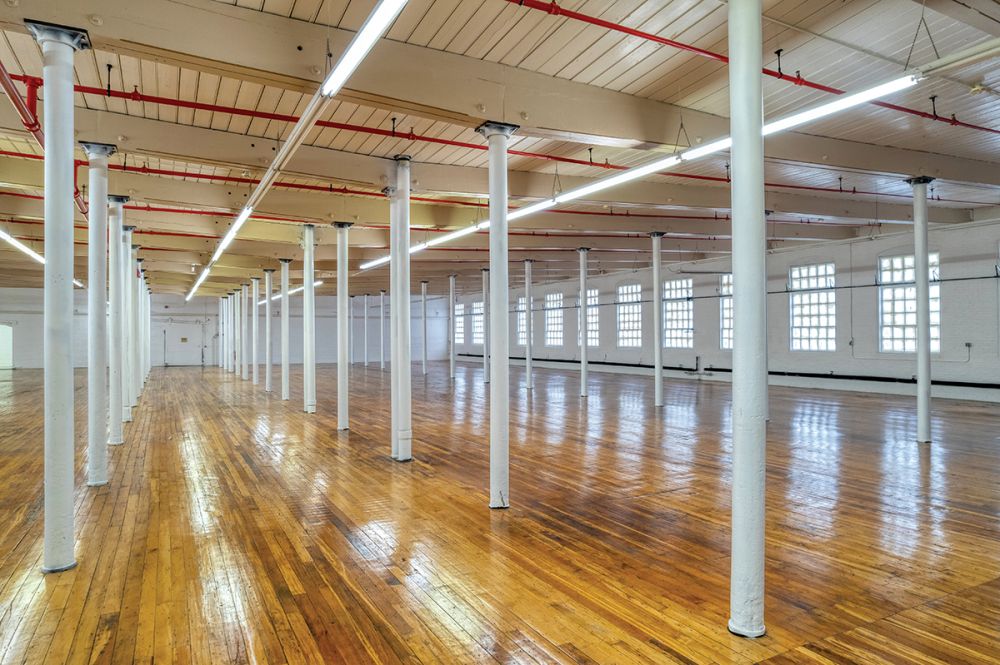
Original support columns and wood floors at Newport Mill. Inset: Newport Mill exterior (Courtesy photo)
When talking about old buildings, Realtors will often say they have good bones. Luckily for builders and developers, NH has an abundance of such buildings as adaptive reuse has gone from a niche in the construction industry to standard practice.
“In New England, the building stock is old and we’re pretty built up,” says Doug Shilo, project designer, sustainability leader, and senior associate at Lavallee Brensinger Architects. “From a practical point of view, we have to look at renovation first almost in every case.”
Textile mills once powered by water wheels now house apartments, lab spaces and offices. Libraries built with Carnegie money more than a century ago are being retrofitted for accessibility and energy efficiency, often with help from state and federal preservation funds. Mid-20th century office campuses, designed for a full workforce that is now hybrid or remote, are being transformed into apartments as the state’s housing shortage deepens. But reuse and preservation is not always feasible, especially for behemoth retail dinosaurs like malls.
So, when does it make sense to save the past and when is it better to rebuild?
Reuse is rarely simple. Shilo points out every project is shaped by zoning battles, structural limitations, historic preservation rules, energy codes, and, perhaps most critically, budgets. In NH, historic renovation is supported by tools like the Land and Community Heritage Investment Program (LCHIP), state and federal historic tax credits, and municipal bonding.
For Brady Sullivan Properties, the answer is almost always reuse. Founded in 1992 by Shane Brady and Arthur Sullivan, the Manchester-based company has built a reputation across the region for transforming underused and historic buildings into residential, commercial, and mixed-use spaces, particularly in Manchester.
“Our approach is always to reuse existing buildings,” says Chris Lewis, Brady Sullivan’s director of architecture and design. “We started out doing a lot of mill conversions, and that mindset has carried forward.”
The company’s imprint on Manchester is hard to miss. Projects like Jefferson Mill, Waumbec Mill, Mill West, and the Lofts at 25 Canal Street—each representing multimillion-dollar investments—have turned former industrial buildings into housing, offices, restaurants, and retail.
“Now you see people walking home with their groceries,” Lewis says. “It brings life back to these buildings.”
Shifting Market Creates New Opportunities
When COVID sent workers home, many companies downsized their footprints and the need to transform office space into housing took on new urgency. At Jefferson Mill in Manchester, where Brady Sullivan’s main offices are located, Lewis says vacancies appeared almost overnight.
“A shift happened almost right away,” Lewis says. “There were already some office vacancies. When COVID hit, we knew these were going to be challenging spaces for us to fill.”
Rather than wait for office demand to return, the company pivoted. Buildings once designed exclusively for desks and conference rooms became candidates for residential conversion.
This conversion has been happening in Manchester for years and is also spreading. The former 218-acre Liberty Mutual campus in Dover will feature up to 500 residential units, commercial space, a restaurant, and amenities like a dog park. Phase one, which will begin this year, includes about 245 units at 150 Liberty Way. “There’s a massive surplus of office space out there,” Lewis says. “All those people who went home during COVID? They’re not all coming back.”
At Brady Sullivan Plaza, a 20-story tower on Elm Street built in the 1970s and formerly known as Hampshire Plaza, Brady Sullivan has invested tens of millions of dollars over the last several years converting 10 floors of office space into apartments while retaining ground-floor retail and other commercial uses.
The transformation didn’t stop there. Parts of the building’s attached parking garage was also converted into apartments, a move that sounds improbable until you walk through it. “When you’re in that space, it doesn’t feel like you’re in a parking garage,” Lewis says.
Additional projects are already in the pipeline, including approvals to build apartments on top of the Plaza Street parking garage in Manchester and further redevelopment that would connect multiple buildings via enclosed walkways. “It’s architecturally exciting,” Lewis says. “One floor of parking becomes residential, and you build two more floors on top.”
Working With What You Have
For architects working on these projects, the excitement often comes with constraint. Columns land in the wrong places. Floor plates often don’t align with modern layouts and many of a building’s internal systems weren’t designed to
be replaced.
“As an architect, you look at it and try to reuse what you can,” Lewis says. “You keep vertical circulation. You flip the design process, finding ways to make it work instead of starting with a blank slate.”
This balancing act between creativity and feasibility is familiar territory for Tracy Kozak, founding principal of Arcove Architects in Portsmouth, whose firm works extensively on renovation and adaptive reuse projects across the state. “Most of what we do has some element of renovation,” Kozak says. “The first step is walking through the building and seeing if it’s actually a good fit for what the client wants to do.”
Some buildings, she notes, are simply built better than others. Converting older commercial structures into housing can be especially complex, requiring more stairs, stricter fire resistance, and egress patterns historic buildings weren’t designed for. “You’re often dealing with floor plates that don’t have a lot of stairs, or fire resistance that isn’t adequate anymore,” Kozak says. “We have to bring it up to code.”
In NH, unreinforced masonry, a hallmark of many 19th-century mills and downtown buildings, can quickly escalate costs. How far a project pushes under the International Existing Building Code often determines whether modest interventions are possible or whether a full overhaul—sometimes doubling project budgets—is unavoidable. “Sometimes we try to stay within a threshold of change,” Kozak says. “Other times, you have no choice but to make big moves.”
Arcove frequently conducts historic building assessments, prioritizing stabilization first, followed by fire safety and accessibility. Those assessments can unlock preservation grants and tax credits, but they also slow timelines and narrow design flexibility.
Municipal projects, Kozak says, can be among the most challenging but also the most meaningful. Her firm’s work on Soldiers Memorial Hall in Franklin, which houses Franklin City Hall in its opera house space, became urgent after the opera house space was deemed unsafe and shut down. “That became the driver,” she says. “The building had to be renovated so it could be occupied again.” The project relied on a mix of municipal funding and state preservation support, she adds.
Older buildings also come with surprises, some less charming than others.“We’ve found mold, environmental hazards, even zombie spiders in basements,” Kozak says, laughing. “We didn’t find buried treasure. The stories themselves are the treasure.”
Not all projects go as initially planned. Arcove’s work on a Federal-era mansion in Portsmouth shifted from a proposed microhousing project to a hotel after zoning barriers and post-COVID market changes altered the equation. “If these buildings are going to have a future,” Kozak says, “they have to perform.”
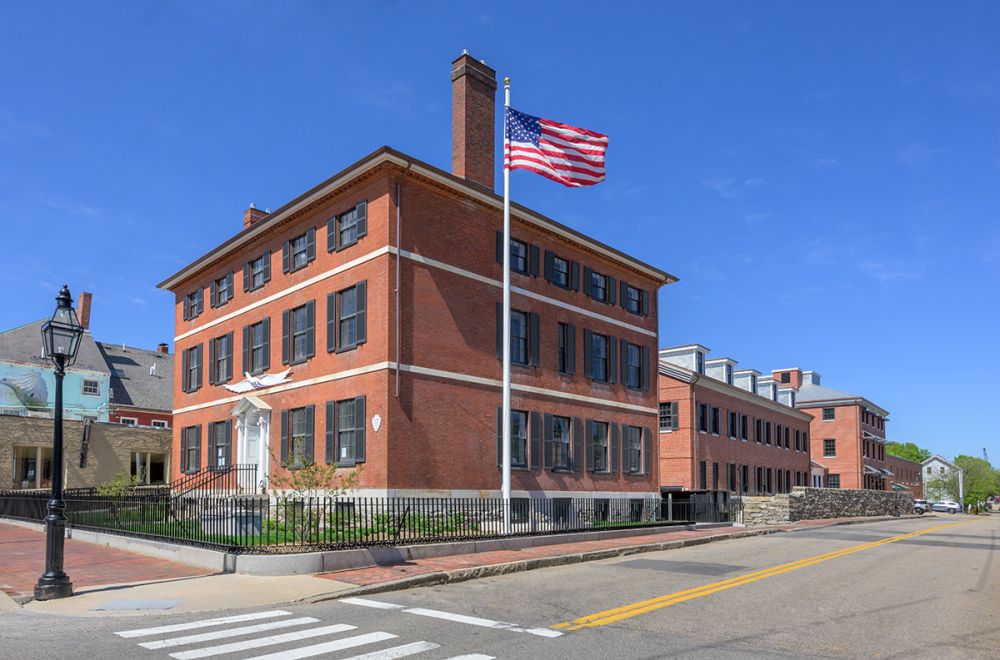
Treadwell Mansion Hotel. (Courtesy photo)
Making Old Buildings Sustainable
Performance increasingly includes sustainability, but not always in the ways people expect. For Shilo of Lavallee Brensinger, the strongest environmental argument for reuse isn’t operational efficiency but embodied carbon (the total greenhouse gas emissions generated from the entire lifecycle of building materials). “When you build a new building, there’s a lot of embodied carbon that goes into it,” he says. “With renovated buildings, those impacts have already been spent.”
That thinking guided Lavallee Brensinger’s renovation of Hetzel Hall at the University of NH in Durham, a nearly 100-year-old dormitory that was gutted and modernized inside while preserving its historic slate, brick, and copper exterior—a project valued at more than $40 million.
“Outside, it was a real beauty,” Shilo says. “Inside, it wasn’t in good shape. We replaced systems, windows, everything, while keeping the character.”
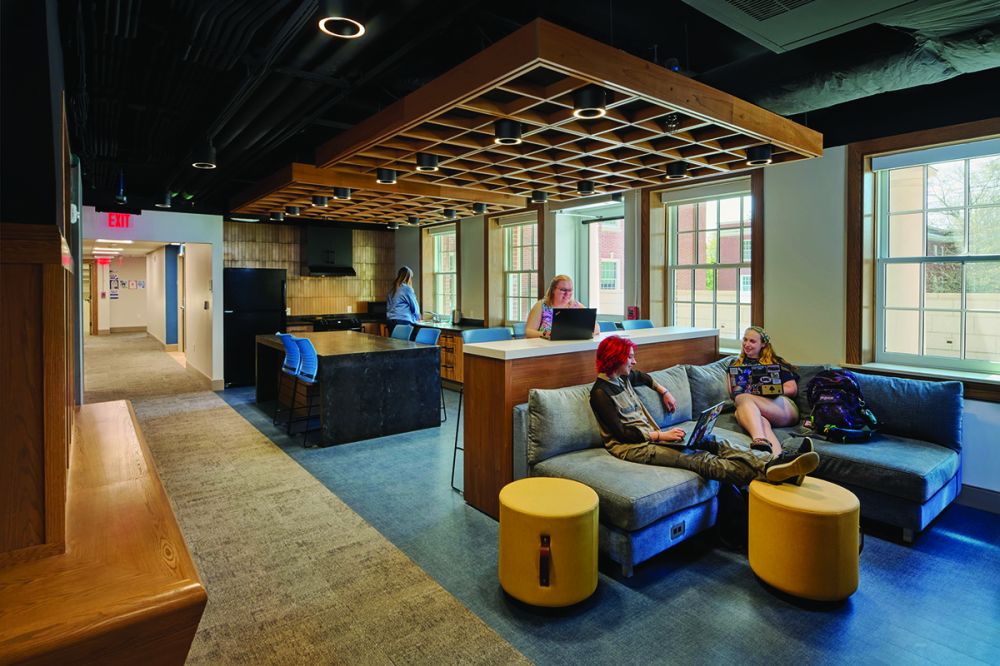
Hetzel Hall, student common kitchen and lounge. (Courtesy photo)
Still, reuse doesn’t always win. Shilo points to a Grafton County courthouse study that examined whether renovating and expanding the 1970s-era building could meet modern safety, accessibility, and program needs. “When we looked at renovating and adding to it, some things just couldn’t be achieved,” he says. “A new building was safer, more accessible, and less expensive.”
Evaluating those tradeoffs is why preconstruction becomes critical, says Chris Huston, vice president of preconstruction at ReArch, a Vermont-based commercial construction management and real estate development firm, with offices in Lebanon and Portsmouth, that specializes in sustainable building projects.
“The redesign and repurposing of older buildings is where preconstruction really shines,” Huston says. “Our role is to identify risks and challenges before construction starts.”
That includes everything from contaminated materials to geothermal feasibility. On the 1905 Dexter Richards & Sons Woolen Mill in Newport, a $17 million redevelopment that transformed the long-vacant mill into 70 apartments, ReArch spent nearly a year in preconstruction, almost as long as the 16-month construction phase. “The bones were there,” Huston says. “Brick, granite, rustic wood floors, it
was gorgeous.”
What made the project viable, he says, was identifying dozens of cost-saving ideas upfront without sacrificing durability. “Most projects generate 50 to 100 ideas during preconstruction,” Huston says. “That prep work is half the battle.”
Preserving the Past
For Eric Anderson, chief design and engineering officer at PROCON, adaptive reuse is ultimately about stewardship. “We don’t want to demolish buildings and send material to the landfill,” Anderson says. “Especially when there’s hazardous material involved.”
PROCON’s work ranges from modern office renovations, like Lighthouse Credit Union’s headquarters in Dover, to deeply complex historic projects such as the Easterseals NH Military and Veterans campus in Franklin, where buildings dating back to the late 1700s were preserved under historic easements and supported by public funding.
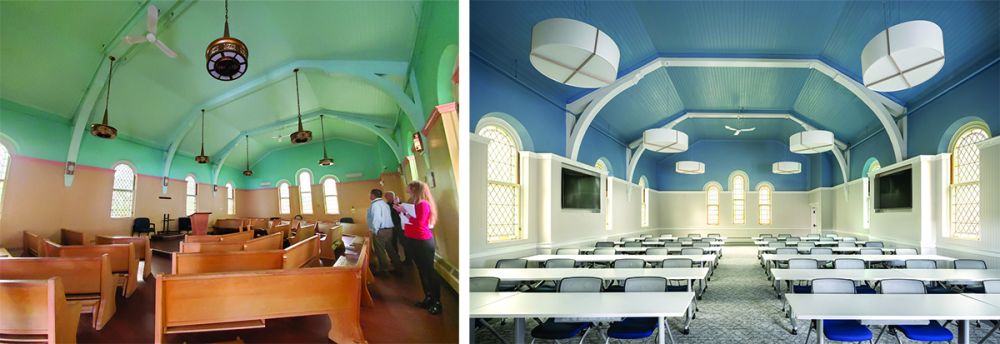
Easterseals Retreat Center prior to (left) and after renovation (right). (Courtesy photo)
“That project wouldn’t have happened without public investment,” Anderson says. “Private developers probably wouldn’t have taken it on.” The work took years of coordination, approvals, and energy modeling to make the buildings efficient without altering historic exteriors.“It’s more effort,” Anderson says. “But it’s far more rewarding.”
Across NH, those reuse efforts are reshaping communities. “These are buildings you study in college,” says Lewis of Brady Sullivan Properties. “To revive them and make them last another 100 years, that’s exciting.”