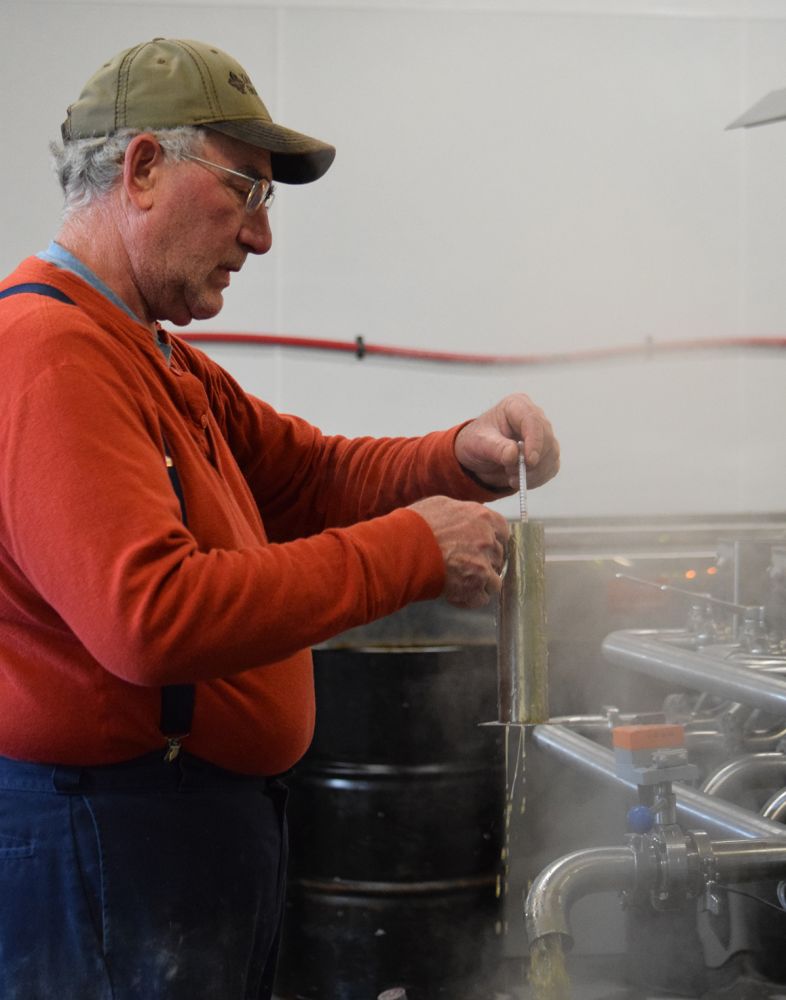
Dave Fuller checking density during a boil. Courtesy photo.
At 17, Dave Fuller knew he wanted to get into the maple industry, even if the future looked uncertain. It was the early 1970s, and “people looked at us like we were kind of crazy,” he recalls. “It was considered a dying industry.”
Today, maple syrup is enjoying renewed demand as consumers gravitate toward natural sweeteners and locally produced foods, while technology has reshaped how syrup is made. The United States produces about 20% of the world’s maple syrup, with Quebec, Canada, accounting for roughly 80%. New England remains the center of U.S. production. New Hampshire businesses produced about 149,000 gallons of maple syrup in 2024, valued at roughly $7.9 million, according to USDA data, compared to roughly 3 million gallons produced in Vermont.
“It’s a relatively small industry in terms of volume, but it’s emblematic of New Hampshire’s agricultural heritage,” says Rebecca Ross, director of the Division of Agricultural Development at the NH Department of Agriculture, Markets, and Food.
That heritage will be on display when maple producers open their doors to the public for NH Maple Weekend on March 21 and 22. Many producers have embraced the agritourism component by offering tours, music, food trucks and more to attract crowds. The NH Maple Producer’s Association, which boasts more than 350 member businesses, lists almost 190 sugarhouses and farms that will be participating in NH Maple Weekend.
Among them is Fuller’s Sugarhouse, on main street in Lancaster run by Fuller and his wife, Patti. Born and raised there, Fuller is preparing to begin his 53rd sugaring season. “I’ve been around maple pretty much all my life,” he says. His parents bought a farm in the 1950s where the sugar maples had already been cut, forcing the family to wait decades for the forest to grow back. “By the time I got out of high school they were finally big enough to get started. My father was very instrumental in helping it get off the ground.”
Today the operation spans roughly 1,000 acres and taps between 31,000 and 32,000 maples. Almost all those trees are leased, primarily from the Randolph Community Forest, with the remainder on privately-owned land in Lancaster. When Fuller began, production averaged closer to a quart per tree. His target crop is now 15,000 to 16,000 gallons of syrup per year, averaging about a half-gallon per tree. “Efficiencies have allowed us to double [production] over the years,” he says. “And we’re only taking a tiny percentage from each tree.”
Improvements in Technology
Those efficiencies reflect decades of technological change. Buckets hanging from individual trees have largely been replaced by networks of plastic tubing that carry sap directly to centralized tanks. Reverse osmosis systems remove much of the water before boiling begins, cutting energy use and labor, and evaporators are far more efficient than earlier generations, Fuller says.
Ben Fisk, owner of Ben’s Sugar Shack in Temple, has watched that evolution since he was five years old. “I got into the business after taking a field trip in preschool,” he says in jest. “Me and my dad tapped 13 trees the next day.” At 15, he won an award for the best maple syrup in the state. Today, he employs 70 people and taps 33,000 trees on 1,200 acres leased from private landowners, with a 30% to 50% annual growth rate. “My whole life all I wanted to do was sell syrup,” he says.
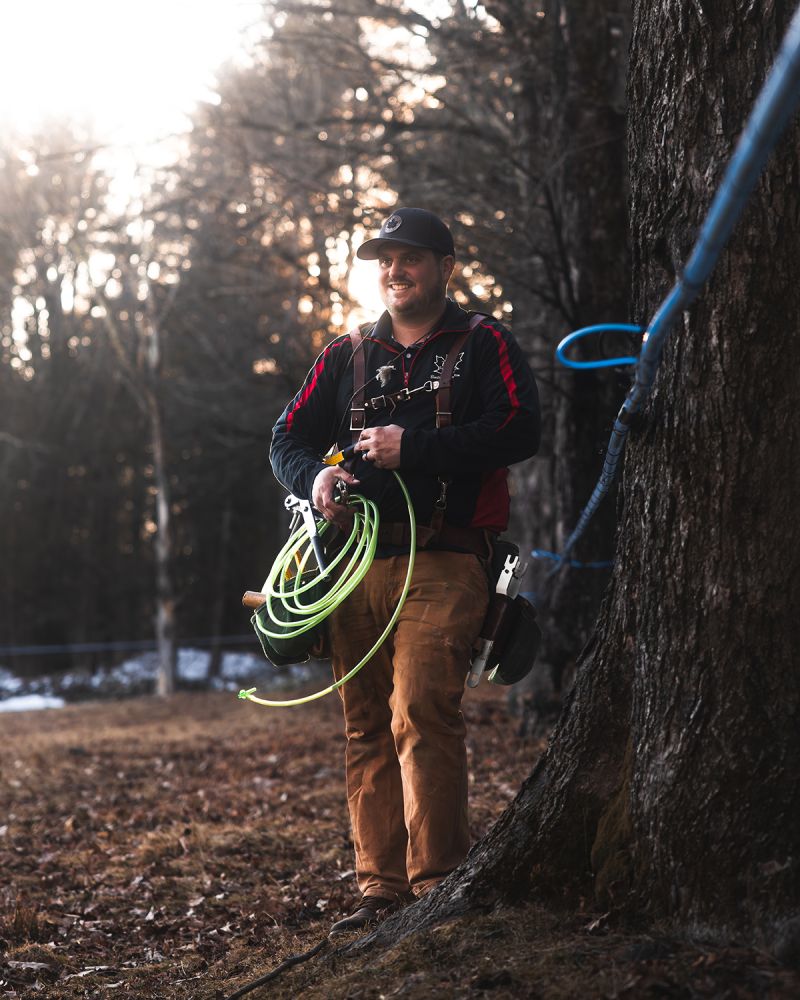
Ben Fisk tapping trees. Courtesy photo.
Fisk says technology is a major driver of the industry’s progress. New tubing and fittings that withstand high vacuum pressure, precision drills, and monitoring systems all boost efficiency. “If a squirrel chews on a line and there’s a pool of sap, that could lead to no production on some days,” he says. “Before the monitoring system you’d have no idea.”
For Fuller, technology also means more sleep. He can monitor sap flow, tank levels, and even pinpoint leaks from his phone.
Weather Challenges
Despite advances, maple syrup remains an agricultural business shaped by uncertainty. Weather is the most persistent challenge. Sap only runs when temperatures freeze at night and are warm during the day, typically from late February and March into early April.
“Climate variability is one of the biggest pressures facing the industry,” says Ross of the NH Department of Agriculture. “If it doesn’t freeze at night, sap won’t run. If it warms up too fast, the season can be cut short.”
Producers have adapted with new spout technology that reduces bacterial contamination and extends the tapping window. “Instead of six weeks, we can stretch it to 16 weeks,” Fuller says.
Labor availability, energy costs, and thin margins also add to the pressures. “You work hard for a small return,” Fuller says. “But that’s farming.”
Ross notes that her division supports the industry through USDA specialty crop block grants that fund maple research, education, and marketing. “A lot of the value is in the tradition,” she says, “but it’s also about sustaining the businesses behind it.”
For Fuller, the business remains deeply tied to community and tourism. Fuller’s Sugarhouse employs about 13 people, operates year-round, and sells everything it produces, occasionally buying syrup from other producers during tight markets.
Asked why maple syrup costs what it does, Fuller doesn’t hesitate. “Because we’re farming and it’s a lot of work,” he says. “But it’s also a way of life that’s been pretty close to perfect.”