
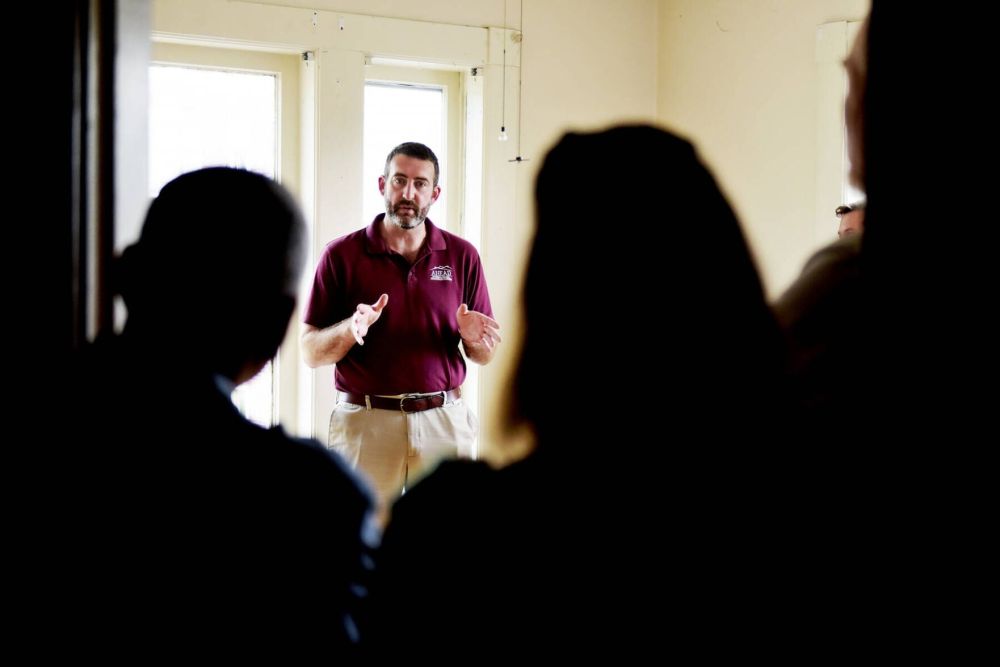
AHEAD executive director Harrison Kanzler speaks during a tour of the 12 King Sq. redevelopment project on Monday, Aug. 28, 2024. (Photo by Paul Hayes)
To increase the stock of affordable housing and offer broader benefits such as bolstering the local workforce, Affordable Housing, Education and Development Inc. (AHEAD) is rolling out the New Hampshire Rural Community Land Trust, a new and separate nonprofit registered on March 27.
In Coos County and in northern Grafton and Carroll counties, AHEAD plans to acquire and own several parcels of land to create permanent, affordable single-family homes that residents will own and that will give them easier entry into the housing market.
The land trust will also create new tax revenues for municipalities, address the problem of older housing stock, and, it is hoped, keep residents local by giving them another living option, said Harrison Kanzler, executive director for the Littleton-based AHEAD, who began working on forming a community land trust (CLT) in his previous role before joining AHEAD.
About two years ago, Kanzler and AHEAD’s board of directors laid the groundwork for the AHEAD-formed CLT.
While community land trusts such as the Champlain Housing Trust have operated in Vermont and others south of the North Country have functioned in the Granite State, the New Hampshire Rural Community Land Trust (NH RCLT) appears to be the first of its kind in the defined North Country region, said Kanzler.
“Champlain Housing Trust is one of the longest-standing CLTs and has done some incredible work in their communities,” he said. “We have had the privilege of working with one of their consultants during the formation process for NH RCLT.”
Conversations
As it stands now, AHEAD’s CLT encompasses all of Coos County, northern Grafton County down to the Plymouth area, and northern Carroll County.
“Working in all of these areas, there is a lot of similar conversation and action being taken by communities,” said Kanzler. “We feel that the CLT can help connect and unite our communities to make these projects easier for everyone.”
The homes would largely be starter homes for young families, but can also be for retired persons who want to downsize.
One perk with homes and land trusts is that AHEAD wouldn’t have to worry as much about the property management needed with apartment complexes, which will save on resources when management could be an hour or more away and busy with other properties, he said.
Now, the same community can come to AHEAD with a single-family home concept.
“That is a lot easier for us to pull off in more remote communities,” said Kanzler. “And these are taxpayers. The properties are going to be taxed. You’re adding to the tax base.”
Although there is a model in which community land trusts construct apartment buildings, which can help generate revenue for a land trust and could, in the future, be studied as an option, AHEAD’s CLT remains focused on houses, he said.
“For right now, we are looking at single-family homes, and largely because the more communities we’re talking to the more that seems to be the conversation that is popping up,” said Kanzler. “We need families to move here and stay here and start businesses and fill these job positions.”
Some candidates make too much money to live in an AHEAD apartment building because they have to income-qualify, but they would be a good fit for an affordable home, he said.
“How do we keep them here?” said Kanzler. “We give them a home they can actually reach and attain. That’s what we’re trying to do here.”
How It Works
While AHEAD is creating the CLT, the CLT and AHEAD are different entities.
“The CLT has its own board and will have its own assets separate from AHEAD,” said Kanzler. “The CLT already has a land lot, which was generously donated by a landowner in the town of Jackson. This approximately 6-acre parcel will serve as the pilot project for the CLT and will likely include five or six single-family ‘starter-home’ units. Single-family homes will certainly be part of what the CLT does, but the board envisions small-business ownership and rental opportunities, as well as a variety of residential ownership models. The key here is that the model will be community-driven and something that fits for and in the community where the project is happening.”
AHEAD’s CLT is also looking at prospective land parcels in Coos and northern Grafton counties.
Housing features, such as square footage, number of bedrooms, and cost can vary from community to community depending on need and available funding.
“As for 2026 and 2027 plans, we will be focusing on our pilot project in Jackson, as well as community engagement and education around CLTs and their uses for our communities,” said Kanzler. “We are currently in talks with other groups/landowners about partnership opportunities that would bring other projects into the pipeline, but those are in their infancy … At this point, we’re open to everything. We see a real need for smaller-sized homes that could be downsize options for people, empty-nesters who are looking for something smaller, but want to stay in the community. That will bring larger family homes back on the market.”
A starter home, for instance, could feature three bedrooms and 1 1/2 baths and encompass 1,100 to 1,200 square feet.
“Something like that is what we’re aiming for,” said Kanzler. “It might get a little smaller, it might get a little bigger. It depends on the community, the want, and what the needs are. The important part of this is every project will have its own committee formed of people in that community. They will drive part of the design aspect, understanding that design has cost associations. These are truly community projects we are trying to facilitate and start up. Each project will be unique.”
AHEAD’s CLT has designs that can be replicated and it can offer options to factor in such considerations as costs savings, but communities can still move forward with their vision while accounting for available money.
Before her retirement, U.S. Rep. Ann Kuster, D-NH, was able to secure a Congressional appropriation, which will go toward the CLT’s first project in Jackson.
There are a number of federal programs involving rental units, but AHEAD has been advocating to New Hampshire’s federal delegation to build out more programs for homeownership so people can invest in themselves and their families, said Kanzler.
“Shared Equity Housing” And Funding
The system used to keep units affordable through multiple sales is called Shared Equity Housing.
“The simplest way to think about this is a legal form of ‘paying it forward,’” said Kanzler. “Buyers who are getting one of these homes acknowledge that the home is worth more than they are paying for it, and there is a calculation done when they go to sell to an approved buyer (these are not open market sales), which dictates a maximum possible resale value. Most buyers who participate in this model of homeownership are able to sell after several years of ownership and gain enough equity to put a sizeable down payment on a standard/open market home. This is a step ladder into open market ownership.”
The concept of Shared Equity Housing will be a large part of AHEAD’s education.
“Yes, you buy it and own it, but it is not a market-rate house,” said Kanzler. “Because you are getting that benefit, you are agreeing when you buy it to pass that benefit on. So you are limited on what you get on resale.”
The concept strikes a balance and is intended to eventually move folks into market-rate homes by adding a step in the middle that makes it easier to traverse, he said.
For funding, the CLT has had generous support from the Conservation Fund and NeighborWorks America in getting started, said Kanzler.
“NeighborWorks also acted as an intermediary to help us get USDA funds through the Rural Community Development Initiative program, which helped us secure technical assistance in getting all of our documentation and programming structured with help from folks who have been in the CLT field all around the country,” he said. “This was a major help to the formation of the NH RCLT.”
He spoke of the broader benefits.
“The CLT was created to be a tool for our communities to use as they need,” said Kanzler. “It was intentionally set up as a separate entity by AHEAD to facilitate the use of the CLT by other groups, municipalities, and organizations. It isn’t AHEAD’s CLT, it is the region’s CLT.”
CLTs have done incredible things all around the country, from supporting the redevelopment of downtown areas with affordable small business opportunities, to creating community projects and amenities, and working with municipalities to revitalize blighted properties, he said.
“There is a lot of work a CLT can do, and a big part of our immediate horizon is educating our communities on how they can make use of the CLT,” said Kanzler.
He spoke of the older housing stock in the North Country.
“Is that part of the issue in attracting people to the region, is that they would like a newer house with a modern design?” asked Kanzler. “If we can create that opportunity and make it affordable … there is a clear opportunity here to attract more workforce to the area and also to provide an outlet to those folks who have been in a tough rental position. You have that in the community already. This will let them set down roots and stick around. To me, this is the bigger piece — to keep folks and not have them leave us. But if we bring in folks, too, that’s great.”
These articles are being shared by partners in the Granite State News Collaborative. Don’t just read this. Share it with one person who doesn’t usually follow local news — that’s how we make an impact. For more information, visit collaborativenh.org.