
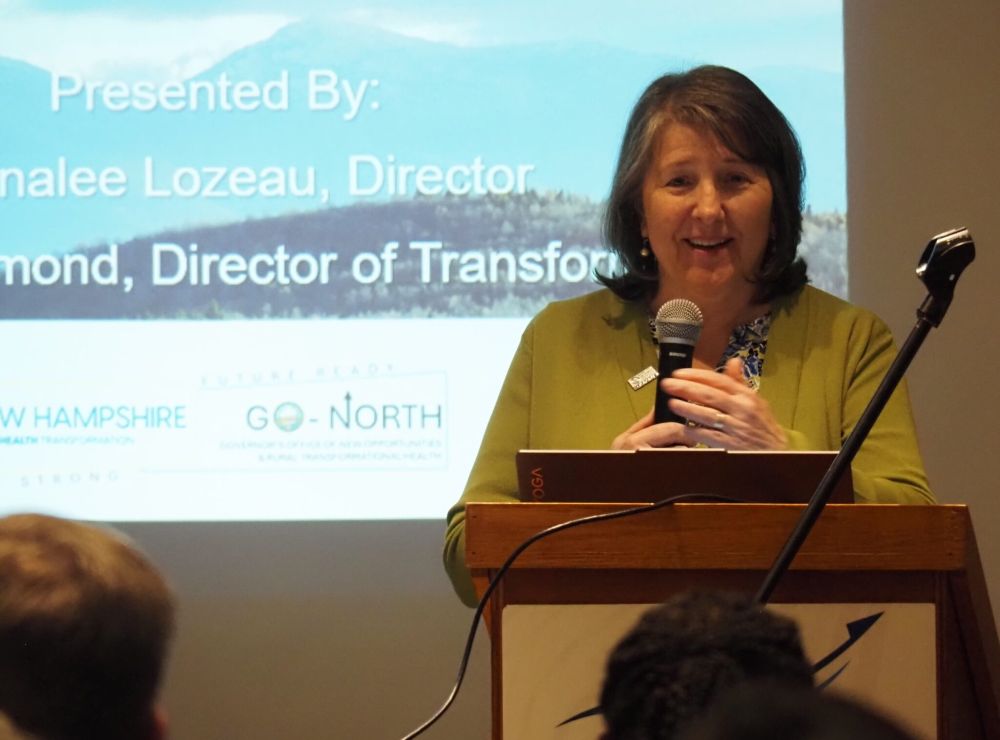
Donnalee Lozeau, GO-NORTH director, speaks to the New Hampshire Public Health Association at the McAuliffe-Shepard Discovery Center in Concord on April 23, 2026. (Photo by William Skipworth/New Hampshire Bulletin)
Donnalee Lozeau, director of GO-NORTH, said her philosophy in distributing the hundreds of millions of dollars the federal government is giving New Hampshire to spend on its struggling rural healthcare system will be about long-term investments, not short-term fixes.
“It’s not just about spending the money,” she told the crowd at a New Hampshire Public Health Association meeting in Concord Thursday night. “It’s about investing it.”
GO-NORTH is the state’s marquee rural health initiative. It was created after the state received roughly $200 million through the federal government’s Rural Health Transformation Program this year. The state expects to receive similar amounts every year through 2030.
What the money may do
To spend the money, GO-NORTH has designated five “hubs” throughout the state, which will each distribute money to different projects:
- The Foundation for Healthy Communities received about $283 million to distribute to projects on expanding access to primary care, behavioral health, and speciality services.
- The New Hampshire Community Development Finance Authority received $223.2 million to initiate capital infrastructure projects on buildings like rural hospitals, health centers, EMS providers, and telehealth.
- The New Hampshire Behavioral Health Association received $132 million to distribute to community mental health initiatives.
- The University System of New Hampshire received $96.9 million to work on the higher education to healthcare workforce pipeline.
- The Community College System of New Hampshire received $37.8 million to work on training healthcare professionals.
“Federal policymakers determined that they wanted a transformational, long-term, sustainable health access solution,” Lozeau said, before joking, “pretty small ask.”
Among projects that may happen, Lozeau said, are: renovating nursing homes and child care centers, helping hospitals develop new payment models, and creating mobile health units that can do X-rays or MRIs out of a van.
“Our current system is designed to treat illness, not consistently keeping people well or healthy,” she said. “It’s reactive versus proactive care. It’s fragmented services. … It’s limited support for daily life needs, and it’s volume-based versus value-based.”
Lozeau pointed to challenges hiring health care professionals in rural areas, financial pressures on providers, and access issues, including transportation.
Lozeau noted that congressional lawmakers gave the federal Centers for Medicare and Medicaid Services only 70 days to develop a program to roll out to the states, and the New Hampshire Department of Health and Human Services subsequently had only about 50 days to respond to the federal government’s application for funding.
“Just think about the breadth of that work,” she said.
Who’s leading this effort
As the inaugural GO-NORTH director, Lozeau acknowledged she doesn’t have a public health background.
“I don’t bring public health to the table,” she said. “I have a little bit of information about enough things to be a problem, but I’m very good at bringing the right people to the table to talk about things and try to move things forward.”
Lozeau was a state representative for 16 years before being elected the first female mayor of Nashua, a role she served in from 2007 to 2015. After leaving office, she entered the nonprofit world and was most recently CEO of the Community Action Partnership Hillsborough and Rockingham Counties. She said she was set to retire in January before Gov. Kelly Ayotte called her and asked, “Are you, like, really retiringretiring?”
“I have failed at retirement,” she joked.
Ayotte convinced her to lead GO-NORTH, an office she established through an executive order late last year to manage the new funding. Ayotte made the office separate from the Department of Health and Human Services, keeping it within the governor’s office, though Lozeau said the department will be important to ensuring that programs continue once the federal funding runs out.
“We were structured to be nimble, flexible, focused,” Lozeau said, “to deliver this transformational initiative across rural New Hampshire, and we will execute Rural Health Transformation investments for the term of the grant (five years).”
In the McAuliffe-Shepard Discovery Center that hosted Thursday’s event, Lozeau urged healthcare providers in the audience to reach out so the state can determine whether the services they provide would be a good fit for funding.
The money’s background
The Rural Health Transformation Program was created as a mitigation measure for incoming healthcare policy shifts. In 2025, when Congress was debating President Donald Trump’s massive tax cuts and spending legislation, the One Big Beautiful Bill Act, many in the rural health field worried the health-related provisions of the bill, which include major cuts to Medicaid, would decimate their industry.
As a compromise, lawmakers created the Rural Health Transformation Program, which is now distributing money to states to be used on rural health care initiatives. Many critics are quick to point out that the rural health program, which is distributing $50 billion over five years nationwide, represents a fraction of the funding the One Big Beautiful Bill Act cuts from health programs. KFF estimates that the law will reduce federal spending on Medicaid by roughly $991 billion over the next decade.
Asked whether she believes the federal government has given her team the resources it needs to meet the lofty goal of mitigating the affects of the Medicaid cuts, Lozeau said “the jury’s still out on that.”
“Can we meet some of the challenge? Maybe,” she said. “I think there is something to be said for: If there are going to be Medicaid cuts, are they giving us a chance to do something different that might mitigate some of those cuts? I think they are.”
This story was originally published by New Hampshire Bulletin and is being reprinted here under Creative Commons license CC BY-NC-ND 4.0. Click here to visit NH Bulletin and view their other stories.