
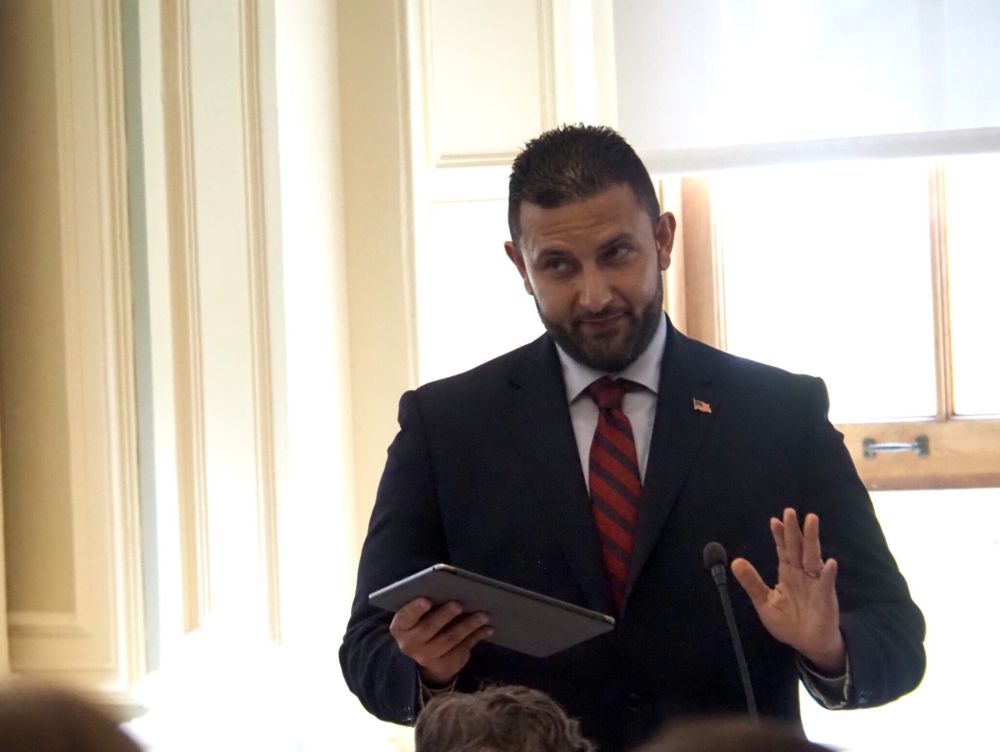
Salem Republican Sen. Daryl Abbas, shown here on May 15, 2025, said the new version of the “divisive concepts” law seeks to achieve the same objectives but in a clearer and fairer manner. (Photo by Ethan DeWitt/New Hampshire Bulletin)
Four months after the death of conservative activist Charlie Kirk, the arrival of House Republicans’ CHARLIE Act in January quickly drew attention.
Officially named the “Countering Hate And Revolutionary Leftist Indoctrination in Education (CHARLIE) Act,” the state bill paid homage to Kirk, the conservative activist assassinated at a rally in September. And it sought to regulate instruction on some of Kirk’s longtime foes, proposing to bar New Hampshire educators from advocating for an “intersectionality framework,” “critical race theory,” “LGBTQ+ ideology,” and anything else that might frame society “through lenses of inherent oppression.”
House Republicans were elated when the bill, House Bill 1792, passed the chamber in February. Many invoked Kirk’s memory in speeches to the floor. But this month, Senate Republicans took an ax to it, stripping out major provisions and advancing something new. On Thursday, the full Senate will vote on the altered legislation and decide whether to pass it on.
The new version of the bill removes all reference to critical race theory and LGBTQ+ ideologies, as well as Marxist analyses and “critical consciousness.” It takes out the mechanisms to allow parents to sue teachers. It even drops the bill’s title: The CHARLIE Act has been renamed the “Prohibition on Teaching Discrimination.”
In its place, Senate Republicans are seeking to use the bill to revive a recent bill: the 2021 teaching prohibition bill often referred to as “divisive concepts.” And this time, they are hoping to avoid court invalidation.
“I believe this revives that law,” said Sen. Daryl Abbas, a Salem Republican. “That’s just my opinion. If someone were to address that in a court, we’ll see. But I think this is the way to go.”
Rep. Mike Belcher, the Wakefield Republican who authored the original CHARLIE Act bill, did not respond to a request for comment on the changes.
The amended version of HB 1792 proposed by Abbas and Sen. Victoria Sullivan, a Manchester Republican, would once again ban public school figures from advocating any of four major ideas: that people of a protected characteristic such as race, gender, or sexual orientation are inherently racist, sexist or oppressive; that people of one characteristic are inherently superior to those of another; that an individual of one characteristic should receive adverse treatment because of that characteristic; or that people of one characteristic “cannot and should not attempt to treat others without regard to” their protected characteristic.
That language mirrors that of the “divisive concepts” legislation passed in the state budget in 2021. A U.S. District Court judge struck down that bill in May 2024, ruling that it was unconstitutionally vague and would thus chill free speech, after teachers unions and the American Civil Liberties Union of New Hampshire sued to stop it.
Democrats have said the 2026 version of the bill does little to improve on the CHARLIE Act, and they warned it would just lead to another lawsuit.
“This is going to go right back to court,” said Sen. Debra Altschiller, a Stratham Democrat. “We have to stop passing legislation for the purpose of going to court with it. This state can’t even afford to pay for adequacy in education, never mind purposefully throw itself into yet another protracted court case.”
HB 1792 does differ from the 2021 bill. While it still prohibits teachers from advocating for the same topics, the 2026 bill has fewer enforcement mechanisms. Unlike the 2021 law, it does not allow individuals to file civil lawsuits against school districts and staff members for alleged violations, and it does not allow individuals or state officials to bring forward Human Rights Commission complaints against teachers. It does still allow teachers and other employees of school districts to face professional consequences from the State Board of Education for violating the law under the educator code of conduct, which could include the loss of their teaching license.
The new bill also adds a new requirement that teachers must have “purposefully” advocated for one of the banned concepts.
Speaking at a committee meeting about the amendment, Abbas said those two changes — reducing the types of penalties and requiring intentional violations — are intended to respond to the vagueness issues raised by Judge Paul Barbadoro.
“Part of the rationale of the court was they felt that the penalty was rather harsh when there’s not a clear line in the sand when someone’s violating or not,” he said.
The ACLU of New Hampshire, one of the organizations that sued the state to strike down the 2021 law on behalf of teachers unions, disagreed that the amendment addresses the issue. “HB 1792 — in all its various forms — maintains the same constitutionally concerning problems of school censorship, vagueness, and confusion in our classrooms,” said Amanda Azad, the organization’s policy director, in a statement Wednesday.
The Senate amendment includes a number of other teaching provisions and requirements not seen in the 2021 bill.
The proposed bill prohibits teachers from “mandating or encouraging” using a name for a student that does not match with that student’s birth certificate, unless a parent or guardian has consented to that change. It bars educators from awarding a student a higher grade on an assignment if the teacher agrees with that student’s position on the topic, and also stops educators from deducting points because of the student’s position.
The bill requires teachers to act as neutral moderators of classroom discussion on ideas, without endorsing those ideas. If disagreement emerges, teachers must use a Socratic method of debate, and they must always present academic theories and frameworks with “counterpoints and multiple viewpoints,” the amendment states.
Any “ideological discrimination” or “attribution of opinions and beliefs to an individual’s identity group membership” between students must be considered to be bullying or harassment by educators, the amendments adds.
And civil education must be taught “in a manner that cultivates a neutral or patriotic disposition, emphasizing shared national values and constitutional principles,” the amendment states — a provision carried over from the original House version.
When the CHARLIE Act first passed the House and crossed to the Senate, the Department of Justice raised concerns that it could be too vague. In March, Assistant Attorney General Sean Locke, who heads the state’s Civil Rights Unit, told the Senate committee that the House’s version could have conflicted with existing anti-discrimination laws and put teachers in an impossible bind.
But the vast changes in the new version make HB 1792 much closer to the 2021 law that the Attorney General’s Office is defending in court. It is not clear whether those changes satisfy the Department of Justice’s concerns; the department did not respond to a request for comment Wednesday.
Azad, speaking for the ACLU, called the bill a ban on freedom and said it was “not what Granite Staters are looking for.”
“They have real needs that they hope lawmakers will tackle instead of extreme proposals that infringe on the freedom of speech and expression that lead both to educators leaving the profession and wasted taxpayer money on lawsuits,” Azad said, speaking of New Hampshire residents.
Altschiller raised an issue with the prohibition on alternative names. “I think we are trying to dip our toes right back into a backdoor way of attacking transgender students again,” she said. “… Why can’t we let kids be called what they want to be called in school.”
Republicans countered that students could still call each other preferred names, and that the amended bill would merely prevent teachers from requiring or encouraging those names. “It says the teacher can’t do it — the children can decide what they want to be called and ask their peers to call them whatever they want,” said Sullivan.
But Democrats maintained that the bill overall was too vaguely written for teachers to understand. Altschiller pointed to a portion of the amendment that prohibits the teaching that one’s national origin is inherently superior to another. “Let’s take the pledge of allegiance to the flag,” she said. “Would that not be teaching, instructing, and inculcating based on a national origin? Like, are we getting ourselves deeper into a policy that wasn’t a good policy to begin with?”
Abbas made the case that the new version of the “divisive concepts” law seeks to achieve the same objectives but in a clearer and fairer manner.
“We may disagree with the policy in whatever form, but I think even if you didn’t like that policy, this is an improvement,” Abbas said.
But Sen. Suzanne Prentiss, a Lebanon Democrat, argued the new bill does not adequately fix the concerns about vagueness.
“We can talk all about how to tweak this in a way to make it fit, but the problem is still there,” she said. “This is not needed. We should let teachers do their jobs. We are again meddling, in my opinion, with what’s happening in the classroom.”