
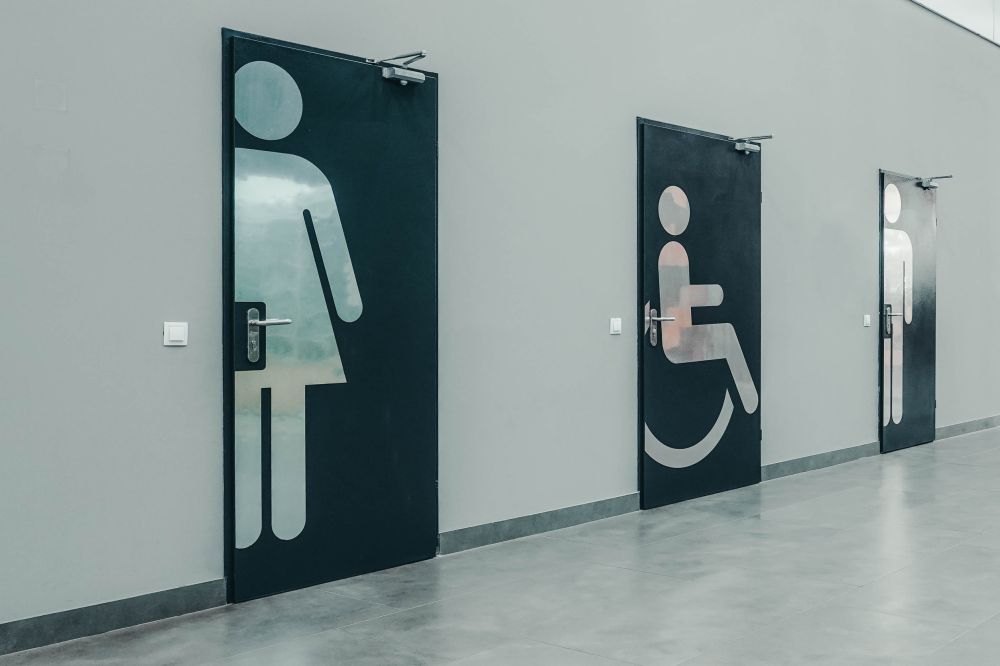
After rebukes by three vetoes from two different governors, Republicans vowed this year to keep trying to pass a law separating bathrooms by biological sex instead of gender identity.
Variations sought to add legal definitions, carve out exceptions and provide alternate bathrooms, some in hopes of placating Gov. Kelly Ayotte, who has vetoed this legislation twice in the past year.
As lawmakers near the end of the session, however, just two bills remain active and in play — and they’re identical to those that met their demise on the governor’s desk.
New strategies
State Rep. Bob Lynn came to the hearing with an amendment prepared — one that he hoped would alleviate Ayotte’s concerns.
The Republican from Windham tacked onto a copy of the vetoed bill a provision that would only let government entities — like schools or town halls — separate bathrooms by biological sex if there was a single-occupancy, gender-neutral bathroom available for use in the same building. That way, he said, a transgender woman wouldn’t have to use the men’s bathroom.
“I do not know if this, in fact, will address her concerns, but I’m hoping it will,” Lynn said at a hearing of the House Judiciary Committee, which he chairs, earlier this year. “The other thing I hope is that this will reflect that this committee is — we don’t put a stake in the ground and say, ‘It’s this way, my way or the highway.’ We are willing to talk and to compromise and to hopefully come to a reasonable resolution.”
The legislation vetoed by Ayotte and her predecessor, Chris Sununu, sought to allow government and private entities to separate bathrooms, locker rooms, athletics and prisons by biological sex instead of gender. Proponents argue it’s necessary to protect the safety and privacy of women. Naysayers retort that it discriminates against transgender people who want to use the bathroom that corresponds with their gender identity.
New Hampshire already prohibits transgender athletes from competing in school sports, which Sununu signed into law in 2024.
Ayotte first vetoed the bathroom policy last July, then again in February, calling it “overly broad and impractical to enforce.” She wrote that it could incite lawsuits.
“While I believe that the legislature should address this serious issue, it must be done in a thoughtful and narrow way that protects the privacy, safety and rights of all New Hampshire citizens,” Ayotte said of the veto last year.
Another variation brought forward this year sought to legally define the terms “male” and “female” by X and Y chromosomes and whether a person’s reproductive system “in normal function” produces sperm or ova, as well as by the indication on their birth certificate. It would’ve added changing areas and sleeping quarters to the spaces that could be separated by biological sex, as well as created exceptions for custodians, emergencies and parents accompanying their children to the bathroom.
Both of those bills were tabled by the state Senate last week at the request of Sandown Sen. Bill Gannon, a Republican who has typically supported such efforts. He did not respond to an interview request.
Other legislation is already dead. Senate Bill 459, which would’ve specified that separating athletics and prisons does not qualify as “unlawful discriminatory practice,” was killed by the House.
The only two related bills that are still in play — House Bill 1442 and Senate Bill 552 — are both awaiting action from the House before they can move forward. They are identical to the versions vetoed by Ayotte.
While being tabled usually means a bill will not survive, the Senate could still vote on its tabled bills this week, or lawmakers could choose to add similar language to another bill.
Becoming more common
Despite the proposed changes, Chris Erchull, an attorney for GLBTQ Legal Advocates & Defenders, maintained that any version of this law would exclude transgender people and be difficult to enforce.
These so-called “bathroom bills” have gained traction in conservative states like Florida and Texas. They often draw hours of emotional public testimony. Some version of the bill has been proposed in New Hampshire in each of the past three years.
Erchull called them an “attack” put forward by a “really hostile legislature.”
“We are just constantly overwhelmed by how year after year, it just seems to get more intense,” he said.
Not every Republican gender-related policy gets passed, however. House Bill 1564, which sought to remove all references to gender identity in New Hampshire law, was killed earlier this year. The Senate also rejected a plan to ban the display of flags in public schools, including rainbow displays, which often are seen as symbols of LGBTQ+ inclusion.
Some Republicans who champion these bathroom policies say they’re not about being “anti-trans” but about protecting women’s privacy, safety and peace of mind.
“It is absolutely not my position and not my intention that this be an anti-trans bill,” state Rep. Jim Kofalt, a Wilton Republican, said while introducing a version of the vetoed legislation earlier this year. “I do believe in the anti-discrimination law, and my goal, my vision, is that we figure out a way to all live together and work things out.”
Others say the legislation is necessary to fight back against liberal “radical gender ideology.”
Over the past few years, New Hampshire has outlawed hormone treatments, puberty blockers and breast and genital surgeries for transgender minors, largely along party lines. House Republicans are doubling down on their efforts, rejecting a Senate-passed bill that would’ve allowed girls to get breast reduction surgery to alleviate musculoskeletal pain or other physical discomfort, as long as they consulted with a primary care physician.
“Republicans have always made our position clear: children should not be subjected to permanent, irreversible genital mutilation surgeries,” state Rep. Lisa Mazur said in a Republican newsletter last week. She represents Goffstown and Weare. “We will not bow down to the extreme policies pushed by Democrats, and we will not compromise on the need to protect our children from radical gender ideology.”
These articles are being shared by partners in the Granite State News Collaborative. Don’t just read this. Share it with one person who doesn’t usually follow local news — that’s how we make an impact. For more information, visit collaborativenh.org.