
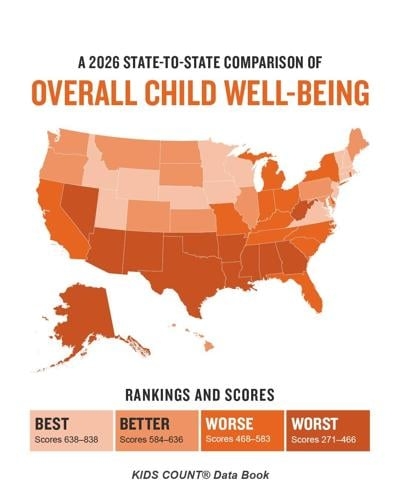
For the fourth year in a row, New Hampshire has ranked number one nationally in an annual survey by the Annie E. Casey Foundation that tracks 16 indicators of child well being.
The foundation’s 2026 Kids Count Data Book, released Monday, examines metrics across four categories — economic, educational, health, as well as family and community — over five years from 2019 to 2024.
This year, the organization for the first time instituted a scoring system that tops out at 1,000 points.
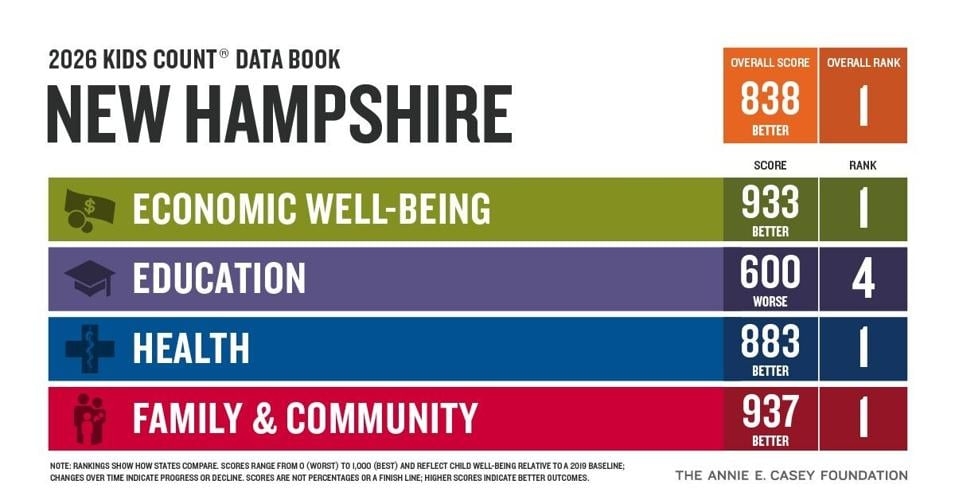
The overall scores ranged from 838 in New Hampshire to 271 in Mississippi. Massachusetts was second at 775, followed by Utah at 759, Vermont at 756 and Minnesota at 743.
Gov. Kelly Ayotte said in an emailed statement that she is proud that the state remains atop the rankings.
“It’s a testament to the work we have done together to support our schools, make childcare more affordable, and protect access to critical services for our kids,” she said.
“I thank the parents, educators, health care providers, state leaders, and everyone who has helped make this possible, and I know we will continue working together to ensure an even brighter future for families in our state.”
Rebecca Woitkowski is vice president of policy at New Futures, a health policy and advocacy organization that helps with the survey.
“New Hampshire’s top ranking in the Kids Count Data Book is a testament to the strength of our communities and the dedication of the families and providers who show up for children every day,” she said.
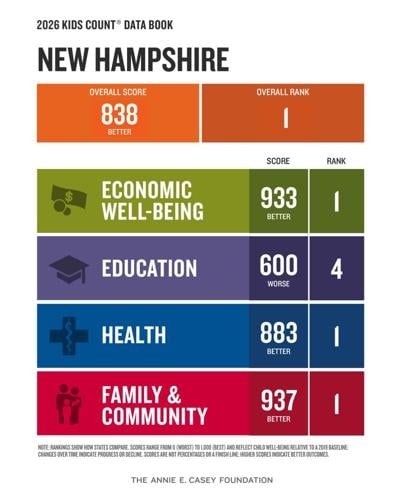
“But we cannot let that ranking obscure a troubling trend: our education indicators are moving in the wrong direction, and our children are falling further behind on reading and math.”
The report noted that in 2024, 64 percent of fourth-graders in New Hampshire were not proficient in reading and 68 percent of eighth-graders were not proficient in math.
“Research points to early childhood education as one of the most powerful levers for improving those outcomes, yet New Hampshire remains one of only six states in the country with no state investment in pre-K. Nearly half of all Granite State three-and four-year-olds—about 13,000 children—are not in any school setting, a rate that has barely budged in over a decade,” New Futures said in a news release.
Woitkowski also said the state needs to invest more in affordable child care.
Lori Weaver, commissioner of the state’s Department of Health and Human Services, said she was grateful for the state’s showing in the survey.
“Investments in kids today build strong families and communities tomorrow. This continued recognition of the Granite State reflects our pride in our communities, our commitment to working together, and our focus on the future,” she said.
New Hampshire’s good showing in the survey stems from relatively low numbers of residents suffering economic and public health problems, such as:
A total of 41,000 children in the state, or 17 percent, had parents who lack secure, full-time employment.
Only 2 percent of children, or about 6,000 kids, lacked health insurance.
There were five births per 1,000 females ages 15 to 19.
Lack of affordable housing remains a problem in New Hampshire, where rents and home prices have skyrocketed in recent years.
The report found that 61,000 children lived in households spending more than 30 percent of their income on housing.
The Kids Count Data Book is in its 37th year of publication.
Rick Green can be reached at 603-352-1234, extension 1435, or rgreen@keenesentinel.com.
These articles are being shared by partners in the Granite State News Collaborative. Don’t just read this. Share it with one person who doesn’t usually follow local news — that’s how we make an impact. For more information, visit collaborativenh.org.