
To understand the hierarchy of workplace needs, we begin with Psychologist Abraham Maslow’s hierarchy of needs. From an employee’s perspective, a job must pay enough money to cover physiological needs, to be physically and mentally safe, and provide stable hours and pay.

Any time an employer threatens that stability, they risk losing employees. Even though most of us are resistant to change, if our basic needs are being threatened, we will search for and find alternatives. We’ll go to a company that has low turnover, doesn’t have layoffs, pays better or offers consistent hours.
When an employer can provide an environment that meets both the physiological and safety needs, she can then take actions that address the psychological needs of employees. “What kind of culture do I want to create?” is not always on the top of an employer’s mind when interviewing the next new hire. But it should be. Every person you employ and every person you attach to your population either adds to or detracts from your culture. A stable, happy, productive, cooperative culture is the key to meeting your employees’ hierarchy of workplace needs.
Studies have shown that 92 percent of your employees will come to work every day, do the best work that they can, play well with their co-workers and play by the rules. The employer will spend the bulk of the “Human Resource” time with the other 8 percent. Those employees are the ones who detract from your culture by demonstrating poor regard for company policies and procedures, having poor attendance and poor quality work, and being involved in conflicts with other employees. Management’s job is to weed out the 8 percent and replace them with the employees who expand the 92 percent range.
Meeting Employee Needs
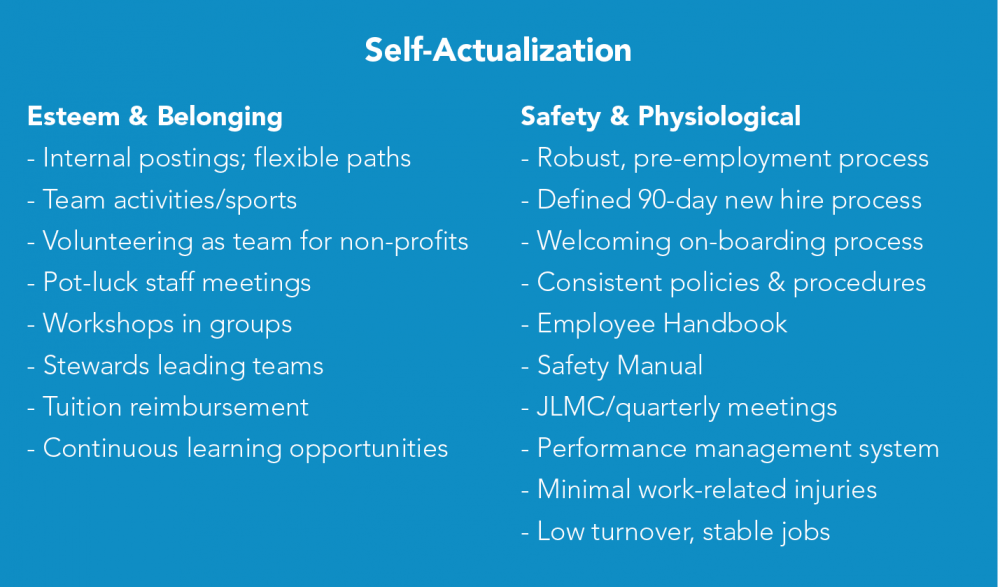
Although it’s up to the employees to achieve their own potential, employers can use many methods to satisfy their employees’ hierarchy of workplace needs.
Internal postings/flexible paths. This is powerful. If all jobs are available to your current employees, there is incentive to become eligible, gain needed experience, take required courses and to climb the ladder. A strong performance review system, combined with internal postings and career paths, allows you to home-grow your next management team and define paths for their successors.
Team activities and sports. It makes sense to sponsor a bowling or golf team or enter employees in a chamber of commerce’s fund-raising event as it gives your employees a chance to get to know one another outside of their normal working environment.
Regular staff meetings. Weekly or monthly meetings are another way to keep communication channels open and clear up any misunderstandings in the early stages.
Food for thought. Some companies have food brought in or hold potluck luncheons. Another client bought a grill and on Fridays from Memorial Day to Columbus Day, the production supervisor cooks hamburgers and hot dogs and provides side salads for employees. “Breaking bread” is a time-honored tradition of getting to know others.
Effective Onboarding
Organizations need to create strong building blocks for their employees in terms of their safety and physiological needs.
A robust pre-employment process will help you keep the 8 percent employees off your payroll. Many clients have learned to their dismay, when they aren’t careful, they end up with one of the 8 percent. When you hire someone you don’t know or haven’t thoroughly checked out, you put your organization at risk. For what? Sexual harassment and fraudulent workers’ compensation claims come to mind.
But those are only a small part of the problem. Calls to the Occupational Safety and Health Administration and the Department of Labor are also what you can expect from one of the 8 percent who is terminated or disciplined. The best practice possible in keeping them off your payroll is to conduct background checks and get good solid references. Often, an applicant will hide a gap in work history by falsifying dates of employment. “You can’t be serious. Gertrude told you she worked for us for three years? It was less than 90 days, and she was fired for attendance. Good thing you checked.”
90-day introductory period. We all make mistakes in hiring. The trick is to fix them as soon as possible. The 90-day introductory period should be regarded as the honeymoon when the new employee should be on their best behavior.
Whatever work habits they exhibit during this trial period will be a true sample of what you can expect in the future. With a buddy system, you can assign the new employee to a trusted, senior employee who will be the person’s mentor, break-buddy and one of their trainers. If that senior employee comes to you in the first week indicating problems, take immediate action to fix the issue. Sometimes a verbal warning can correct the behavior if you catch it
early enough.
An employee handbook. A handbook or policy manual is a cornerstone in meeting an employee’s hierarchy of needs. Everyone wants to know what the rules are. It is also important that the organization’s policies and procedures are applied to all employees equally and consistently. It’s all part of saying what you do and doing what you say. You will keep your employees happy when they can trust you and rely on the policies to be enforced consistently.
Creating a Safe Environment
Some industries have hazardous processes, such as working with chemicals, operating forklifts or using equipment that requires guarding. For NH companies with more than 15 employees, the Department of Labor requires quarterly JLMC (Joint Loss Management Committee) meetings and posted minutes. Those members are tasked with identifying workplace hazards and making sure corrective action is taken. These committees have been proven to reduce work-related accidents.
A robust pre-employment process will also help reduce turnover. If you are careful about who you hire and pay careful attention to them during their 90-day introductory period, you shouldn’t experience high turnover. Voluntary turnover higher than 10 percent is an indication that you aren’t meeting your employees’ needs.
Paula Mathews is the HR business partner at HR Synergy, LLC , an outsourced HR services firm based in Bedford. For more information, visit hrsynergyllc.com.