
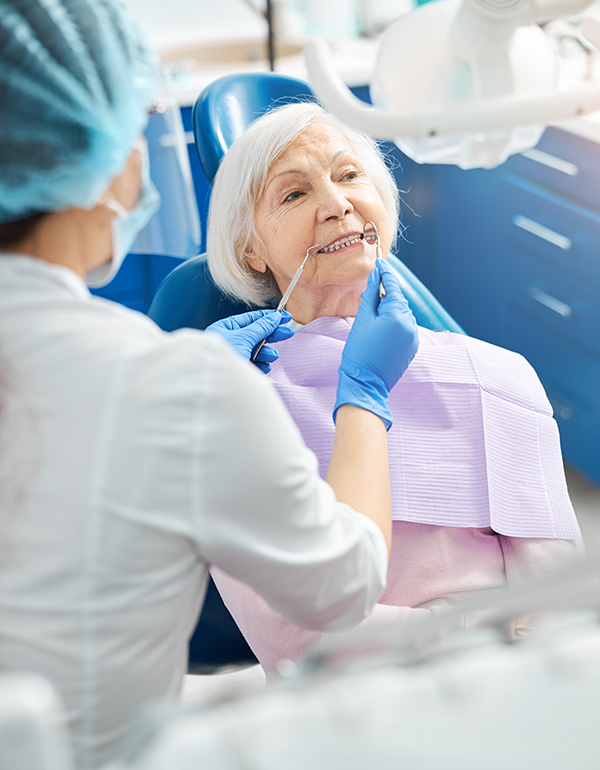
After dental offices closed for two months in March 2020 due to the onslaught of COVID-19, patients quickly returned though many dental workers did not. Hygienists and dental assistants, and other support staff, continue to be in short supply, and that’s a problem that needs addressing soon as tens of thousands of new patients are going to gain access to dental services thanks to a law that will go into effect in April 2023.
“There’s definitely a workforce shortage; we’re dealing with the shortage of assistants and qualified dental hygienists. That has been a tremendous strain,” says Mike Auerbach, executive director of the NH Dental Society.
That lack of staff has translated into a backlog of appointments. New patients might have to wait for many months, if not a year, to get in for an exam or cleaning.
If the backlog is not reduced soon, it will be compounded after April 1, when the 80,000-plus adult Medicaid enrollees become eligible for routine dental care. Up to the passage of that law, children on Medicaid could get basic dental care, but adults were only eligible for tooth extractions or other emergency dental services.
The law, which passed with bipartisan support, was sponsored by state Sen. Cindy Rosenwald, who represents six wards in Nashua. She says she has been interested in expanding dental care coverage for Medicaid enrollees for years, ever since she encountered a constituent while campaigning in her district.
“I rang a doorbell and a young man answered the door, 30, maybe 35, years old. And he was a really good-looking guy, and he didn’t have any teeth. He had a mouth full of rotten tooth stumps.” Rosenwald was seeing what a lifetime of denied dental care looked like. “How is he going to get a good job like that? It was so sad.”
And it was bad policy, she concluded. Someone with poor dental health can’t eat a healthy diet, will be susceptible to other diseases and will wind up needing more expensive health care as a result—all because the state wouldn’t pay for teeth cleaning.
“We are going to pay for it one way or another,” Rosenwald says.
Limited Dentists for Medicaid Patients
Now that the law’s passed, the work begins. The state has to determine how it will compensate dentists for the care they provide to Medicaid patients and to do so fairly enough that dentists are enticed to welcome those patients into their already busy offices.
Currently, only 14% of dentists will take Medicaid patients, Rosenwald says.
Dr. Jeffrey Vachon, who runs a second-generation practice in Manchester, is part of that slim minority. He says caring for patients on Medicaid is a continuation of the legacy established by his father, who started the practice in 1977.
“It’s been our philosophy to be providing care to as many patients as we can,” Vachon says. “The Medicaid population deserves care just like everyone else.”
Bringing those patients into the practice will be “more of a trickle” than a “tsunami,” Vachon predicts, as it will take time for the word to get out about the expanded benefits. He says his office is fortunate to be well-staffed and has room to grow to meet the need. “I’m hoping that this new Medicaid benefit will allow more people to understand that dental health is just as important as overall health,” Vachon says. “They will now have more access to preventative services.”
Auerbach says it’s likely that those first patients won’t need just preventative services, though. “Many of these folks are dealing with more critical care needs. They don’t just need a cleaning because they waited so long to get care,” Auerbach says. “We are going to see a lot of people with complex needs.”
Despite the challenges, and the reality that Medicaid reimbursements tend to be lower than from private insurers, he’s hearing from dentists who don’t currently treat Medicaid patients but are interested in doing so.
“We are hopeful,” Auerbach says. “There’s a lot of energy right now after the adult benefit package passed. We were ecstatic that this became a reality.”
Invisible Hand of the Hygienist Market
Tom Raffio, president and CEO of Northeast Delta Dental in Concord, says he’s optimistic that the market for hygienist labor will sort itself out, especially once people realize that they can make $78,000 per year after earning an associate’s degree.
The median pay for dental assistants is nearly $50,000 per year, and they can earn a certification through the dental office that hires them.
“It’s going to take a while for the invisible hand to course correct on this,” Raffio says, citing a few factors that pulled hygienists out of the workforce during the pandemic. The first was that those close enough to retirement decided to call it a day, second was a switch of careers into something that allowed remote work and a third is the lack of high-quality child care. “Some hygienists who wanted to come back couldn’t,” for lack of child care, Raffio says.
Northeast Delta Dental is part of a broad discussion, including the NH Dental Society, the Oral Health Coalition, NHTI and other hygienist training institutions, to attract more high school graduates into the profession. But, he says, there isn’t an overnight fix, so keep flossing.
“Everybody is aware of this. It’s just going to take some time to address it,” Raffio says. “It’s still a great profession to be in.”