
 Sea Dog Brewing Company, along the banks of the Squamscott River. (Courtesy of the town of Exeter)
With a vibrant downtown, a diversity of industry and housing and a forward-looking town government, Exeter is becoming a destination community for would-be residents and businesses.
“Exeter is more on the tourist trail than when I opened and is now seen as having one of those rare gems of a downtown that people go out of their way to visit,” says Dan Chartrand, owner of Water Street Bookstore, which he co-founded in 1991 in downtown Exeter. “And some of those tourists decide they want to live here.”
“It’s sort of following in the footsteps of Portsmouth,” agrees Tim Roache, executive director of the Rockingham Planning Commission.
The town of 16,000 rests where the Exeter River becomes the tidal Squamscott River, a setting that first drew indigenous people to the area because of its fish-filled waters, according to Barbara Rimkunas, Exeter Historical Society curator.
Those same waters later attracted Europeans who harvested the nearby woods for lumber, built dams along the rivers and constructed water-driven mills used over the years for grain milling, shipbuilding, tanning, printing, textiles and manufacturing.
The introduction of the railroad in the 1840s provided new market opportunities and the town soon saw construction of Exeter Machine Works, Exeter Brass Works, shoe factories and a box manufacturing company.
Employment Hub
Today, many of the mills have been converted to housing, and long-closed industries have given way to such establishments as Exeter Hospital, the town’s major employer, with 900 workers; the renowned Phillips Exeter Academy, which employs 520; and Riverwoods at Exeter, an independent living community for older adults with about 500 workers.
Specialty lighting maker Osram, weapons manufacturer Sig Sauer, electronics firm Cobham and medical technology company Vapotherm are other key employers.
But there are several newcomers, especially in the 587-acre TIF (Tax Increment Financing) district along Epping Road. TIFs provide funding for infrastructure improvements to spur additional development, with the tax dollars coming from that development paying off the cost of the improvements.
Town Manager Russell Dean notes that electric supplier Unitil has a new development in the district, along with the 116-unit Ray Farms condo community for people age 55-plus. GourmetGiftBaskets.com has its new headquarters nearby. The Kane Company has purchased a building on Osram’s site and will be bringing a company with about 75 employees, according to Economic Development Director Darren Winham.
“We’ve got a great mix of industrial, retail, office, commercial, health care and nonprofit businesses all contributing to the makeup of the town,” says Winham.
Infrastructure Improvements
The town has also seen a number of infrastructure improvements in recent years. With the backing of voters, a $53.5 million wastewater treatment plant was constructed in 2020, and the town recently purchased property at 10 Hampton Road with plans to relocate the Parks and Recreation Department there.
Select Board Chair Niko Papakonstantis says town officials are also looking to bring a proposal for a new $15.9 million Public Safety Building that will house the police station and a fire substation before voters, hoping to get the required 60% approval at Town Meeting.
 The historic Town Hall and gazebo in downtown Exeter. (Courtesy of the Town of Exeter)
It’s About Downtown
But the beating heart of Exeter is its downtown, which now mixes old and new with its 1855 Town Hall, numerous historic buildings, new sidewalks and flourishing restaurant scene. “We’ve attracted an eclectic collection of eateries that has moved us into what we call ‘foodie’ status,” says Winham. Among the offerings are the Sea Dog Brewing Company, Oba Noodle Company, Otis, Me & Ollie’s Bakery and Cafe, Capital Thai, Laney & Lu and the Flyby Cafe.
The vacancy rate for downtown buildings is “close to none,” Dean says. “If you see one store come and go, there’s usually one right behind ready to take its place,” he adds.
The town’s economy was boosted 22 years ago when Amtrak added it as a stop for the Downeaster train, which runs from Boston to Brunswick, Maine. Dean says Exeter is its busiest stop in NH, and the train makes for an affordable way for riders to stop and get to know Exeter.
But it is the town’s residents who helped downtown businesses survive the pandemic. “People went out of their way to support the independent, family-owned Main Street businesses,” Chartrand says. “They wanted to make sure we were here when we emerged from the pandemic. It’s something I’ll always be grateful for.”
“Really all of the businesses in town survived through the support of residents,” adds Papakonstantis. “I love how our community can come together in the best times and the worst times.”
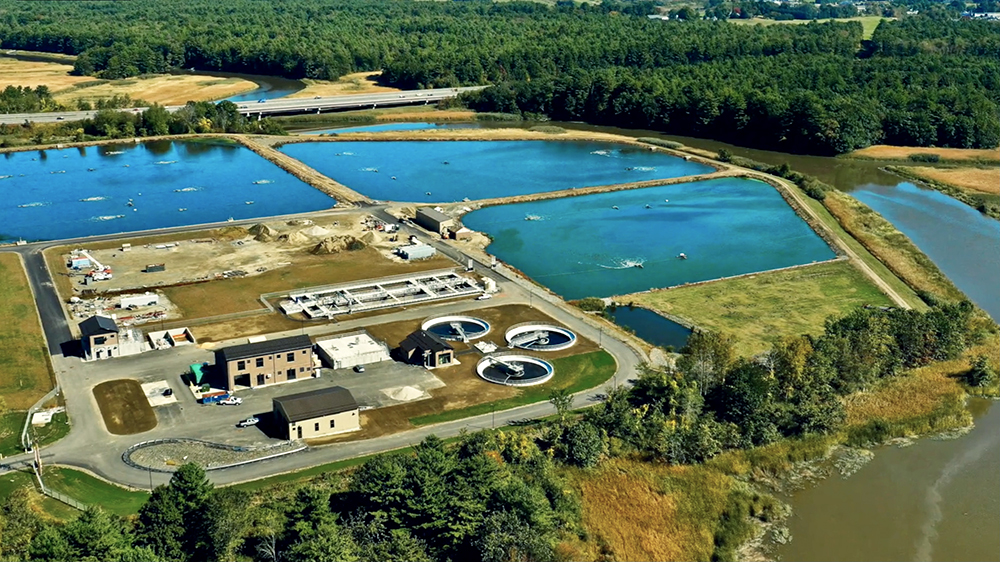 The wastewater treatment plant, constructed in 2020. (Courtesy of the Town of Exeter)
A Historic Community
Another reason visitors and residents alike enjoy Exeter is that it is a town steeped in history with buildings that reflect its storied past.
Nike, the shoe manufacturing company, was born in Exeter and operated in town between 1974 and 1984 before relocating. One of its principal factories, at 156 Front St., still stands, now converted to condominiums.
President Abraham Lincoln came to Exeter and gave a speech at the Town Hall in 1860 while his son Robert was a student at Phillips Exeter Academy.
According to a book by the late NH Gov. Hugh Gregg, Exeter is also the birthplace of the Republican Party, which was formed Oct. 12, 1853, at a secret meeting of abolitionists at Exeter’s Squamscott Hotel at 24 Front St., now repurposed as office space under the name A.P. Blake’s Hotel. (Wisconsin also claims to be the site of the Republican party’s founding, and a friendly argument has continued for years as to which locale is entitled to that distinction, “but we’ll claim it,” Dean says.)


The Ladd-Gilman House, left, and Folsom Tavern, right. (Courtesy of the American Independence Museum)
Exeter is also home to the American Independence Museum, which is dedicated to “connecting America’s Revolutionary past with the present.” It includes two buildings, the Ladd-Gilman House (Pictured Left), a registered National Historic Landmark, and the Folsom Tavern (Pictured Right), listed on the NH State Register of Historic Places, both dating to the 1700s.
Arts and Culture
Visitors will also find miles of recreational trails and a burgeoning arts and culture scene. In addition to the music and arts festival at Swasey Parkway and the Exeter Bandstand in the Town Center, Phillips Exeter Academy has arts and performance venues. Pre-COVID, Town Hall was used for many artistic endeavors, and “we’re slowly starting to see that come back” with help from a new Arts and Culture Advisory Commission, says Papakonstantis.
In 2016, the town completed removal of its Great Dam, allowing the Exeter River to flow freely through the downtown into the Squamscott River and providing scenic views for pedestrians.
 Squamscott Hotel Postcard (Courtesy of the Exeter Historical Society)
A rehabilitated String Bridge provides safe passage from the downtown to Swasey Parkway, called by Papakonstantis, “our crowning jewel.” The half-mile-long waterside corridor replaced wharves and warehouses along the Squamscott River and now offers a green walkway used for events like farmers markets, arts and music festivals, a springtime children’s egg hunt and leisure pursuits. In March, residents voted overwhelmingly to partially close the walkway to vehicular traffic to make it more pedestrian-friendly, though it remains open one-way.
Facing Housing Challenges
A diversity of housing is another Exeter asset. Of the town’s 7,000-plus housing units, only half are single-family homes, according to the NH Economic & Labor Market Information Bureau. Dean says the town’s housing inventory includes manufactured homes, mobile home parks, apartments and condos.
 (Pictured: The Former Nike Factory, Which Has Been Converted to Condominiums, Courtesy of the Exeter Historical Society)
Still, workforce and affordable housing remains a challenge for Exeter and its surrounding communities. “Workforce housing is the number one economic development issue on the Seacoast, and it will likely remain that way for the next two decades,” says Winham. “It won’t get fixed until more communities embrace attainable housing development.”
In Exeter, a Housing Advisory Committee continues to seek ways to address the issue, especially in a town where the average sales price of a single-family home is $450,000, according to Dean. One example, Dean says, is the Meeting Place off Epping Road, an affordable housing complex of about 70 units, completed in 2015.
Winham notes that Exeter recently passed a Mixed-Use Neighborhood Development zoning change that provides incentives for including 10% affordable housing in developments in the downtown and Lincoln Street corridors. In addition, “Exeter is working with a consulting company to make further changes to our zoning to encourage more workforce housing,” he adds.
A mixed-use development is planned for the Epping Road TIF district, according to Papakonstantis, with some 25% designated as workforce housing. The $80 million project, called The Gateway to Exeter, will include a total of 224 units.
Taxes
Taxes are another ongoing concern. Exeter’s tax rate is $24.01 per $1,000 of valuation. Top employers like Exeter Hospital and Phillips Exeter Academy are nonprofits and tax-exempt. However, “both entities contribute to the town by offering high-wage employment, eating in our restaurants, shopping in our downtown, etc.,” Winham says.
Papakonstantis says town officials strive to keep the town portion of the budget below 25%. “We make sure we’re examining each tax dollar,” he adds.
Dean agrees, saying “I think we’ve been very responsible. We have an A-1 bond rating, which I’m very proud of.”
Other Challenges
Papakonstantis lists parking as another economic challenge, especially as the town undergoes more development, as is recruiting volunteers for civic engagement. “We have openings on many boards and committees, particularly in the past couple of years,” he says.
Public transportation is another area that deserves study, according to Roache. “As you get an aging population and you’re trying to develop workforce housing, you could conceivably have people living in the region who don’t need to own a car, but now you do,” he says. “It’s an issue that Exeter and every community should be working on.” Town officials say they’re striving to meet such challenges, while celebrating what Exeter has to offer now. “I just think it’s the quintessential New England town,” says Dean. “It has a little bit of everything. You don’t have to go very far; you don’t have to leave town. You can stay here and enjoy what it has to offer.”