
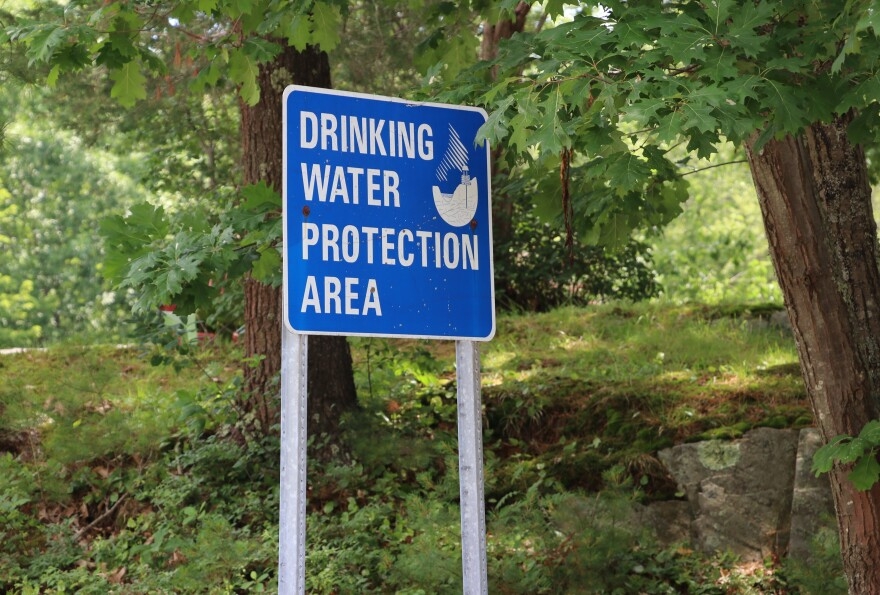
Sign for a Drinking Water Protection Area in New Hampshire. (Dan Tuohy/NHPR)
The Environmental Protection Agency announced efforts earlier this week to roll back federal drinking water limits on four of six “forever chemicals” that are associated with certain cancers and other health problems, sparking pushback from longtime advocates for drinking water protections in New Hampshire who say the move will undermine public health in the state and around the country.
“We need federal protective standards that protect all of us, said Andrea Amico, the founder of Testing for Pease. “It really shouldn't matter what state you live in.”
While New Hampshire has had limits on PFAS in drinking water since 2019, state regulators had been moving toward adopting new federal regulations developed under the Biden administration. But the Trump administration argues those rules
failed to follow legal requirements under the Safe Drinking Water Act.
“The EPA’s proposal is solely based on a need to correct this unlawful procedure,” federal regulators said in a press release.
Betsy Southerland, who retired from her work as an EPA water regulator in 2017, said implementing the Biden era goals is feasible.
“The Biden administration had done extensive analyzes on all the available treatment technology and the costs necessary to meet these limits. It's very affordable and cost effective,” she said.
Officials said the agency would continue to evaluate PFAS in drinking water, and that future requirements could be even stricter than the ones introduced by the Biden administration.
But local advocates were critical of the agency’s motivations. Laurene Allen, a Merrimack resident and PFAS activist, said the rules contradict the EPA’s stated mission to protect both the environment and public health.
“[The proposed changes are] a giveaway to big industry… We can drag things out and we can weaken things and amend things and create loopholes and reduce liability,” she said.
The chemicals that would no longer be regulated under the EPA’s proposal are PFHxS, PFNA, HPFO-DA, and a combination of those three chemicals and PFBS. Some of those chemicals have been found in water in New Hampshire, and in the blood of residents. Studies have shown those chemicals may be connected to health impacts like immune system issues, liver issues, reproductive harms, and thyroid issues.
But those chemicals haven’t been studied as extensively as PFOA and PFOS, sometimes known as “legacy” PFAS chemicals. The limits for those chemicals are not part of the proposed change.
In a separate proposal, the EPA has announced they intend to give water systems the chance to request a two-year extension on their efforts to comply with limits on PFOA and PFOS, moving the deadline from 2029 to 2031.
“Places in New Hampshire that have to comply with the PFOS and PFOA EPA standards will have additional time to implement their treatment, which means that the communities that drink that water will be exposed to chemicals that the EPA is saying is not safe for an extended period of time,” Amico said.
New Hampshire regulators said meeting these standards will not be particularly challenging for the Department of Environmental Services.
“New Hampshire is way ahead of the nation,” said Brandon Kernen, who leads the state’s Drinking Water and Groundwater Bureau. “We adopted drinking water standards back in 2019, and we actually started testing statewide private and public wells in 2016.”
“The new federal regulations kind of fit in seamlessly to what we're doing,” he said. “We just have to adjust the standard and react accordingly.”
But advocates said state progress does not negate the need for federal protections.
“I'm grateful for the work that we've done here in New Hampshire, but having federal protective drinking water standards for multiple PFAS protects New Hampshire residents as well as the entire nation,” said Amico.
The proposed rules are subject to a 60-day public comment period, and the agency will hold a virtual public hearing on July 7.
These articles are being shared by partners in the Granite State News Collaborative. Don’t just read this. Share it with one person who doesn’t usually follow local news — that’s how we make an impact. For more information, visit collaborativenh.org.