
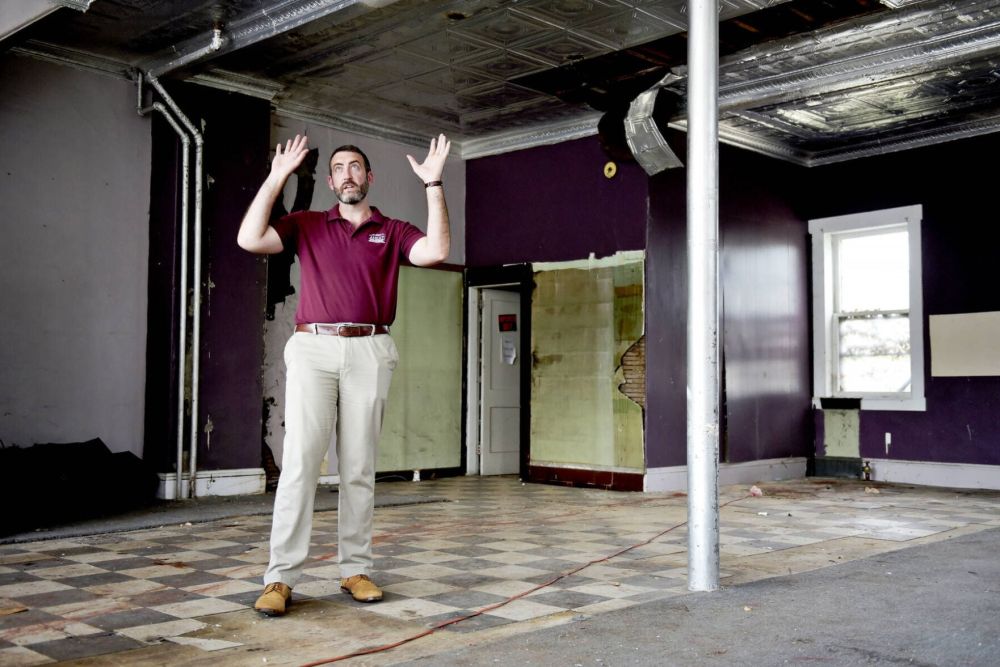
AHEAD executive director Harrison Kanzler speaks during a tour of the 12 King Sq. redevelopment project on Monday, Aug. 28, 2024. (Photo by Paul Hayes)
WHITEFIELD — As construction moves forward on the long-vacant former Shurtleff Pharmacy building at 12 King Square, town officials are weighing whether to grant up to 11 years of tax relief for the $3.4 million redevelopment project.
The affordable housing nonprofit AHEAD is rehabilitating the roughly 1910 downtown landmark into a mixed-use building with ground-floor commercial space and four two-bedroom apartments upstairs, including at least three affordable units expected to remain affordable for 20 years.
“Rehab on the old 12 Kings Square property in Whitefield is moving along,” AHEAD said in a May 3 social media post announcing that construction was underway.
The Whitefield Board of Selectmen held a public hearing on May 11 on AHEAD’s request for tax relief under New Hampshire’s RSA 79-E community revitalization program, which allows municipalities to temporarily freeze property assessments on qualifying redevelopment projects in downtown districts.
AHEAD Director of Real Estate Development Larry Berg said the organization is seeking the maximum relief allowed under state law because the project includes both affordable housing and a new residential unit.
“11 years is dictated by the RSA,” Berg said in response to questions from The Caledonian-Record. “It is the allowable period of tax relief for the redevelopment, the addition of units, and the units being affordable.”
Berg said Whitefield’s adoption of RSA 79-E was a factor in AHEAD’s decision to take on the project.
“The cost to redevelop these small downtown projects is staggering,” Berg said. “Once developed, they can only carry a fraction of the development cost as permanent debt.”
He added that AHEAD was surprised when the application was tabled.
“The tabling of AHEAD’s application was surprising; given the enormous investment being made on a prime downtown building with such historic significance to the town, and the town’s adoption of RSA 79-E designed to spur development just like this,” Berg said.
AHEAD finalized the purchase of the property on March 13 after first entering into an agreement with local investors in September 2023. The building, vacant for decades and known for the ghost mural painted on its eastern wall, has long been viewed as a prominent but deteriorating downtown property.
“This building holds deep significance for the people of Whitefield,” Berg said in the May 3 announcement. “Restoring it is about more than bricks and mortar — it’s about investing in the future of the town.”
Funding for the project includes Union Bank, the New Hampshire Community Development Finance Authority, the Northern Border Regional Commission, BEA and InvestNH.
Town officials said they are still evaluating what level of tax relief, if any, should be granted and what the completed building’s future assessed value might be.
Town Administrator Mike Lee said one preliminary estimate suggested the redeveloped property could eventually be assessed at around $400,000, compared with its current assessed value of $138,700.
“We want to make it work, but also not get us into something we don’t want,” Lee said during the hearing.
Berg said AHEAD expects the building to be ready for tenants by mid-October and estimated it could take at least 10 years for the project to break even because of rehabilitation costs and loan repayment obligations.
Public comments during the hearing reflected both support for the project and concerns about the proposed tax relief.
Supporters said the redevelopment would preserve a historic downtown building, add housing and restore commercial activity in the town center.
“If that building was torn down, it would be a big hole in the downtown,” Lee said.
Others questioned whether freezing the property’s tax assessment for years would unfairly shift the tax burden to other property owners or create inconsistent treatment for taxpayers who improved their own properties without incentives.
Selectman Shawn White said the board is trying to balance those concerns with the town’s broader goal of encouraging downtown investment.
“All I hear is we need our downtown developed, and as soon as something comes in everyone complains about it,” White said.
The board plans to revisit the request after obtaining additional financial projections and legal guidance on how the tax relief agreement would be structured.
These articles are being shared by partners in the Granite State News Collaborative. Don’t just read this. Share it with one person who doesn’t usually follow local news — that’s how we make an impact. For more information, visit collaborativenh.org.