
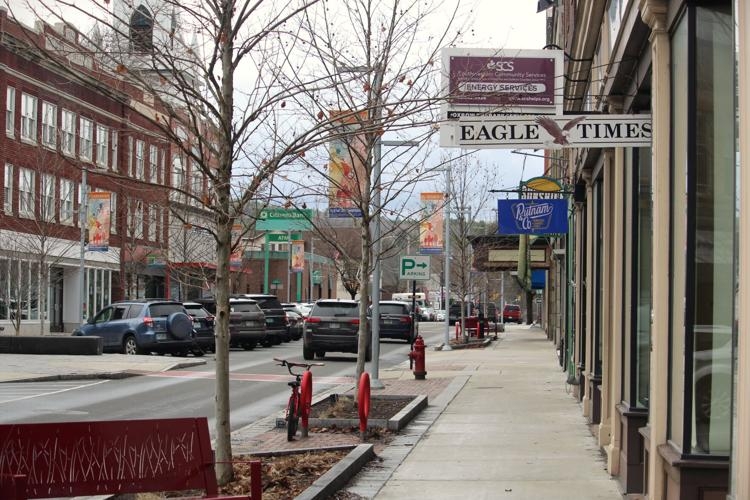
The former home of The Eagle Times now sits empty on Pleasant Street in Claremont. (Abigail Ham/Sentinel staff)
It was summer in Claremont last year when the city’s hyper-local newspaper, The Eagle Times, announced it would cease publication. It had been a long and hard-fought struggle for the paper dedicated to the Twin State Valley, but after nearly 200 years and several different names and owners, it gave up the ghost.
After paychecks allegedly bounced, the staff walked out of the latest revival, owned by entrepreneur Jay Lucas. By the end of the year, Lucas was facing charges, accused by the N.H. Department of Justice of fraudulently raising millions from private investors that he spent on alimony, rent and “vanity projects,” like his publishing company. (That case is pending in federal court.)
But for the residents of Claremont, Charlestown, Cornish, Newport, Plainfield and Unity, as well as the Vermont towns of Ascutney, Springfield, Weathersfield and Windsor, The Eagle Times was no vanity. It was a vital source of dedicated community news.
Without it, the region from which some of the first written dispatches from the Upper Connecticut Valley were composed now has no local paper.
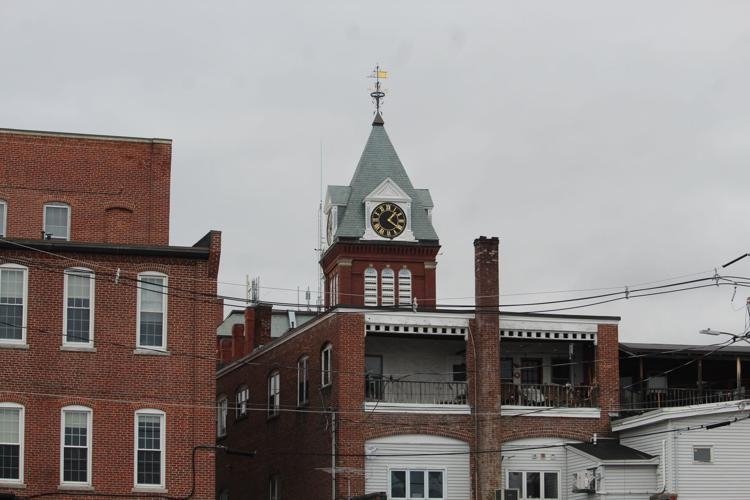
The Newport Opera House clocktower looms over an apartment building in downtown Newport, near the former home of the Argus-Champion. (Abigail Ham/Sentinel Staff)
Into the dark
At a café on Main Street in Claremont, gray clouds paint patterns of light and shadow on a window-side table where two old friends are eating lunch.
Craig Messer and Butch Roy went to Stevens High School, just around the block. Messer still lives in Claremont, while Roy now lives across the river in Springfield, Vt.
Both were readers of The Eagle Times.
On the Vermont side of The Eagle’s old coverage area, Roy said there are other sources for local news. But in Claremont, Messer said the paper left a void.
“You don’t know what’s happening anymore,” he said.
With the closure of The Eagle Times, the Claremont-Newport area joined a host of communities around the country whose newspapers have gone out of business. Nearly two in every five newspapers have shuttered since 2005, according to the Northwestern University 2025 State of Local News Report.
More than 130 closed in 2025, and, as of that year, fewer than 1,000 daily print papers remained.
In New Hampshire, The Sentinel is one of just eight dailies left.
Closures have left many Americans, particularly in rural areas, without local news coverage.
If Americans are enraged by this dying of the light, they don’t show it on surveys. Despite the fact that the majority say they trust their local news source significantly more than they trust national news sources, less than one in three who pay for news do so from a local source.
The Northwestern University researchers, who coded papers based on their base location, classed Sullivan County as one of those places without any local news source and Cheshire County, the home of The Sentinel, as a one-source county.
They are the only two counties in New Hampshire where residents have fewer than three local papers based within them. (Even rural Coos County has multiple papers.)
Local news blind spots are rare in the Northeast, where many local newspapers began operating in the times of fledgling statehood, but those blind spots are getting more common, especially in the region’s most rural areas.
The 43,000 residents of Sullivan County share their plight with the people of Essex County, Vt. (population 6,000) and much of Northwest and Central Maine.
The county’s top stories, like Claremont’s fiscal problems, have been picked up by outlets like WMUR, N.H. Public Radio and The Valley News, but “nobody’s doing the day to day reports,” local writer Steve Taylor said. “... It’s really very sad.”
While the West Lebanon-based Valley News sends more resources for larger stories, Patrick O’Grady, a part-time contributing writer for that outlet, is the last remaining reporter dedicated to coverage of Sullivan County.
“For the most part, my reporting on Claremont-Newport is all there is for local news” in that area, he said.
As for the smaller surrounding towns, like Charlestown, Cornish, Unity and Weathersfield, Vt., “There’s almost no news out of those towns,” he said.
Coverage of sports at Newport High and Stevens High is now more limited, too, O’Grady said.
“Week to week, the coverage isn’t there.”
The Sentinel cursorily covers Charlestown, The Valley News’ coverage area includes all but Springfield and Ascutney, and the weekly Springfield Reporter covers that town, but none of those sources provide the level of attention to the communities of Sullivan County that The Eagle Times did.
Valley News Editor Matt Clary, who is also a former editor at The Eagle Times, said Tuesday The Valley News would like to do more in Sullivan County, but that, despite being a large market, the area has acute market challenges for any news business.
The communities left without local coverage are ones that would benefit profoundly from the civic goods that coverage can provide, he said. “The people who need it the most don’t get it.”
The Valley News does cover high school teams that do well and big stories that emerge in the county, such as the recent school funding issues, he said.
At his desk at the Fiske Free Library on Broad Street, Circulation Librarian Colin Sanborn said the region’s remaining sources, including The Valley News and The Sentinel, can’t offer Sullivan County what a hometown newspaper did.
The library keeps newspaper archives, from 1834 issues of the National Eagle to microfilm copies of The Eagle Times.
Although use of online news is on the rise, there are still people who aren’t comfortable with computers or simply prefer not to use them, he said.
In a July column in The Valley News, Taylor described how “owner after owner” of The Eagle Times had “tried to make a go of it” in the decades since the fading of Sullivan County’s once-robust manufacturing economy.
In its most recent revitalization, the paper “offered a readable package of obituaries, sports, police blotter reports, accounts of the shenanigans on the Claremont City Council plus community doings,” Taylor recalled.
“... readers will now be left without the nuts-and-bolts stuff of community journalism, a far cry from the days when the daily Eagle Times, plus a superb Newport weekly, the Argus-Champion, were alive.”
As a result, the Claremont area has had to deal with recent events without its two historic sources of news.
Just months after the final pages of The Eagle Times rolled off a press last year, the Claremont School District revealed it was $5 million in the red.
The months since have been marked by resignations, investigations and a controversial bid for a state bailout.
In downtown Claremont Wednesday, April 1, Stevens High School student Alex Laroche said it’s been a challenge to find out what’s going on at his school.
“There’s not a lot of information being given out,” he said.
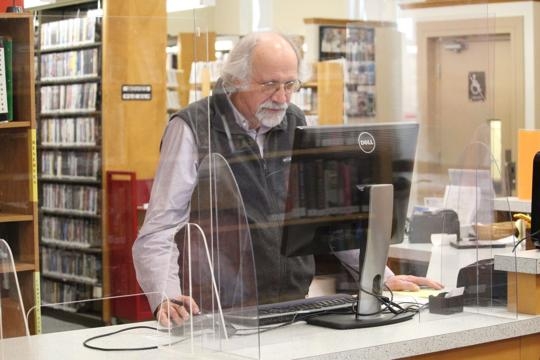
Circulation Librarian Colin Sanborn works at his desk Wednesday, April 1, at the Fiske Free Library on Broad Street in Claremont. The library has archives with hundreds of years of local newspapers. (Abigail Ham/Sentinel staff)
The heart of local news
The city on the Sugar River has seen many things come and go since its founding in 1762.
Lively manufacturing sites rose and fell there, leaving behind a host of historic infrastructure, like the towering mill building that looms over the parking lot of the café where Messer and Roy were eating lunch.
The Boston and Maine used to chug into town on the Claremont-Concord line, bringing tourists and economic opportunity. (An uncovered platform now welcomes Amtrak’s Vermonter to town once a day.)
And once, Claremont was the battleground in an old-fashioned newspaper war.
The first issue of The Valley News came hot off the press in Lebanon, 25 miles north of Claremont, in 1952.
The competition pushed both papers into rare form. “The readers were treated to a wonderful thing,” Taylor said. “They were getting a local news report that was complete.”
But the ‘50s and ‘60s were tough times for newspapers, said Taylor, who wrote for The Eagle’s sports section while a student at Hanover High in the ‘50s, recalled.
Then-owner Rhoda Shaw Clark and her husband, John Clark, had bought the paper while it was heavily in debt, and “used it to help rebuild a community that had become demoralized by the loss of many of its industries,” according to her obituary in The Boston Globe.
Around 1960, Clark shrank the paper’s coverage area to focus on Sullivan County and parts of Windsor County, Vt., surrendering the greater Lebanon area to The Valley News.
That’s an area that has never been at a loss for stories, Taylor said.
But with local papers no longer competing for those stories, coverage of the area is uneven, he said.
For Taylor, the loss of a local newspaper is about more than the top headlines.
“The core things of community journalism, without that local paper, go away,” Taylor said.
Without things like obituaries, daily sports scores, school graduation lists and coverage of city government, community connections fall by the wayside.
“Your neighbor could be dead and you wouldn’t know,” he said.
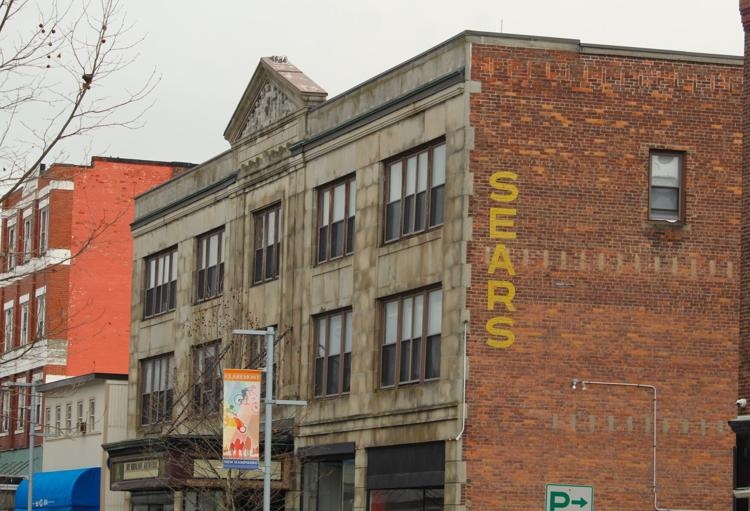
In a city that was once the center of a heated newspaper rivalry, just one reporter remains. (Abigail Ham/Sentinel staff
The last newspaperman
Much of The Eagle Times’ staff walked out last year, saying they hadn’t been paid, according to reporting by NHPR.
But Taylor said it would be a mistake to think that the region’s newspeople were motivated by money.
“The people who covered the news for The Eagle, they weren’t in it for the money,” he said, but “because they loved Claremont.”
He recalled the life of Georgia Croft, a woman who was born in Claremont in 1937. Croft attended Stevens High School, Keene Teachers College and the University of New Hampshire to study teaching.
But after several years at the Windham Center School in Vermont, she left that profession to become a reporter and later the city editor at The Daily Eagle.
Her legacy there may not have made any national headlines or won a Pulitzer Prize, but it served an important role in the community she loved.
Taylor said he believes her reporting was partially responsible for the restoration and reopening of the Claremont Opera House, which remains a regional center for theater, music and culture, and the establishment of the city’s downtown as one of the first Multiple Resource Historic District on the National Register of Historic Places.
“There’s no vehicle for it,” he said.
Larger outlets swoop in readily enough to cover big stories, but they can’t replicate the work of a local reporter.
O’Grady, who worked for The Eagle Times from 1993 until that iteration’s bankruptcy in 2009, said institutional memory and a determined presence give local reporters the ability to provide context that others might miss, and to stay with stories that are one-offs to larger outlets.
The role of the local reporter is to be “a constant presence, developing sources, being on top of developing stories,” he said. “... It takes persistence.”
The Eagle persisted in its various forms for 192 years.
The region’s two other local papers, the 74-year-old Valley News and The Sentinel, founded in 1799, persist still.
Abigail Ham can be reached at 603-355-8554 or aham@keenesentinel.com.
These articles are being shared by partners in the Granite State News Collaborative. Don’t just read this. Share it with one person who doesn’t usually follow local news — that’s how we make an impact. For more information, visit collaborativenh.org.