
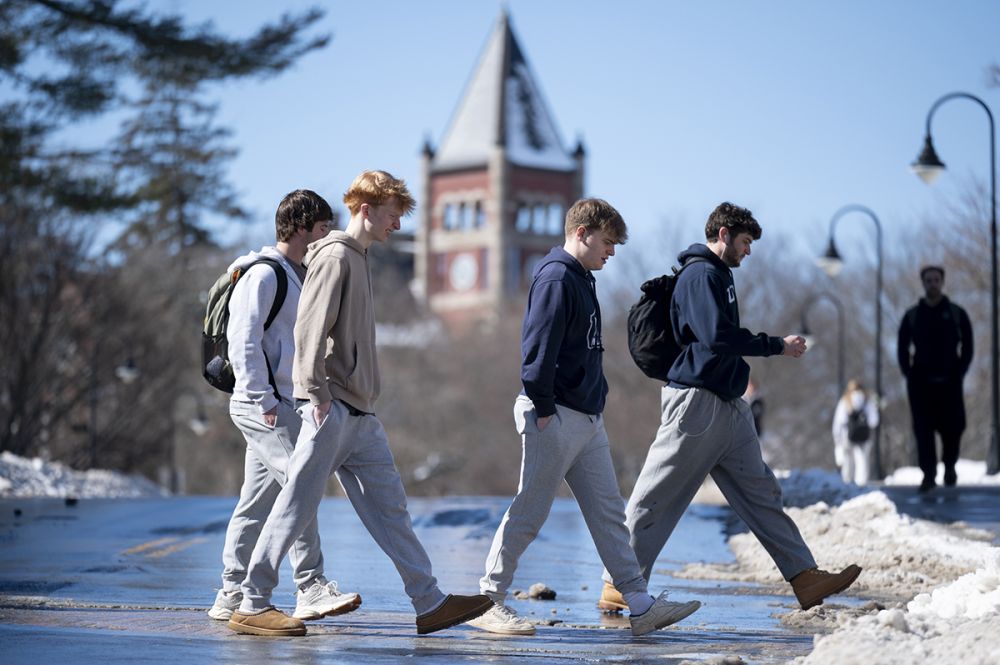
Thompson Hall looms in the background as students cross the street at the UNH Durham campus, on March 4, 2026.
State budget cuts are forcing the University System of New Hampshire to evaluate its mission and raise the price for students to attend.
With 11 colleges and graduate schools, the university system is the largest provider of post-high-school education in New Hampshire. The flagship is the University of New Hampshire in Durham, with about 13,500 students; the system also includes Keene State College and Plymouth State College, each with more than 3,000 students.
A 2025 study found that the university system is a significant driver of the state’s economy, with a total economic impact of $7.6 million in fiscal year 2023 and responsible for nearly 52,000 jobs.
But the university system has its critics, particularly in the Legislature, which has voted periodically to reduce the system’s budget, forcing major adjustments. The N.H. Fiscal Policy Institute found in 2025 that New Hampshire continues to rank last in the nation for public higher education funding, and the ripple effects include rising tuition costs, cutbacks in education programs, and the strength of the state’s workforce.
In the 2024-25 school year, higher education funding in the Granite State dropped 3.9%, while that funding in the U.S. overall increased 4.3%. U.S. News and World Report ranked UNH among the 10 colleges with the highest in-state tuition. Keene State College eliminated 25 staff positions in November, with 12 faculty opting to leave voluntarily after a $4 million budget shortfall. In 2025-26, the cuts were even deeper, with an additional budget cut of 17%.
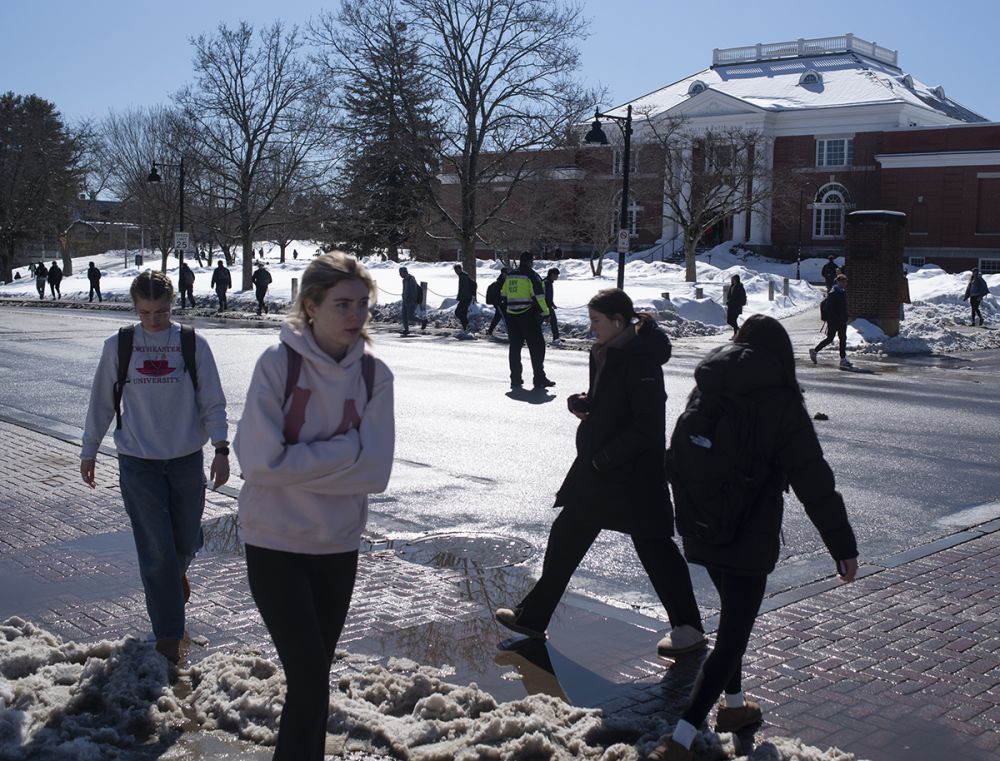
Students cross the intersection at the UNH Durham campus, on March 4, 2026.
In 2025, Rep. Dan McGuire, R-Epsom, was the primary sponsor of House Bill 1, the foundation of the new appropriations for the state budget. McGuire says the funding for USNH does not serve the general population as well as other services of the state. He said the budgets increased funding for special education and nursing facilities. And he believes in the Community College System of New Hampshire as the way to fill the gaps in the workforce, such as nursing and the trades.
But as a proponent of school choice, he felt the increased funding for Education Freedom Accounts – a program that provides vouchers to help families pay for private schools – is one of the biggest achievements of the current budget. Over $87 million in total was allocated for the state fiscal years 2026 and 2027, 119% percent more than the previous budget.
“Is government there to be something for everybody, or is government there to protect people’s rights and fill in the gaps for people who can’t provide for themselves?” he said.
Despite the financial adversity, UNH has earned major plaudits. In 2025, it was named the Best Value Public University in New England for the fifth straight year, based on four factors: academic quality compared to price; percentage of students receiving aid; how much of that is through grants and scholarships; and the average discount from the university system’s original sticker price.
So how can a university system with budget struggles be such a good value? It’s complicated.
One Graduate’s Experience
Tucker Nugent , a 23-year-old research technician in the Adaptive Agroforestry Principles and Teaching Lab, graduated from UNH in December 2025.
He comes from southern Massachusetts but pays in-state tuition — an opportunity afforded to students in the wildlife and conservation biology program and other niche programs through the New England Board of Higher Education Tuition Break program.
While he had a good experience with UNH academics, he said, the in-state tuition was his biggest draw to the school. And while the price was value enough for him, he thought the school did everything it promised — and got him a job in his field.
“I got employed the day I graduated. As far as opportunities, there's plenty of that here,” he said. “Especially in the natural resources field, there's a lot of opportunity for students who are young and hungry and want to make a difference.”
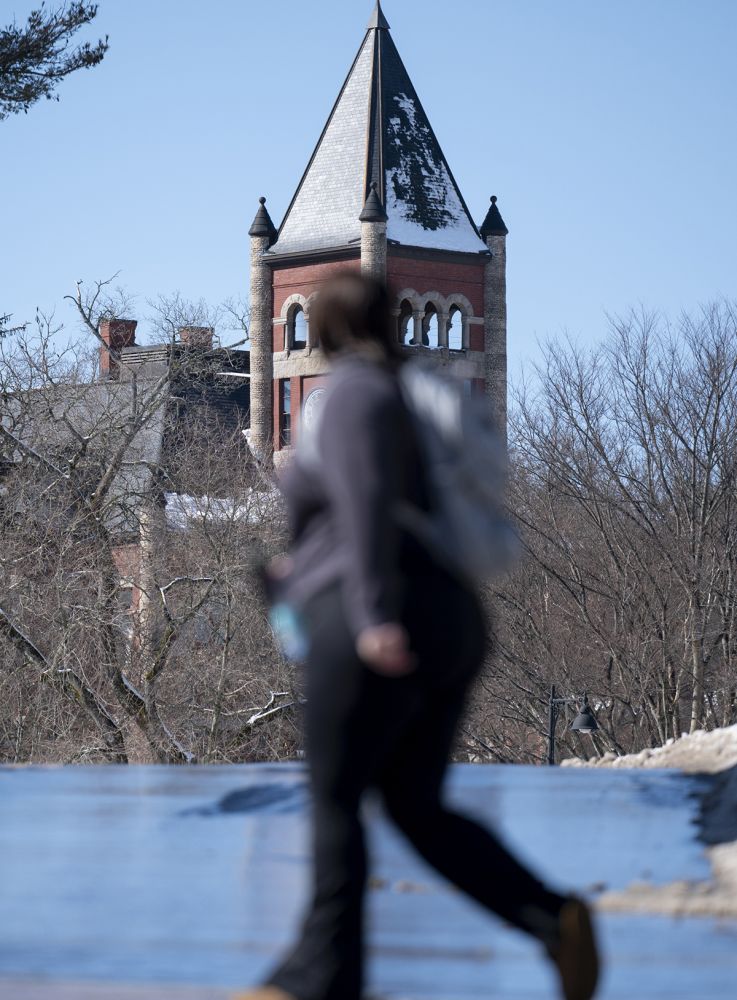
A student looks at Thompson Hall as she passes by it at the UNH Durham campus, on March 4, 2026.
Being Creative About Value
The school has had to be creative in how it competes with other schools in the region, said Kimberly DeRego, UNH’s vice provost of enrollment management. According to a 2024 UNH Destination Survey, recent graduates have an average starting salary of almost $60,000, 88% have jobs related to their major, 91% were satisfied with their education, and 75% had at least one major internship during their time at school.
“It takes a lot to make that happen for students. You can't just tell students, ‘Go find internships,’” UNH provost DeRego said. “You have to support them. You have to have people to support them. You have to have industry partnerships and things like that.”
Though the University System of New Hampshire had to deal with a state budget cut of almost $18 million for the 202 and 202-26 fiscal years, it is still pitching itself as a good option for students. But for the first time in six years, in-state tuition at the University of New Hampshire has increased, and it is expected to increase more in the next school year.
“Most of the money that the state of New Hampshire gives us, appropriates to us, goes toward reducing the cost of tuition for the residents in the state of New Hampshire,” DeRego said. “We have had to be very thoughtful and very careful about what we do when we offer tuition to students.”
In the 2019-20 school year, in-state tuition was $15,520 a year. For the 2025-26 school year, it increased 2.5%, to $15,908. The 2026-27 yearly tuition rate is expected to hit $16,304 – just over a 5 percent increase.
The school has maintained a priority for academics as it battles reduced funding.
UNH President Elizabeth Chilton “has said repeatedly she wants to protect the student experience and undergraduate student offerings,” said Tania deLuzuriaga, executive director of UNH media relations. “And so that's why you see, when these reductions happen, it's, you know, the closing of a pharmacy. It's closing the on-campus print shop. It is a consolidation of dining hall services on the weekends.”
Looking for External Help
One of the ways UNH has supplemented its funding is through external sources. In 2024, external funding hit $252 million — $42 million more than the previous year. It has doubled since 2019.
The federal government has been its largest source of funding, with the National Oceanic and Atmospheric Administration its leading agency, at $28.3 million. UNH has broken ground to construct a new Center of Excellence for Operational Ocean and Great Lakes Mapping funded by NOAA and the National Institute for Standards and Technology. It is expected to open in 2027.
The Center for Coastal Ocean Mapping at UNH, founded in 1999, provides research and development and funding to its related industry. Interactive Visualization Systems was one of the first companies to collaborate with CCOM when it moved from New Brunswick, Canada, to Portsmouth in 2003. Lindsay Gee, one of the company’s founders, said CCOM moved to New Hampshire to be closer to the major airport in Boston to connect with its American and European clients because of the funding UNH offered.
“The business would not have succeeded to the level we had without the collaboration with UNH, certainly,” Gee said.
CCOM has more than 60 industry partners, including New Hampshire-based sonar technology company Klein Marine and the French maritime robotics company Exail.
.jpg)
A sign for the University of New Hampshire on a lamppost lines a walkway at the UNH Durham campus, on March 4, 2026.
Federal Cutbacks
But last year, the Trump administration imposed widespread cuts in funding to universities like UNH. In fiscal year 2025, total federal funding for UNH was more than cut in half – to $121 million – and the number of awards reduced from 1,057 to 392.
For instance, a grant focused on marine biodiversity research was eventually cut because of a federal anti-DEI initiative that flagged certain keywords such as “diversity.”
“Universities across the nation are all experiencing delays in receiving funding, so UNH is not unique in this regard,” said Jennifer Miksis-Olds, interim vice president for research and innovation at UNH.
Miksis-Olds also said many grants that existed during the Biden administration were set to expire come the next presidential term, unless renewed. Every president has different funding priorities, with the Trump administration focusing on quantum technology, artificial intelligence and autonomy, while Biden remained passionate on topics like climate change.
But UNH tries to adapt to these changes quickly.
“A shift in federal funding priorities between the Biden and Trump administrations was expected, and the UNH research community is actively responding to the new priorities,” Miksis-Olds said.
Private Sources
Because of the uncertainty about much federal funding, UNH has turned to industry-backed funding.
Industry funding at the university is still small compared to federal funding, with the highest amount received in recent years coming in fiscal year 2023, when it received over $18 million from domestic sources and $740,000 from international companies. And while it is unclear whether the current fiscal year will outpace that total for domestic support, international funding has doubled, to $1.3 million.
While it is unclear why UNH has seen an increase in international corporation funds, it is a welcomed addition.
“I can’t pinpoint the exact reason for the increase in international corporate funding, other than the global reputation of UNH, its faculty and its students is attracting attention and partnership more widely internationally, as reflected in the growing portfolio of international awards,” Miksis-Olds said.
State budget cuts don’t directly affect external funding from agencies like NOAA, but performing the necessary research can become more difficult, with less money to hire and maintain researchers. And in turn, that can lessen the incentive for industry to stay in New Hampshire.
“It puts the ongoing research under threat, so that can impact industry,” Gee said.
Together, the state’s public universities are among the largest employers in the state. For instance, in 2024, Keene State College employed 687 people, making it the fourth-largest employer in the city, behind Cheshire Medical Center (1,531), C&S Wholesale Grocers (1,200) and the Keene School District (846). Keene Mayor Jay Kahn, who has also been interim president for the college and vice president of finance and planning, said the school has played a large part in attracting people to the city.
“That attraction has the potential of providing the workforce needed by our state that we just can't satisfy with the high school population that there is within the state,” he said. “The return on investment to higher education is enormous.”
Lessons from 2012
Gene Martin, executive director of the N.H. Fiscal Policy Institute, said current events reflect a moment in the past, when state appropriations for the University System of New Hampshire were cut nearly in half, from $100 million in 2011 to $51 million in 2012. Not only do deep budget cuts make it more difficult for USNH to maintain its operations, Martin said, but they send a difficult message to students, which reduces the pool of students coming to the Granite State.
The university system’s $100 million budget in 2011 would be equivalent to $144 million today, yet the fiscal year 2025 budget was just $95 million, and was cut 17% in the current two-year budget. But overall, Martin sees a national trend of disinvestment in public education, and one result is that going to college is increasingly expensive.
“Not only did you lose funding, but you lost students, and that created sort of a ripple effect,” Martin said. “I don't know what's happening now, but it's possible that could be happening again.”
New Hampshire’s public colleges get 68% of their revenue from student tuition; the national average is 39%. Full-time student enrollment in 2023 declined 13.6% from 2019, and as many as 56% of recent NewHampshire high-school graduates leave the state to seek their four-year degree – the second-highest percentage in the country, behind Vermont. Out-of-state tuition is expected to rise from around $37,070 a year in the 2025-26 academic year to a projected $37,996 in 2026-27.
“Over the last 20 years, we've just had demographic declines, which has led to enrollment declines at our universities, and so already we were feeling that pressure,” DeRego said.
“The real question for policymakers and residents is what underinvestment costs New Hampshire’s future economy,” Martin said in an email. "The result will sadly be higher prices, more student debt, fewer in-state students, and lost economic activity from employee reductions at a time when nearly six in ten New Hampshire high school graduates leave the state for college, and our aging workforce and economy can least afford it.”
These articles are being shared by partners in the Granite State News Collaborative. Don’t just read this. Share it with one person who doesn’t usually follow local news — that’s how we make an impact. For more information, visit collaborativenh.org.