
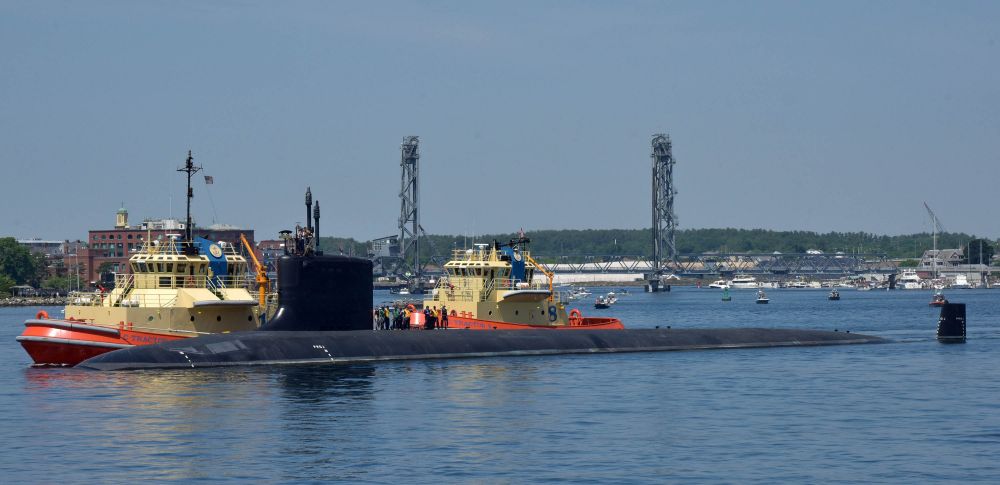
 The USS California departs for sea trials after completing a scheduled maintenance period at the
Portsmouth Naval Shipyard. (Courtesy by Jim Cleveland)
The United States Navy is spending billions of dollars on a new mission to rebuild its submarine fleet. For manufacturing companies in the Granite State, this explosion of capital has led to long-term contracts to produce parts needed for the submarine
building pipeline.
To help meet the increasing demand for skilled tradespeople in the ship building industry, community colleges in NH have entered partnerships with defense industry organizations. They’re offering training programs subsidized through grants from the U.S. Department of Defense that teach skills to become machinists and welders.
The Congressional Research Office reports that the U.S. Navy has procured 40 Virginia-class nuclear-powered attack submarines since 1998 at a rate of two per year starting in 2011. The production rate for these submarines—which cost $4.5 billion to produce—has fallen short of two boats per year since 2022. These reduced production rates, caused in part by workforce and supply chain issues, led to an industry decline. Gary Hildreth, public affairs officer for the Portsmouth Naval Shipyard, says American manufacturing and shipbuilding atrophied more than 60% since the end of the Cold War.
Portsmouth Naval Shipyard’s mission is the overhaul, repair, and modernization of the U.S. Navy’s nuclear-powered fast-attack submarines, specifically Los Angeles and Virginia-class. Typically, Hildreth says, there are three to four submarines at Portsmouth Naval Shipyard undergoing major overhauls. The shipyard employs approximately 6,800 people and looks to fill approximately 600 jobs each year.
Most people recruited to work at the shipyard come from within a 50-mile radius, Hildreth says, adding that the shipyard met its hiring goals set for FY2024 to accomplish scheduled submarine overhaul work.
“The shipyard is one amongst many employers of skilled trades, technicians, and engineers in the New England region supporting submarine work,” he says. “The demand for this type of workforce is growing throughout the region.” Helping with this growth, he says, is the Submarine Industrial Base program and the Maine Defense Industry Alliance, along with other efforts outside of Maine and NH, to fill workforce gaps.
Rebuilding the Workforce
Deloitte and The Manufacturing Institute report state that manufacturing will need up to 3.8 million jobs between 2024 and 2033, though many could go unfilled due to a lack of skilled workers.
To address this, Blue Forge Alliance launched the Build Submarines ad campaign in 2022. Blue Forge Alliance is a nonprofit organization focused on advancing maritime technology and innovation for the U.S. Navy’s Submarine Industrial Base, a network of companies and organizations that is part of the Navy Talent Pipeline.
The Alliance recently launched a marketing campaign— “Built to Last”— focused on “elevating awareness of opportunities in maritime manufacturing.” The Blue Forge Alliance says the Navy’s current goal is to add three submarines to its fleet each year beginning in 2028. This will require an estimated 140,000 skilled workers over the next decade.
Locally, community colleges are stepping up to meet current and future workforce needs. Chuck Nield, workforce training program manager at Manchester Community College (MCC), says the college has received support from SENEDIA to fully fund a welding program.
SENEDIA is a nonprofit organization that contracts with the U.S. Department of Defense and facilitates workforce training for the submarine ship building industry by funding training at NH’s community colleges.
“What we’re seeing is that there are students out there who want to be part of the mission of serving their country indirectly,” Nield says. Nine students graduated from MCC’s new welding program in August and three of them now have full-time jobs. “Two of those jobs are at Granite State Manufacturing.”
In June, RFK Racing, a NASCAR stock car racing team that competes in the NASCAR Cup Series, unveiled its ties to the Boston Red Sox and the BFA’s Build Submarine program at a NH Motor Speedway race in Loudon. BFA has also been teaming up with the Boston Red Sox to showcase career opportunities at more than 1,600 industrial base suppliers across New England. This includes promoting careers at General Dynamics Electric Boat in Groton, Connecticut, which is contracted to deliver two Virginia-class and one Columbia-class submarine per year.
Nonprofit organizations like SENEDIA play a crucial role in facilitating shipbuilding in the New England region by acting as a bridge between defense contractors, research institutions, and government agencies. SENEDIA was awarded a special contract by the U.S. Department of Defense in 2020 to facilitate the training of over 6,000 workers in submarine building.
SENEDIA’s CEO Molly Magee says the driving force behind the training initiative for skilled workers is to address a “trades and industrial skilled workforce crisis.”
“This is true for the Department of Defense and across the board,” Magee continues. “The idea that everyone should go to college is being modified now to ‘everyone should have some tech training.’ We believe in sharing knowledge and that we have the ability to pull companies together in the supply chain in New England so they can find resources, including workers.”
Community College Programs
In addition to the shipyard, NH has a bustling manufacturing sector serving government contracts.
SENEDIA provides money to schools that allow manufacturing companies and the Navy to recruit trainees on demand, Magee says. “We want to make sure we’re training people who can get out and get a job,” she says. In 2023, SENEDIA paid the $8,600 tuition for five students at Nashua Community College (NCC) as part of a pilot program. Since then, three cohorts with 10 people in each one have graduated.
Students who complete the 10-week program at NCC have been offered jobs at various NH companies that produce submarine parts, including Granite State Manufacturing in Nashua and Manchester, Mercury Systems in Hudson, Spraying Systems in Merrimack, Sweeney Metals in Nashua, and Teledyne DGO in Portsmouth.
“SENEDIA did such a great job with that program,” says Doug Thomson, CEO of Granite State Manufacturing. “We had pushed to make sure that program was done near us. One of the reasons I wanted it in my backyard is that NCC knew how to run the machining course.”
Granite State Manufacturing, which employs 170 people, creates complex pieces of equipment for submarines, says Thomson. “We do everything from machining, welding assembly, testing of cable handling systems,” he says. “Everything needs to be made perfectly.”
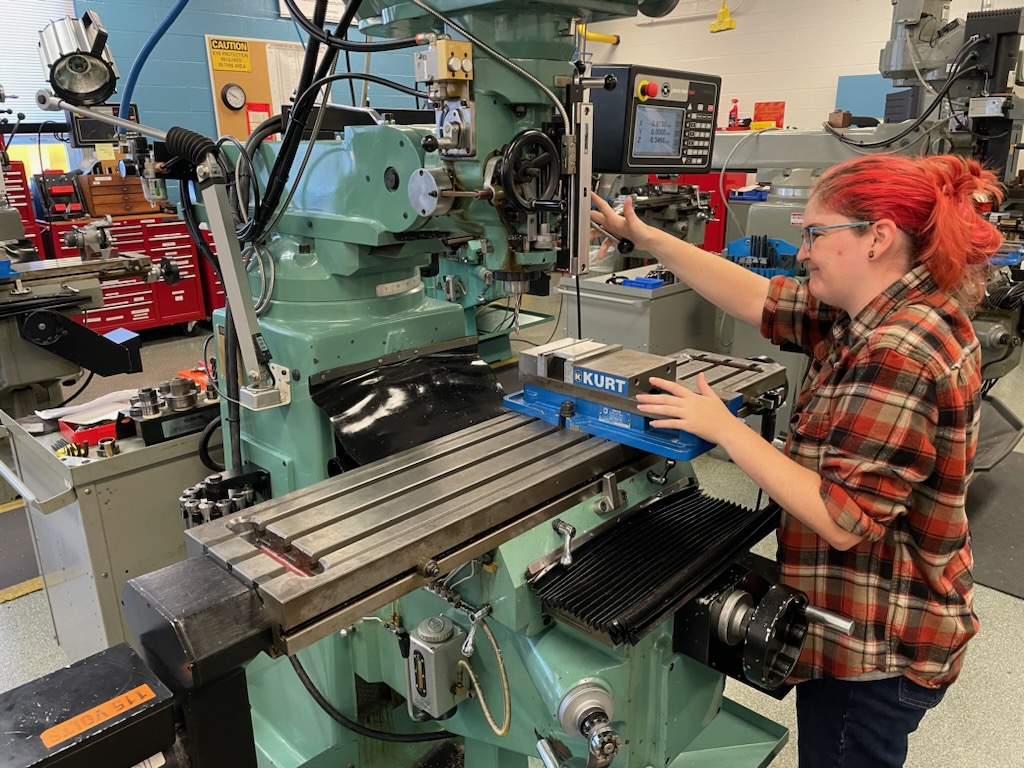
One of the technical skills NCC is teaching students is Computer Numerical Control (CNC) machining, a manufacturing process that uses computer software to control the movement of machinery and tools to shape objects. Jonathan Mason, director of workforce development at NCC, says people in the program are learning to do CNC work to make metal parts that go into the hulls of submarines.
“We’re focused on people off the street and teaching them geometric design. It comes down to how to make a good part, how the machines work, and the program also involves some blueprint reading,” Mason says. “We also teach soft skills as well. People need to learn they need to show up on time and they can’t be on their phones.”
The NCC program has a 90% graduation rate, Mason says, adding that 10 graduates are now working at Granite State Manufacturing. “This program is for anyone who has graduated high school, college, and even those who want a career change. We’ve had people in their fifties and young people from the My Turn program that offers career guidance, job training, and placement assistance for young people.”
Twelve students started at Manchester Community College’s welding program in September and Nield says he expects them all to be hired after graduating. “There are three or four real highflyers in the class right now. If they’re not hired, I’d be really surprised,” Nield says, adding that along with Electric Boat and Granite State Manufacturing, the Portsmouth Naval Shipyard also reviews student resumes and conducts interviews. “For companies in the Navy Talent Pipeline the process of providing submarine parts to Bath and the Portsmouth Naval Shipyard is crucial,” he says.
The welding program at MCC is a 15-week program involving 426 hours of training. Tuition is $18,000. “SENEDIA covers all of the cost,” Nield says, adding that this includes all protective clothing.
MCC’s welding program has also been supplied with new out-of-the-box welding machines that allow trainees to learn about the latest equipment being used. “Some of our equipment was a little outdated,” Nield says. “Now students are able to get a fresh start.”
Mason says people are taking advantage of the machinist program and finding jobs around the region, adding that the programs are changing lives. He says one of his recent students was homeless before going through the program.
“He was from Rhode Island, had lost an apartment, and needed to leave his dog behind. He eventually moved into a church in Manchester. After going through our bootcamp he’s now thriving. He was able to get his dog, and an apartment. This program is turning people around,” Mason says.
A Rising Tide
Thomson of Granite State Manufacturing, who attended SENEDIA’s Defense Innovation Days last year, says the event allowed him to have access to important people in the Submarine Industrial Base. The series of events brings together defense industry leaders, policymakers, and technology innovators and addresses critical national security challenges.
“I was standing in front of the Secretary of the Navy, Carlos Del Toro. We were all taking about workforce and even though the Secretary of the Navy isn’t going to fund Granite State Manufacturing directly, having him there to hear our needs was important,” Thomson says.
He says Granite State Manufacturing doesn’t have the hiring capacity of companies like Electric Boat but adds that working together to meet workforce demands is a key priority. Electric Boat has been discussing outsourcing more work to Granite State Manufacturing, Thomson says. “They need an additional five million labor hours a year in an industrial base that’s a third of the size from the 80s,” he says. “I need all other companies aware of these [welding and machining] programs and to hire these people. Submarines aren’t built overnight and we’re signing projection contracts into the 2030s. A rising tide lifts all ships.”
Mason says it has been inspiring for him to see people who may not have been in the right place in their lives “get out of the machining program and make $25 an hour right out of the gate.”
Nield says Nashua Community College is hoping to hire a part-time instructor for the welding program to reach more students. “There are some students who really want to take this program but need to work during the day,” he says. “We’re trying to create part-time options for people who need that, and we have a curriculum built for it.” Nield explains that while the funding coming through SENEDIA is available for training skilled laborers and additional training on machinery, finding students willing to enter manufacturing programs is an ongoing challenge. “Workforce, workforce, workforce. That is the issue,” he says. “There just aren’t enough people between the ages of 35 and 50.”