
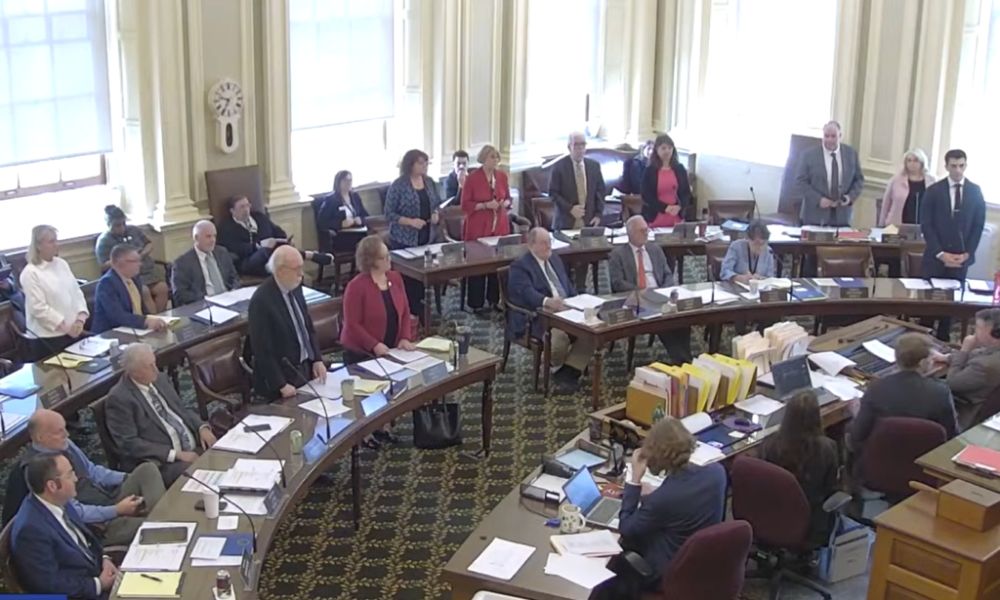
Members of the New Hampshire Senate vote on a bill during the May 14 session. The House and Senate kept alive some of the pro-housing laws passed in recent years during a session when many were up for repeal. (Photo/New Hampshire Senate YouTube screen image)
CONCORD, NH – Some of the housing supply gains achieved in recent years remain alive despite a slew of repeal-focused bills that were introduced months ago, as the New Hampshire Legislature gets close to finishing up business.
The House and Senate enter the conference committee phase of the session this week following a session in which nearly 100 housing bills were introduced, many of which sought to repeal recent gains and even some decades-old housing laws.
Recent efforts to look at space in new ways – through easing zoning restrictions or creating new types of housing – survived repeal efforts as housing advocates looked mostly to save recent gains from backsliding. This included bills that address commercial conversions to multi-family housing, accessory dwelling unit (ADU) flexibility and easing restrictions on manufactured housing.
They’re all things touted by housing advocates as ways to help ease the housing crisis, but were in danger of being repealed.
Streamlining the process for small condominium developments also got a boost, one of the few housing supply wins that didn’t involve turning around a repeal effort.
The gains – or possible gains in some cases – came during a session in which around 100 bills addressing housing were introduced. Many of those sought to repeal recent pro-housing legislation, including eliminating the Housing Champion grant program (HB 1196) and the state’s workforce housing law (HB 1619). Both of those repeal efforts, along with most of the others, didn’t make it to last week.
Thursday was the last day for the House and Senate to act on each other’s bills. Those that passed with differing versions must be hammered into identical form by June 4 before they can move to the governor’s desk. If the House and Senate don’t concur on a bill, they have until this Thursday to form a committee of conference on bills that passed with different versions, with June 4 the last day a committee of conference can meet.
Commercial-to-residential conversions
HB 1010 initially called for repeal of last year’s law that required municipalities to allow former office and retail space to be converted to residential space. The bill, though, has been amended by both the House and Senate to replace last year’s law with an amended version that gives planning boards some leeway. There has yet to be concurrence on the two amended versions.
The House amendments, boiled down, agree that:
- Municipalities may allow multi-family dwelling units on commercially zoned land subject to the planning board confirming that infrastructure is adequate.
- Planning boards may deny applications for multi-family housing on commercially zoned land under certain circumstances.
- It replaces the ability of municipalities to provide an exception for requirements when converting to multi-family housing with permitting a waiver as long as the converted housing isn’t altered to “further violate zoning dimensional requirements.”
The House bill had lengthy criteria regarding water, sewer and road infrastructure. The Senate Commerce Committee amended the bill to simplify and clarify the criteria:
“When a planning board determines adequacy, they may consider a traffic impact study or require an applicant to receive permission from an owner of a public water system to connect to the system. A planning board may deny an application if the volume of traffic is not supported by the road design; an applicant is unable to secure a source of water; or an applicant is unable to properly dispose of wastewater and sewage.”
Making condo development easier, cheaper
SB 415 increases the amount from 10 to 20 the number of units allowed in a condominium development before it must register with the Consumer Protection and Antitrust Bureau of the New Hampshire Department of Justice before the condominiums can be sold or rented.
The original Senate bill sought to raise the cap to 50, but the Senate Thursday voted to concur with the House version of the bill, which put the cap at 20. It becomes law in 60 days.
The bill streamlines the process, making it easier for developers to build condo projects by making the process quicker and less expensive. That makes it less expensive for buyers, too.
Condominiums are traditionally a lower-cost option than a single-family home for buyers, but the market in the state is small. The median sales price for a condo in New Hampshire was $400,000 in April, much less than the $560,000 MSP for a single-family home. But the amount of condos available for sale is less than half of that of single-family homes, and the tight market keeps prices elevated.
ADUs survive multiple attacks
More development of accessory dwelling units (ADUs) is considered another piece of the puzzle that will ease the housing crisis. They provide space on an already-existing property that can be used for additional family members, or anyone else who needs space to live.
Current New Hampshire law requires every municipality with a zoning ordinance to allow at least one ADU, of not more than 950 square feet, on any lot with a single-family home. The homeowner does not need to prove the occupant is related. They can be detached or attached, and municipalities also can’t limit size to less than 750 feet.
Several bills that would have made it more difficult to develop ADUs were proposed this year.
The biggie was HB 1012, which would have repealed the year-old law that requires municipalities to allow them.
The bill to repeal the ADU law died quickly in the House, with the Housing Committee voting 16-0 that it was inexpedient to legislate, and the full House agreeing with a voice vote in February.
The committee believes ADUs are one of the most effective ways to increase housing stock, and if left up to municipalities, most would not change their zoning ordinances to allow them, Rep. Michael Aron, R- South Acworth, told House members. The committee also felt that since the law is new, there hasn’t been enough time to gauge the effect.
Several other bills that would have restricted or changed the ADU law also were voted inexpedient to legislate. These including one requiring on-site parking for ADUS and repealing the law that prohibits municipalities from limiting ADUs to family members of the homeowner, and more.
Manufactured housing bruised, but not finished
A bill that would allow manufactured housing on any lot a single-family home wasn’t passed by either the House or Senate, but it may still be alive when the Legislature meets in the fall. It could have been worse for manufactured housing advocates – a bill was also introduced this session that would have repealed the state’s 43-year-old law that requires all municipalities to provide opportunities for manufactured housing development.
HB 1016 would have eliminated the 1983 law that sought to end manufactured housing discrimination, as well as its 2024 requirement that municipalities provide reasonable and realistic opportunities for siting manufactured housing in residential zones and reasonable and realistic opportunities to expand existing manufactured housing parks.
Rep. Joe Alexander, R-Goffstown, a member of the Housing Committee said, that municipalities still retain discretion on where they would allow manufactured housing, and the committee believed that, given the housing shortage, “manufactured housing is a key piece to the puzzle by providing safe, energy efficient, and affordable housing.” A House voice vote supported the committee’s 17-0 inexpedient to legislate vote.
But support of manufactured housing only went so far.
HB 1357, which would allow newly constructed manufactured homes, by right, in any zone that a single-family home is allowed “and prohibits discriminatory zoning restrictions against them,” was referred for interim study by the House. That means it will be “studied” over the summer and can be brought back in the fall.
Manufactured homes are federally regulated to be built with the same materials as stick-built homes, offsite, and transported to a lot where they are permanently installed. The average price of a manufactured home, including land purchase, is $200,000, according to Freddie Mac, less than half of the average cost of traditional housing.
Housing advocates consider them a vital part of the housing crisis solution. Yet, they still suffer the “mobile home” stigma and are subject to restrictive zoning in many New Hampshire municipalities.
HB 1357 stresses that manufactured homes are not “mobile homes” or “trailers,” but conform to the post-1976 federal regulations surrounding such homes.
“The state of New Hampshire should take a free market-based approach to housing and support more attainable homeownership options by cutting red tape and supporting common-sense laws that protect private property rights and allow individuals to place homes on their own land regardless of whether they were constructed in a factory or on site,” the bill says. “New manufactured homes are a quality, affordable, durable, and attractive option for homeownership across New Hampshire. Allowing more manufactured homes will help to alleviate the state’s housing shortage and enable more Granite Staters to achieve the American Dream of homeownership.”
The bill was supported by New Hampshire Housing Action, as well as the New Hampshire Association of Realtors.
Housing Action NH calls restriction of manufactured homes where stick-built homes are allowed “legalized discrimination.”
“Manufactured homes are a more affordable form of homeownership,” said Housing Action New Hampshire, which supports the bill. “There is no reason to treat modern manufactured homes any differently than other types of housing construction. Concerns around community character and ‘fit’ are rooted in the stigma associated with manufactured housing.”
Another bill, HB 1026, would have allowed municipalities to prohibit ADUs that are manufactured housing. The Housing Committee voted 17-0 that it was inexpedient to legislate.
Rep. Ellen Read, D- Newmarket, of the Housing Committee, said that the bill “would seek to make illegal some of the most affordable housing opportunities for those who need them most…and with no other justification heard by the committee other than stigma and aesthetics.”
Housing Champions, workforce housing survive
HB 1196, which would have repealed the three-year-old Housing Champions Grant program, was voted ought to pass in the House, but failed in the Senate after Gov. Kelly Ayotte said she didn’t want to see it eliminated.
The program, administered by the state Department of Business and Economic Affairs, has awarded $5 million in grants over two years to 11 towns and cities after they met criteria that removed barriers to housing development, including building housing, changing zoning and policy to enable more housing, or making plans to improve infrastructure.
The initial $5 million for the program came from American Rescue Plan Act money, with $1.5 million awarded for workforce housing development and $3.5 million for infrastructure improvements that support any kind of housing development.
The program was not funded in the 2025-26 FY budget, which went into effect last year, but is still administered and allocating the money granted in its first two years.
The program designates Housing Champion status to towns and cities that score enough points on a matrix of pro-housing actions, making them eligible to apply for incentive grants. Municipalities that are named Housing Champions – there are 28 now – are eligible for the grants.
HB 1619 was referred for interim study in March, which means it likely is dead.
The bill asserted “the rights of property owners and limitations on municipal land use regulation,” and also would have repealed the workforce housing “program,” deleting references to workforce housing in nine different sections of the state’s housing law. It also sought to eliminate the Housing Champions program.
The state’s main Workforce Housing Law requires municipalities to provide “reasonable and realistic opportunities” for developing workforce housing, including rental and multi-family housing.
The Housing Committee found the bill “raises complex issues involving zoning authority, housing policy, municipal responsibilities, and potential statewide impacts.”
You can reach Maureen Milliken at mmilliken@inklink.news.
These articles are being shared by partners in the Granite State News Collaborative. Don’t just read this. Share it with one person who doesn’t usually follow local news — that’s how we make an impact. For more information, visit collaborativenh.org.