
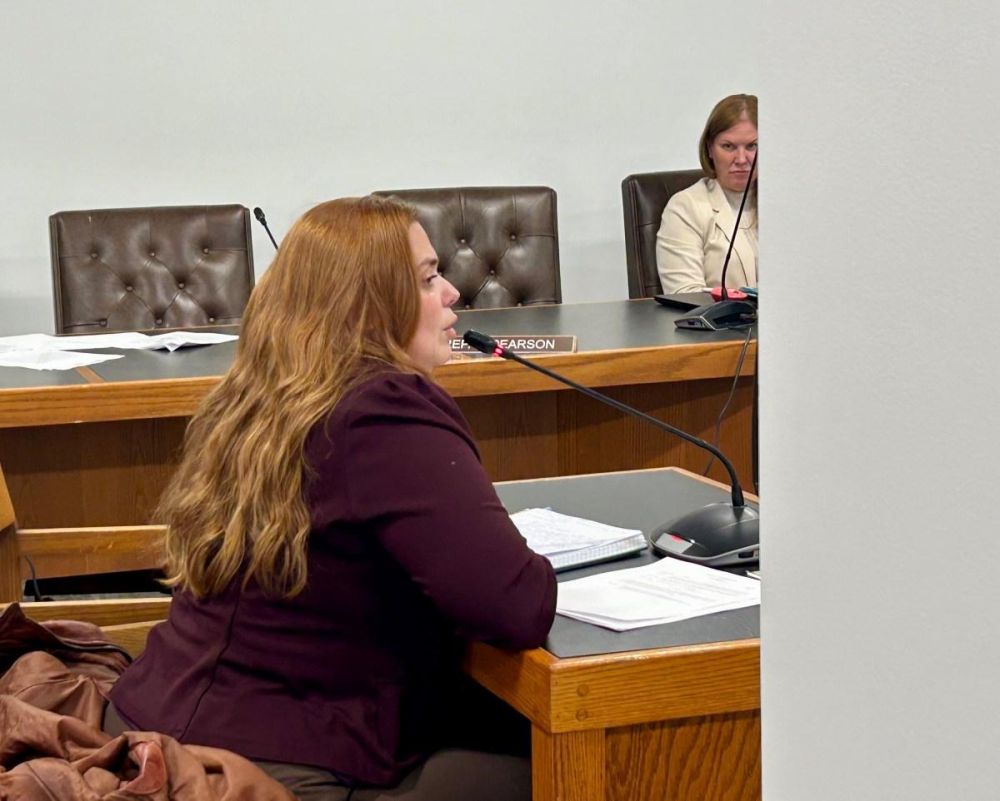
Rep. Ellen Read, a Democrat from Newmarket, said her perception of the NH Coalition Against Domestic and Sexual Violence changed after she noticed it did not support bills that she thought were no-brainers to protect survivors. (CHARLOTTE MATHERLY/Monitor)
After Ellen Read was sexually assaulted in 2022, she recalled thinking that as a state lawmaker, she could get to work to make positive change for others.
When the Newmarket Democrat took it upon herself to present legislation that would expand the information provided to survivors about their rights following an assault, she sought help from the NH Coalition Against Domestic and Sexual Violence to draft the language.
She was surprised to find that they wouldn’t help with her bill. Instead, they lobbied against it, she said during a hearing at the State House this week.
That pattern repeated, Read said, with other legislation, including some that she didn’t work on. Policy changes that she considered no-brainers, like informing survivors of their rights and letting them out of leases if needed, were opposed by the Coalition.
“At that point, it starts to look weird, right?” Read explained in an interview. “It starts to look like how you would feel if, all of a sudden, Planned Parenthood showed up and supported all the abortion restriction bills … It’s unlike any other nonprofit or advocacy group that operates here. It did not make any sense.”
Lyn Schollett, the Coalition’s executive director, said her staff lobbies the way they do because they gather input from all stakeholders: survivors, medical experts, law enforcement and prosecutors. Those professionals told the Coalition that Read’s bill was problematic, she said.
Nevertheless, Read began to talk with other legislators, who shared some of her concerns. Now, she’s pushing for an investigation.
“When things look weird, there’s that sage old advice,” Read said. “Follow the money.”
The Coalition, based in Concord, helps to train police and nurses on how to handle sexual assault and domestic violence cases, as well as advocating and coordinating services for survivors. It passes funds to 12 crisis centers throughout the state, which help victims safely identify and pursue their options. The organization held $12.4 million in grant revenue as of mid-2025, according to an audit, and 98% of its funding comes from the federal and state government.
Read has proposed legislation, supported by a bipartisan faction of lawmakers, that would form a panel to investigate the Coalition. She and others argued that a nonprofit sustained almost entirely by government grants, providing public services, should be subject to greater accountability.
The Coalition, on the other hand, stressed its compliance with existing audit structures for nonprofits. Its supporters warned that restricting funding, as Read’s bill does, would lead to a disruption in vital services for victims of domestic and sexual abuse.
More directly, they see the bill as a targeted attack meant to maim their organization.
Claims about the Coalition
The text of Read’s bill is similar to allegations made by Claire Best, a California resident who owns property in New Hampshire. Best has spent years accusing the Concord-based Coalition of improper lobbying practices, collecting “kickback” payments from victim settlements and other wrongdoing. The Coalition vehemently denies those claims.
In four hours of testimony, several members of the public reflected Best’s allegations. The Coalition considers the campaign to be a form of harassment. They previously sent cease-and-desist orders to Best, which resulted in the removal of some social media posts. They haven’t pursued further legal action.
Best said at the hearing that she has reported her concerns to the City of Concord, the state and federal law enforcement agencies with little response. She said she continues to make these statements and supports Read’s bill because “sunlight is always the best solution to doubt.”
Schollett branded the bill as an extension of Best’s “personal vendetta” toward the Coalition — an attempt not just to curtail its work but to threaten its very existence.
Calls for oversight
Over the years, the Coalition has absorbed most of the survivor services functions in New Hampshire — operations that Read believes should be conducted by the Department of Justice. Read told lawmakers that survivors have few places to turn in the state without being directed to the organization or its subsidiaries.
That, she said, is deserving of greater oversight.
“I don’t know, but it looks like we have an agency of the state that gets to behave with all the power and the funding and the auspices of a government agency, but then gets to hide behind this opaque, private-nonprofit ‘We don’t have to tell you anything,’” Read said.
Schollett stressed at the public hearing that the Coalition is in good standing with the Charitable Trusts Unit at the state’s Department of Justice, which is charged with overseeing public funding used by nonprofits, and has had clean audits for 25 years.
“The Coalition fully supports oversight and public accountability for nonprofits, including our own,” Schollett told lawmakers. “House Bill 1675 does not advance oversight. Instead, it seeks to upend an already well-established system for overseeing the finances and the grant work of nonprofit organizations.”
Government agencies, however, are held to additional transparency and public records laws that nonprofits aren’t. Read said she’s prepared an amendment to her bill that would force the Coalition to abide by New Hampshire’s Right-to-Know Law, RSA 91-A.
Based on its findings, an appointed commission could recommend assigning a special investigator, but the full Legislature would have to agree. The investigator would then look into matters more closely.
In the meantime, the bill calls for the Coalition’s funding to be restricted only to things that “materially benefit survivors of sexual and domestic assault, such as for shelter, food, or medicine,” according to the bill. Supporters warned that it could strip funding for police and nurse training programs, coordination between the 12 crisis centers and other operations, depending on how lawmakers define material support.
Leah Cushman, a former state representative from Weare who’s a domestic violence survivor, said part of the problem is that the Coalition has a “monopoly” on the system of support, making independent oversight difficult. She also repeated some of Best’s claims, saying she’s been concerned about the Coalition’s actions in court cases surrounding widespread sexual abuse at New Hampshire’s former Youth Detention Center.
“Pausing funding, I think, is legit,” Cushman said. “When there’s an allegation against an employee, say in a municipal body or in a school, that person gets put on leave, paid or unpaid.”
Rep. Alicia Gregg, a Democrat from Nashua, disagreed.
“I have a hard time thinking that this is a good-faith bill when it takes away funding before an investigation is done,” Gregg said. “I think that’s irresponsible.”
The impact
In addition to funding uncertainty, the bill would also remove Coalition representatives from state boards and committees, such as those that review the deaths of children and domestic violence victims.
“We are asked to sit on those committees and those commissions to bring the voices and experiences of victims directly to policymakers so that the state can collaboratively craft responses,” Schollett told lawmakers. “What this bill ultimately does is it undermines trust in those organizations that victims need to come to for help, and it will chill the advocacy that we are able to provide to vulnerable people.”
Read said she believes many of the services provided by the Coalition should be housed at the Department of Justice. Schollett, however, said there’s an important distinction between the state’s work and the Coalition’s.
The government advocates that help survivors navigate interactions with police and prosecutors are necessary, Schollett said in an interview, but information shared with them is also shared with police. Community advocates, like those at the Coalition’s crisis centers, can keep that confidential.
“When a victim walks in the door of a crisis center, they are given that protection,” Schollett said. “Advocates are there to help victims identify the options in front of them, to weigh them and to support the decision of the victim going forward.”
Schollett also argued that the Legislature is not the proper venue for an investigation of the allegations laid out in the bill.
Read countered that because the state Department of Justice has outsourced these functions to a nonprofit, it is lawmakers’ job to oversee it, just as they would any other state agency.
“It’s our duty to oversee anything in the executive branch,” Read said. “We create departments, we fund departments, we tell departments what they have to do … How the DOJ is accomplishing its goals by using a nonprofit is directly under our duty.”
What’s next: The House Executive Departments & Administration Committee did not immediately take action on HB 1675. In the coming weeks, the committee will make a recommendation on the bill, which then heads to a vote by the full House of Representatives.
These articles are being shared by partners in the Granite State News Collaborative. Don’t just read this. Share it with one person who doesn’t usually follow local news — that’s how we make an impact. For more information, visit collaborativenh.org.