
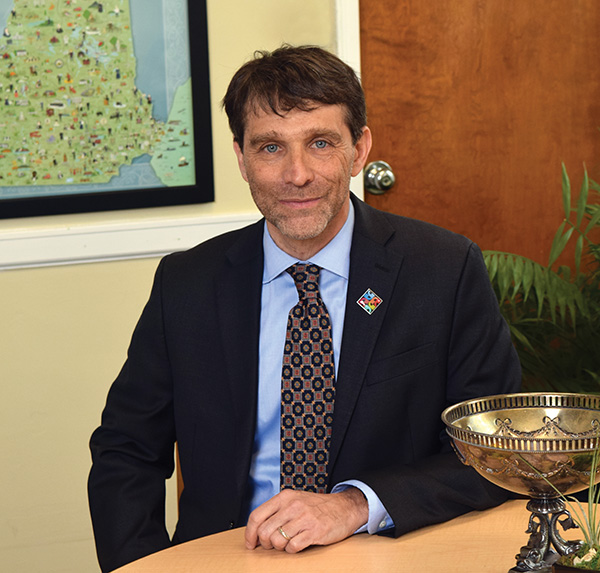
Michael Haley Goldman devoted the past few years to preserving the stories of Holocaust survivors at the U.S. Holocaust Memorial Museum in Washington, DC. He most recently served as the museum’s director of future projects, establishing a digital innovation laboratory team and exploring how to use emerging technologies, such as using virtual reality, augmented reality and 360° video, to further education on the Holocaust.
Now Haley Goldman is bringing that expertise to NH after being named executive director of NH Humanities this past September. He says his goal is to increase innovative public humanities programs in NH and make them accessible to
diverse audiences.
Haley Goldman did not envision a life devoted to the humanities when growing up in a small town in North Carolina. After graduating from college, he began working for the Red Cross. Then a visit to the Holocaust Museum with his future wife, who studied how public places affect people’s lives and who is now a museum consultant, changed the course of his life.
“Going to the Holocaust Museum changed how I thought you could approach tragic history in a way that was not sensationalistic or traumatic in itself,” he says, adding he ultimately landed a job there. He began exploring how technology could be used to tell the stories of Holocaust survivors and served as the museum’s director of the Benjamin and Vladka Meed Registry of Holocaust Survivors and later served as director of global classroom and evaluation.
His passion quickly became using technology to depict history through the people who lived it. “For me it was about immersing you into a space. It gave people an experience and an ability to ask questions in different ways,” Haley Goldman says. His team also used augmented reality to bring out the “humanness of those people.”
He says history informs us about what we are experiencing in the world today. “There are always serious stakes with what is going on around us. We don’t know where it’s going. That’s an incredibly important part of why understanding these histories of genocide and extreme actions is really important,” Haley Goldman says.
The humanities are also important for a broader understanding of the world around us and our response to it, he says. “I am really interested in the way these conversations can have an impact on communities,” Haley Goldman says. “The humanities are all about bringing us together and bridging the human experience. It’s how you understand people who are not you.”
And while the pandemic forced people to embrace technology in new ways to stay connected, there is a “real hunger for people to connect and reconnect in a deeper way,” he says, noting NH Humanities will continue exploring how to build deeper connections through in-person and virtual experiences.
“When people are able to gather in person it is clear there is something they have been missing,” he says. “They can build bridges with the people in the room.”