
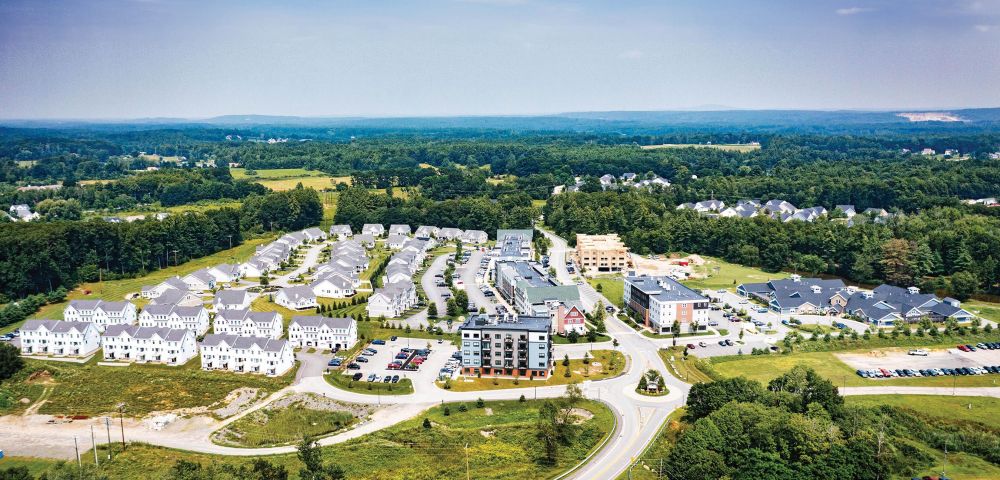
 Pointe Place, a mixed use property in Dover (Photo Courtesy of The City of Dover)
Tour any historic city and you’ll see land being used in many ways all at once—a storefront or professional office facing the street, an apartment upstairs, and maybe a workshop in the back. Modern zoning sought to bring order to this chaos, prescribing what parts of town were best suited for each individual purpose. But it didn’t work.
That’s why mixed-use developments are now trending. These projects buck the vision laid out in zoning maps, instead creating properties where people can live, work, shop, play, and access services.
A Question of Balance
Dover, the state’s oldest city, is also one where planners have long embraced the practices of their original settlers. Donna Benton, Dover’s planning and community development director, says mixed-use is back in favor.
“This is certainly an older style of development and can be seen worldwide,” Benton says. “In the U.S. this has become less prevalent as single-use zoning gained popularity post-World War II.” Since 2010, Dover has incentivized mixed-use projects in its central business district, which Benton says has enhanced the walkability, connectivity and affordability of those neighborhoods. “Furthermore, it tends to enhance density, which means there is a better return on the investment for the private property owner,” she says.
Mixed-use projects are not without challenges, though. Buildings that provide for multiple uses can be more expensive to build, as they must satisfy code requirements for each use. It can also be harder for the developer to sell lenders on the idea of a more complicated project.
For a project to succeed, Benton says it’s important to pay attention to the details. She urges developers to seek input from municipal departments early to avoid wasting time and money on a plan that will need changing later. She says it’s also important for builders to clearly understand the intended uses of spaces. If it’s a restaurant, then grease traps will be necessary. And offices will need conduit for electrical or ethernet wiring run throughout.
When it works, mixed-use developments create communities that are more accessible, affordable, sustainable and culturally and economically vibrant, Benton says. Even so, “each community in general needs to seek a balance.” There will continue to be demand for single-family residences and single-use zones such as industrial parks. “I think having that balance is the key.”
.jpg)
A plan for a mixed-use development in Bedford by The Anagnost Companies (Plans Courtesy of Anagnost Companies)
Market Optimization
It can take years for a large project to come to fruition, from the time it’s first planned until the last unit is leased. Ari Pollack, an attorney with the Concord firm Gallagher, Callahan & Gartrell, has helped with about a dozen mixed-use projects. One thing that draws developers to them is that they can hedge their bets.
“Mixed-use development offers a compromise to better ensure the developer hits the market while it is hot,” Pollack says. The highest demand is currently in housing, but that will someday change, and then the commercial aspects of the project will shine.
“Also, the commercial pieces help mitigate the demands of a development on municipal services,” Pollack says. Building more residential units typically results in a greater need for services, such as police, fire and schools, and that cost can be mitigated by the additional tax revenue generated from commercial properties.
Despite these advantages, such projects often start the permitting process at a disadvantage.
“Traditional zoning separated uses and did not allow for multiple uses to complement one another,” Pollack says. Developers can seek a special exception from the local zoning board, but that outcome isn’t a guarantee, even if it seems to make the most sense.
Developer Dick Anagnost, who has built projects from Manchester to Berlin, has seen how successful such developments can be. One example is in Bedford, where his company was involved in a project that resulted in the Copper Door restaurant, a state liquor store, a bank, senior housing, apartments, office space and clean manufacturing.
He’s currently working with Prime Developers Ken and Grace Solinsky on a project in Londonderry, where a manufacturer is hoping to create a production facility and a village for its workforce. The design includes more than 400 apartments, a child care facility and plenty of retail space to provide for the daily needs of the residents. People will be able to live where they work, which will mean less traffic and congestion in town, and the residents of the development will be able to spend more time with their families and less time sitting in their cars,
he says.
It might be a sensible plan, but it didn’t make sense within the context of the local zoning rules. To move forward, the developer had to purchase more land to get above the 110-acre threshold required to develop their own master plan, which can diverge from the zoning requirements. It was unfortunate that such a step was necessary, Anagnost says, but it was the only way to achieve the kind of development his partner wanted.
“Zoning, respectfully, is way behind the times,” he says, adding it’s made more challenging by the fact that each town has their own version of zoning, and zoning is governed by a board of citizen volunteers. Some, like Dover, explicitly welcome mixed-use developments, while others like Londonderry at least allow for it in some circumstances. “Each time you go into a different jurisdiction it’s completely different and you get different reactions,” Anagnost says. “Some towns don’t want any development at all.”
Making Mixed-Use Work
Dan Scanlon, a senior associate at Colliers in Manchester, has been involved in real estate in NH since 1980. He says what makes mixed-use developments most effective is when complementing tenants move in near one another.
“The key of these things is the synergy you can get among the tenants,” Scanlon says. “People are attracted to live there because there are amenities nearby, and retailers are attracted because there are people living there.”
Simply being mixed-use doesn’t guarantee success, though. Scanlon advises prospective commercial tenants to evaluate the specifics of a development before moving in. For example, if it’s a large project, they should understand how long the construction phase will last and what other tenants will be moving in next door as a non-compete clause could be wise.
Traffic count is another important consideration, he says. Are there enough prospective customers living within the development, or will the business require additional customers from the broader community?
If so, make sure the road used to access the development is already in use and connects easily with other parts of the town or city. Is there enough parking to accommodate the additional traffic needed? Will that additional traffic be driven by an anchor tenant, such as a grocery store or large medical office.
“Understand what it is about the project that draws them there,” Scanlon says, and ask what would happen if that anchor tenant were to leave. If his client is a smaller retailer who depends on the existence of the anchor to succeed, he would negotiate a lease that allows his tenant to leave if the grocery store closes.
Scanlon sees mixed-use as less of a fad, and more of a sign of things to come,
especially as planners and developers consider ways to repurpose retail-only shopping malls.
“I think these kinds of projects are going to continue,” Scanlon says. “We’re just going to see more. There’s always change taking place. I remember when big box stores started to close, people said, ‘what’s going to come next?’ There’s always something that comes along to replace what came before.”