
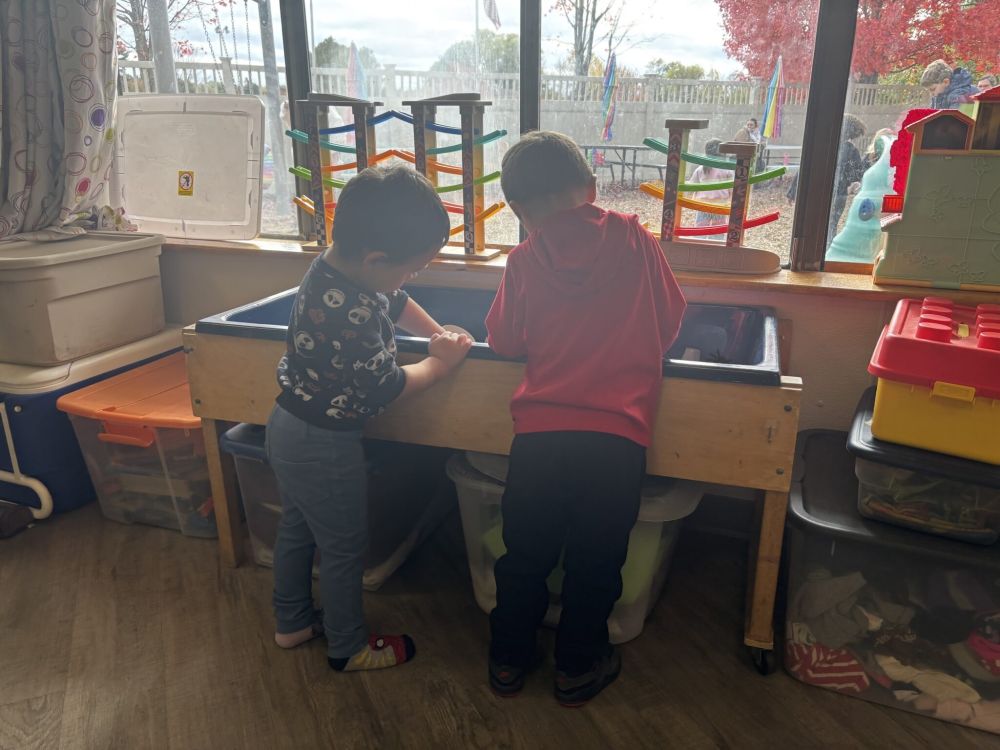
Toddlers play at The Growing Years Early Childhood Center in Manchester. (Photo by Maya Mitchell/New Hampshire Bulletin)
Jen Legere, owner and director of A Place to Grow, hangs staff credentials on the walls of her child care centers. Being known for having a quality early childhood program, she said, shows families her program is worth sending their children to.
“It is super important to us from a marketing perspective,” she said. “When we’re talking about the quality of our schools, 100% it is important to our families.”
One way for child care programs in New Hampshire to invest in quality is through the Granite Steps for Quality, or GSQ, system. The joint federal-state program ensures early education programs maintain quality and operate above the state’s minimum standards, and, as a result, provides educators with support measures, including training and coaching, as well as quarterly and annual funding.
GSQ is New Hampshire’s version of the national Quality Recognition and Improvement System. According to the National Association for the Education of Young Children, defining and measuring quality is important because it ensures educators “are addressing the essential building blocks of a well-financed, high-quality early childhood education system.”
For providers like Legere, whose early childhood education business operates in Brentwood, Salem, Durham, and Wingate, North Carolina, GSQ’s incentives and support are beneficial. It helps to subsidize the cost of running a child care business — which is already high — while motivating her staff to improve. She said she gets between $8,000 and $10,000 a year for being in the program.
Oftentimes, joining GSQ allows early education programs to receive incentives for work they would be doing anyway as a licensed child care program with credentialed staff. The benefit to participating in Granite Steps for Quality is that providers receive extra support in addition to some stimulus funding.
However, the disadvantages are starting to prevail. Maintaining a high-quality program at GSQ standards is expensive and the Bureau of Child Development and Head Start is becoming more rigid in paying out to providers. Communication between the two groups is starting to dissolve. The bureau also changed how employees are classified in the system, making it even more confusing for busy program directors to navigate.
“It’s really a system designed for failure, for sinking child care centers that are already struggling and on the margins,” Legere said. “This is broken. We need to fix it.”
And it’s not easy to leave. The impact of no longer being in Granite Steps for Quality would be a 3% tuition increase for parents, Legere said.
A Place to Grow uses GSQ incentive dollars to fund employee benefits such as telehealth, mental health care, retirement, reduced tuition for children of providers, roadside assistance, and more. GSQ funds are budgeted, so the money has to come from somewhere else.
The child care industry already exists on thin margins. Program tuition is expensive for most families, and programs do not want to raise rates for fear of pricing families out. According to the New Hampshire Fiscal Policy Institute, the recent data shows the average annual price for an infant in center-based child care was $17,250, and the average price for both an infant and a 4-year-old was $31,868 in 2023.
Providers need money to retain their employees, who are leaving the industry due to low wages, few benefits, and burnout. A 17% turnover in child care employees was anticipated between 2023 and 2025, according to the Fiscal Policy Institute.
Programs often look to the few child care subsidies available in New Hampshire to help balance their budgets and retain their staff. With that in jeopardy, businesses will pull out of the system and have to raise tuition— a solution that helps no one.
Invoice issues? No payout.
According to the Department of Health and Human Services, 142 early education programs were a part of GSQ in fiscal year 2024-2025, which is about 19.8% of 717 licensed child care programs in New Hampshire as of December 2024. The department said it awarded over $1 million in quarterly incentives.
Programs can receive between $2,400 and $5,700 per quarter in incentives, depending on the program type and size. The money is authorized for personnel costs such as benefits and employee incentives, implementing state standards and credentialing, purchasing classroom materials, conducting staff and child mental health checks, and more.
Recently, providers have reported that the Department of Health and Human Services and the Bureau of Child Development and Head Start are no longer accepting late GSQ invoices, resulting in programs not being paid despite having completed the work.
Legere said she submitted her invoice after the deadline earlier this year. Health and Human Services told her they would not be paying her, a change from past times when she had submitted late paperwork. She said not getting paid for the work she and her employees did was frustrating, and she was willing to let the loss go until she found out she was not alone.
“If it was just me, I would be much more likely to suck it up, like ‘I’m a s—y bookkeeper.’ But like, when there’s so few of us participating in the system … that’s a system problem,” Legere said.
Kitty Larochelle, executive director of The Growing Years Center in Manchester, said that when she had not received payment from the department, she was told it was “too late,” even though she had sent the invoice on time.
“We never get any kind of confirmation that we’ve submitted anything, and we never get any receipt,” she said. In the past, Larochelle said she had issues with New Hampshire Connections, the website where providers submit invoices, so she was not surprised by the problems. She was, however, surprised she wasn’t paid.
“I have no proof. I didn’t do a screenshot of when I imported it into New Hampshire Connections,” she said.
Larochelle said that GSQ funding is a way for child care programs to get a few extra dollars “when pennies are tough,” especially now when funding for child care employee recruitment and retention is in limbo.
At a Child Care Advisory Meeting held on Dec. 11, Jotham Spreeman, director of operations at the Bureau of Child Development, said Health and Human Services would not be paying out late invoices from previous quarters.
The department’s policy surrounding late payments is not concrete. The current GSQ handbook, last modified on Oct. 5, states that “incentives funding may be denied or paused” if an invoice is not submitted on time. Providers have pointed to the “may” in the sentence, believing that it leaves wiggle room on the rule.
Health and Human Services did not respond to questions about why they would not pay providers if their paperwork was late but they had completed the work.
“I want my f—g money,” Legere said. “Why is there no transparency about it? We did the work. Why can we not get paid in a more fluid and easy fashion?”
Measurement and communication issues
To be part of Granite Steps for Quality, programs must meet specific criteria and benchmarks, including credentialing and training their staff, administrators, and directors beyond what is already required of licensed child care programs. Increasing the percentage of a program’s credentialed staff allows it to move onto the next “step” of GSQ, giving programs more access to funding and resources.
One major problem providers are struggling with is inconsistency in how the state represents staff qualifications. Across the three main qualification systems — state child care licensing, which is required for entry into GSQ; credentialing, the term used for training under New Hampshire’s Early Childhood Professional Development System; and GSQ — an educator can fall under three different qualifications.
For example, under licensing, a “lead teacher” is someone with a high school degree, 18 industry-related college credits, and a minimum of 1,000 hours of work in a licensed program. Under credentialing and GSQ, the title and qualifications for someone who meets the criteria differ.
“You’ve already been through all these inspections, you’ve already proved yourself to be licensed. It should be front-door access,” Larochelle said.
Dealing with this is an administrative burden for program directors. In Larochelle’s eyes, it is a result of child care providers not being included enough in conversations about issues that involve them.
“Systems have been built for us without a whole lot of input from those of us who actually use these systems. So ideally, I would love to see the systems have some communication when it comes to licensing.”
The department said it worked with child care providers, advocates, higher education systems, educators, and the legislatively enacted Child Care Advisory Committee on the changes implemented in 2022. They did not respond to questions about qualification redundancies and differences.
Legere is skeptical of provider input. She is confident providers would have pointed this out if asked.
“I don’t think they realized what they did when they did this,” she said. “They thought they were helping, but it actually hurts mathematically.”
Programs have to reapply for GSQ every three years, and in working on her application, Legere realized that under the 2022 changes, she wouldn’t be eligible for GSQ at all.
“I’ve been at Step Two for three years. Really ready to move into Step Three. But the way that those new changes have happened, I don’t even qualify for Step One anymore,” she said. “I have the most qualified staff I’ve ever had in my life at our schools. But the way this math works makes it look like I’m the worst I’ve ever been.”
Overall, providers have complained about the lack of communication from the department and the bureau. Complaints include no reminders about deadlines or memos about program and form changes.
“There’s a disregard for the complexities of the lives of us as business owners in this industry,” Legere said. “Do you know how many socks and shows and children and parents and grandparents (I manage) in a day? Like, general courtesy, send me a reminder.”
Larochelle said that when problems arise for her, it is difficult to determine who at the department or bureau is the best person to contact. When she reaches someone, responses are not timely.
“We do not have a directory,” Larochelle said. “We don’t know who to contact. We don’t know who we’re actually in communication with. It’s rare for an email to be signed.”
The Department of Health and Human Services did not respond to allegations of lack of communication and slow response to early education providers.
This story was originally publishd by New Hampshire Bulletin and is being reorinted here under Creative Commons license CC BY-NC-ND 4.0. Click here to visit NH Bulletin and view their other stories.