
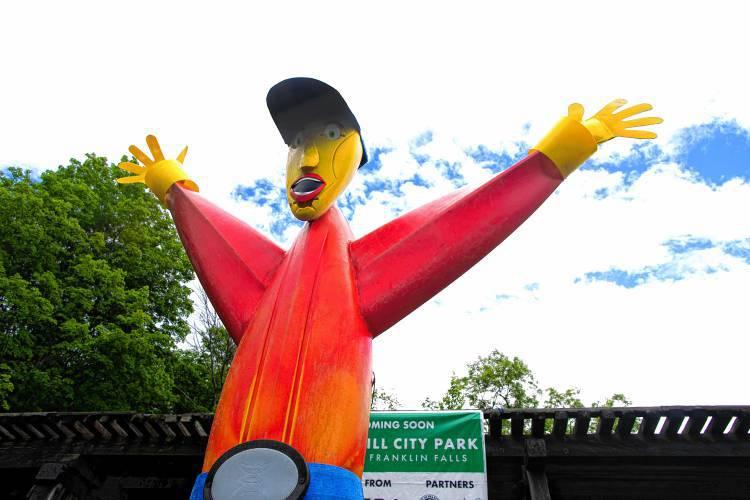
The unveiling of "Kayak Man," an art installation by local Colby Morrill happened on June 21, 2019, near the trestle in downtown Franklin. Kayak Man is a more than 20-foot tall man made entirely out of recycled kayaks. (GEOFF FORESTER photos/Monitor staff)
Franklin’s most controversial resident welcomes visitors with a smile.
Kayak Man, a 22-foot-tall art installation, has come to represent his city in more ways than one. His body, constructed from seven colorful boats, highlights a budding recreation industry. His perch, tucked between Main Street and the Winnipesaukee River, overlooks two epicenters of history.
And his existence — like so much else in Franklin — cannot escape debate.
“It looks like small potatoes to anyone outside, but I will tell you that it is symbolic to the revitalization and rebranding of Franklin,” resident Bob Lucas said in an April city council meeting. “There are people in this town who want to stomp on that any way they can, any way they see fit.”
Over the past decade, New Hampshire’s smallest city has embarked on a transformation that proved more divisive than a rock in the Winnipesaukee River. Young businesses — including a nonprofit whitewater park — attempted to infuse life back into a stagnant economy. Longtime residents — weary of ever-increasing taxes — wanted to make sure they weren’t footing the bill.
Kayak Man became an unwitting city mascot in the midst of this change. Ever since his unveiling in 2019, he has watched Franklin attempt to balance its old-mill-town identity with economic progress.
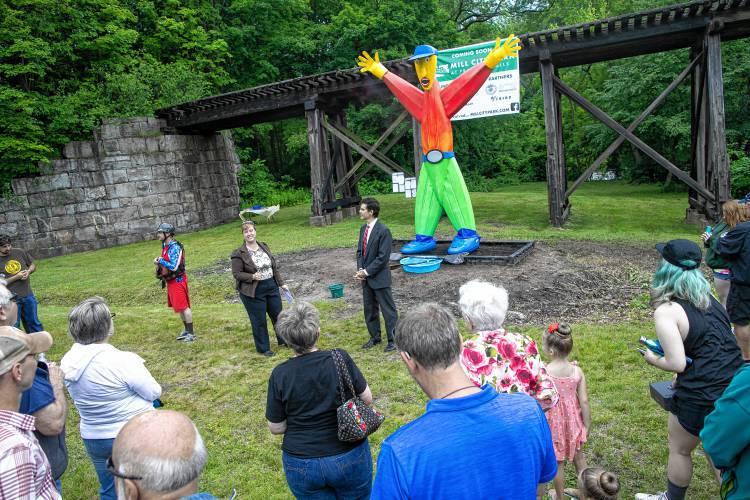
The unveiling of “Kayak Man,” an art installation by local artist Colby Morrill happened on June 21, 2019, near the trestle in downtown Franklin. Kayak Man is a more than 20-foot tall man made entirely of recycled kayaks. (Monitor file)
‘Trash, originally’
Colby Morrill, the artist behind Kayak Man, submitted his statue proposal to former City Manager Judie Milner’s contest on a whim. He didn’t expect to win, much less spend the next two months learning how to weld plastic in his grandmother’s garage.
Morrill and Franklin have a rich history together. The 44-year-old grew up fishing in the city’s three rivers and stargazing with his friends on the tiny ski hill. He made two of the city’s four welcome signs as part of his Eagle Scout project.
After leaving town for 15 years to travel and spend time on the west coast, Morrill returned to find a cleaner river — ideal for kayaking — and blossoming community spaces. An artist at heart, he designed a metal sunflower sculpture for Marceau Park and painted murals on back windows of the Grevior Furniture building.
He wanted to honor the whitewater spirit that had infused itself into the city, and Milner’s contest sprang up at the same time that concept crystallized. After winning $100 for the project with his sketch, Morrill drove from Massachusetts to Maine and northern Vermont to pick up boats he found on local whitewater pages.
It took about two months to complete construction on Kayak Man, with Morrill’s dad and brother often stopping by to offer opinions on the statue’s nose, arm and hands. Franklin donated the concrete, metal rods and four-inch steel pipes required for his perch. The statue’s unveiling took place in June 2019 at the annual Winnipesaukee River Days festival.
City residents had immediate reactions, much to Morrill’s amusement.
“Art is something that’s supposed to elicit emotion, so that initial emotion was all across the board, for everybody,” Morrill said. “Some seemed very enthused. Others were kind of wary.”
To several viewers, Kayak Man assumed the role of a joyful city guardian. Another group thought his recycled-material body and location in front of the historic trestle bridge looked tacky.
“It does hurt a little bit sometimes, when you try your best to do something and people are like ‘that’s trash,’” Morrill said. “But it is trash, originally.”
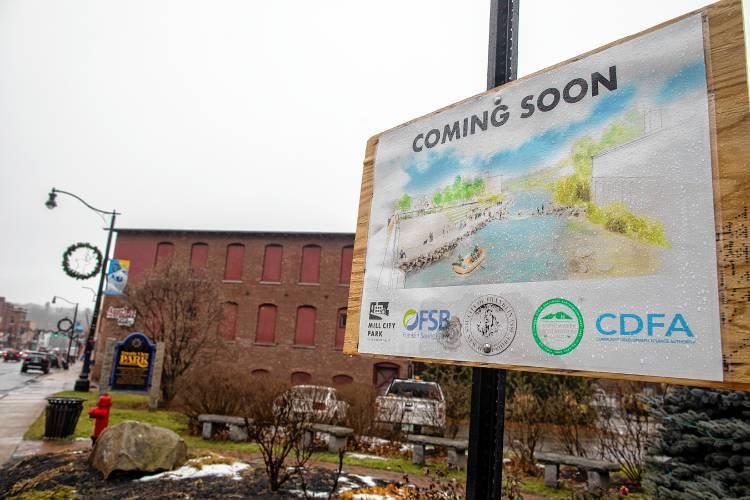
A sign showing the graphic of what the Mill City Park at Franklin Falls project will look like near dowtown Franklin.
Franklin’s kids fell in love with the statue. They helped Morrill come up with ideas for a rotating cast of costumes, from a Santa Claus hat to sunglasses to a fireman’s helmet. Main Street visitors began spotting new looks on their daily commute.
“I think he represents welcoming people to the community for outdoor recreation,” Morrill said. “People, when they drive by, always look. It brings a little light to their day.”
When he found out that Kayak Man’s presence had been debated at an April 7th city council meeting — not from city councilors or the mayor, but a friend’s text — Morrill felt blindsided. The statue’s meaning had taken a detour. Arguments over its location and design grew multi-layered and metaphorical.
“I have never hidden the fact that Kayak Man isn’t to my personal artistic preference,” resident Michael Lombardo said at the meeting. “However, I do absolutely respect and appreciate what Kayak Man has come to represent for many members of the community.”
Several attendees spoke at the podium that night and at subsequent meetings about the importance of the statue. Others chastised the council for spending time on the matter at all. Still more sent messages to their city councilor lobbying for relocation. At the April meeting, Mayor Desiree McLaughlin said she received 13 messages in favor of removal.
“The area of the Trestle Park honors our history of mills and our rivers,” resident Kathy Fuller wrote. “Many photographers used to use the trestle or the river and the stone wall background for pictures, and no longer can with Kayak Man in the picture…It’s time for a change.”
Petitions circled through the city to keep the statue in front of Trestle Bridge. McLaughlin proposed his relocation to Mill City Park, but neither Marty Parichand, the visionary behind the whitewater attraction, nor Morrill were contacted with the idea. The issue remained unresolved.
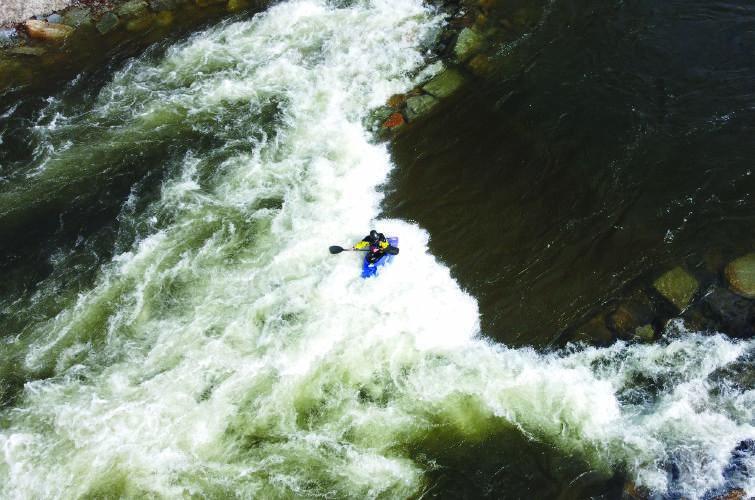
Marty Parichand demonstrates paddling through the whitewater at Mill City Park in downtown Franklin. (Jon Decker)
“I think the whole damn thing is petty,” Bob Lucas told councilors at the April meeting.
Lombardo had another outlook.
“They’re sort of trying to change the subject with these medial, meaningless, pointless topics, when what we really should be talking about is how the city doesn’t really bring in enough money to even run anymore,” he said.
White water
Parichand moved to Franklin four months before Kayak Man appeared in front of Trestle Bridge. He and Todd Workman of PermaCityLife wanted to use the Winnipesaukee River as a centerpiece to revitalize the city.
The shallow, swift-moving water that enabled Franklin to prosper as a mill town held similar potential for a whitewater park. Thirteen acres of river-adjacent land offered space to host experienced adventurers, tourists and new businesses alike.
Mill City Park, Parichand’s newly established non-profit, bought and donated that land to the city, along with an additional 18 acres for conservation. The organization called for volunteers to dig out thousands of trash bags, remove piles of scrap metal and eliminate 22 varieties of invasive species from the former dumping site. Then, with approval, heavy machinery carefully placed concrete blocks into the river to create a standing wave, a signature feature of the park.
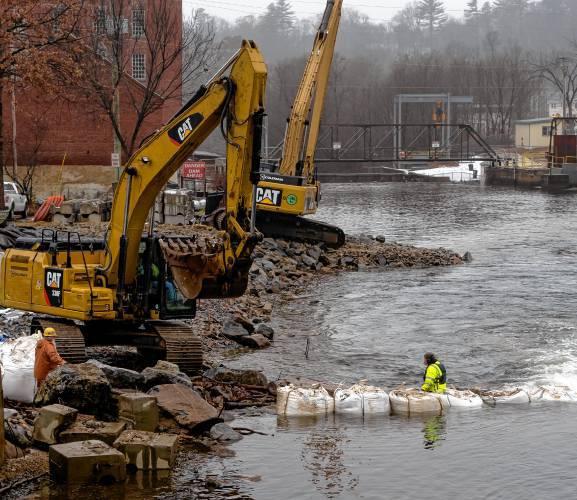
Two workers guide an excavator operator over the last portion of the concrete, rebar and stone boxes part of the 10-feet wide and 8-feet tall area in the Winnipesaukee River for the Mill City Park at Franklin Falls rafting area in downtown Franklin on Monday, December 6, 2021. (GEOFF FORESTER)
Reactions from townspeople initially leaned positive, but they grew leery of any public money being used for the project.
“People wanted to see downtown come back to life. They wanted more business in town. They wanted the storefronts full. They wanted nicer buildings,” Parichand explained. “Not everyone fully understands how, if that happens, the downtown’s tax footprint grows.”
This wasn’t the first attempt to breathe new life into Franklin. The city’s economic council had long attempted to foster growth. In 2016, it hired a finance consultant to help form a downtown development plan. New businesses, like Granite State Hedgehogs and Analog Coffee, popped up on Main Street.
Before the pandemic, private investments helped CATCH Housing renovate the light and power mill to provide affordable apartments. The Shepard block and Odd Fellows block saw makeovers, while Chinburg Properties poured $42 million into a transformation of Stevens Mill.
Some of the changes alarmed residents who had lived in Franklin for decades. They feared the city government would spend tax money on similar capital projects, which created friction with private investors who wanted to boost revenue.
“This community has a history of being extremely frugal, which I think is amazing, but you can only cut expenses so many times,” Parichand said. “We’ve been doing that for so many decades that there’s not much left to cut. Somebody’s got to pay attention to bringing more income and expenditures, reinvestment into our buildings and our communities, so that our property tax base grows.”
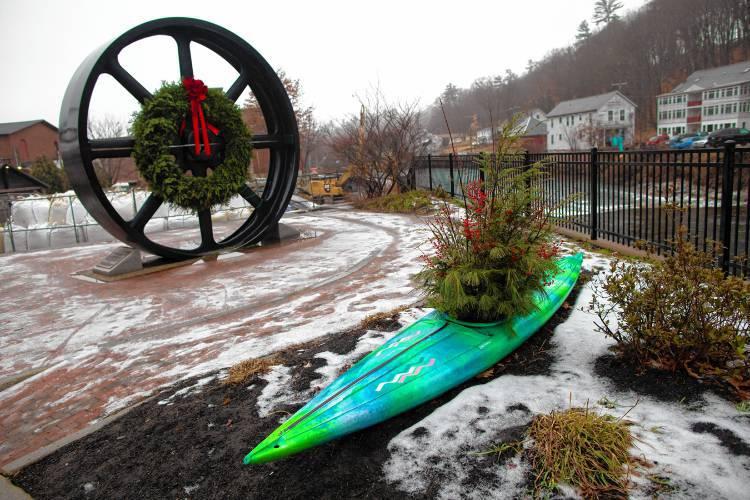
An overall of the Winnipesaukee River and the Mill City Park at Franklin Falls rafting area in downtown Franklin on Monday, December 6, 2021. (GEOFF FORESTER—Monitor staff)
Franklin’s tax-cap community, where the median personal income is $35,657, didn’t want drastic change. When tax bills climbed by 33% between 2015 and 2023, residents expressed fears that more development would price them out of town.
The city’s newly-implemented tax increment financing (TIF) system also came under fire. Its practice of capturing targeted tax revenue to subsidize new development and capital investment rubbed residents the wrong way, and many homeowners blamed large projects like the whitewater park for their jump in payments.
The TIF provided $700,000 of funding to Mill City Park in 2020, but a much larger $5.5 million of the park’s money arrived in the form of state and federal grants and cash matches between 2016 and 2025. That breakdown didn’t matter to those who saw an aggregate increase in private development and a lag in public benefit. Long-term plans and short-term priorities began to clash in public forums.
“People point the finger at us, as a reason that Franklin can’t afford the school, or can’t afford paving the roads,” Parichand said. “In reality, Franklin needs to make more money. They need to find smart ways to generate millions of property tax revenue.”
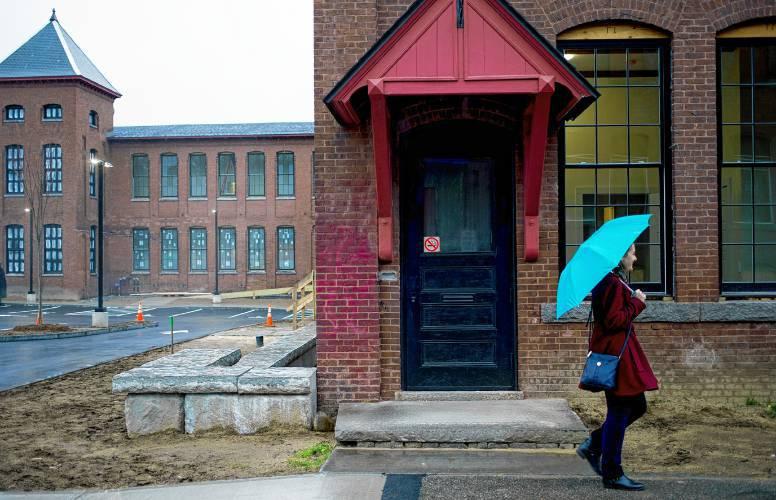
Erin Schaick, development and marketing assistant for CATCH, walks around the outside of the Franklin Mill housing project. (GEOFF FORESTER)
At one point, in 2023, the economic development committee imagined a $20 million bond that could finance the waterpark and other city projects, including sidewalks and road improvements. But for a home valued at $200,000, the then-median in Franklin, the bond would have increased taxes by close to $500 a year. Public outcry killed it.
Franklin remains at a crossroads. Work continues on the waterpark, which has completed one of its three whitewater features. Some new businesses and real estate investments, like Vulgar Brewing Company and the Stevens Mill project, have brought energy back to a once-shuttered Main Street. The changes still stoke the flames of fiery city debate.
.jpg)
The sign outside the Vulgar Brewery in downtown Franklin. GEOFF FORESTER—Concord Monitor
The owner of Granite State Hedgehogs, Sam Hilerio, said he appreciates that Franklin’s downtown has grown much cleaner and more vibrant since he opened his shop. He notes, however, that new pay-by-the-pound trash fines and property taxes will threaten his business’s livelihood if they rise any further.
Jason Grevior, who was born in Franklin in 1969 and manages his family’s namesake 94-year-old furniture shop on Main Street, emphasized that he’s seen life creep back to his city as a result of the capital improvements:
“You get the park, coupled with the Opera House, coupled with all the bike trails, coupled with our little Veterans Memorial ski area,” he said, “and now you’re starting to build a community again.”
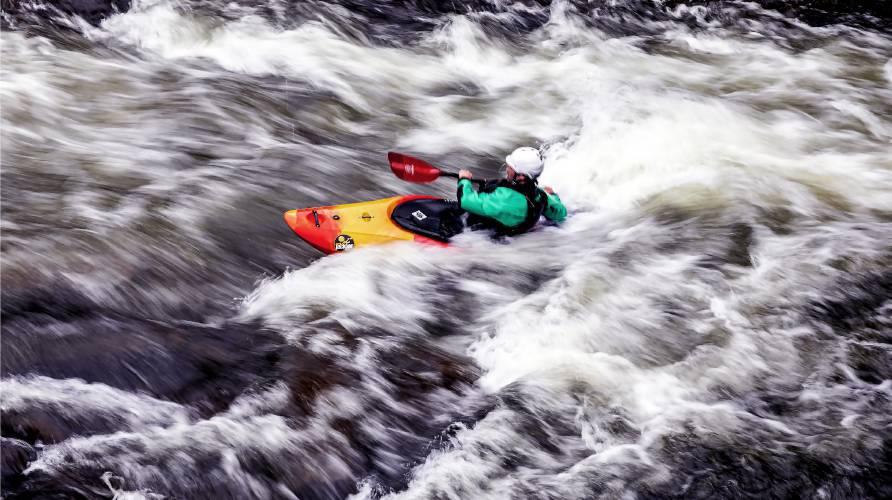
John Garlough paddles in his kayak on the Winnipesaukee River at the Mill City Park at Franklin Falls on Thursday, April 29, 2021. The construction of the new park has started and should be completed by July. (GEOFF FORESTER)
Abby DiSalvo can be reached at adisalvo@cmonitor.com
These articles are being shared by partners in the Granite State News Collaborative. For more information, visit collaborativenh.org.