
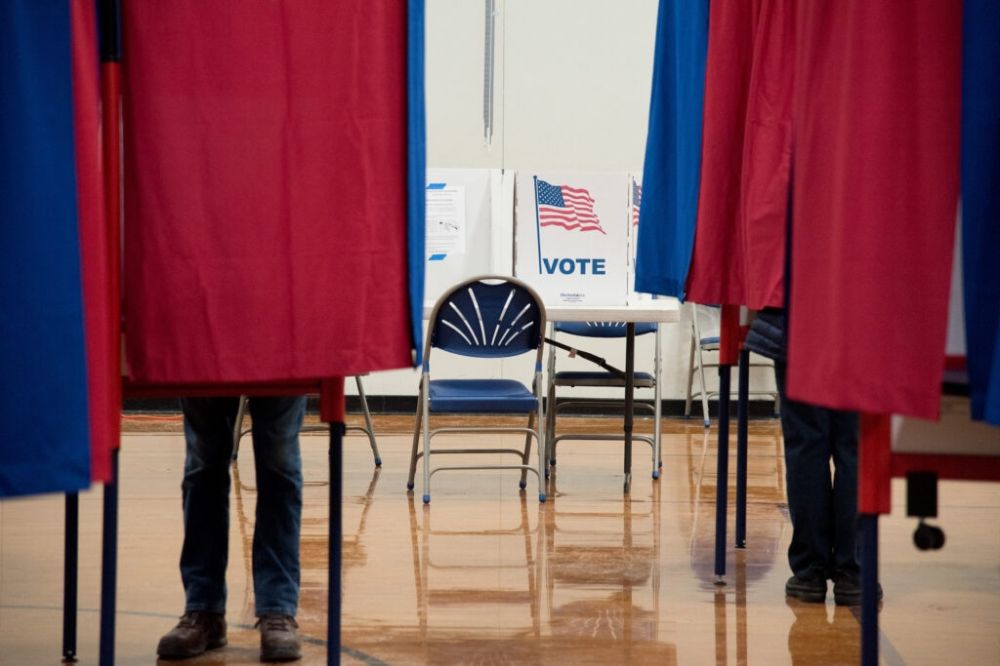
"In a nationalized nomination process, New Hampshire was still important to candidates, but not as indispensable as it once was." (Photo by Kate Brindley/New Hampshire Bulletin)
New Hampshire’s political elites quickly pointed fingers after a Democratic National Committee panel voted Friday to strip the Granite State of its first-in-the-nation status on the presidential nomination calendar. Republican elites blamed Democrats for the Rules and Bylaws Committee decision. Democratic elites blamed their national party leadership. What neither side did, but should, is consider the following: On their watch, New Hampshire has become much less capable of defending its role in the process.
The presidential nomination system has always lacked a single, final authority that decides how the process will go. Instead, national political parties, state political parties, and states themselves all have some leverage. In the past, New Hampshire elites exploited this unsettled state of affairs by being sharp and nimble. In the 1950s, they created a “beauty contest” that allowed voters to cast ballots for candidates (not just convention delegates). This made-for-media event, coupled with our (largely accidental) first-in-the-nation spot on the calendar, made New Hampshire the quadrennial center of the American political universe.
In the 1970s, when other states threatened to muscle in on our action, New Hampshire political elites deftly acted. Democrats and Republicans worked together to create a law that empowered one person, the secretary of state, to ensure that the primary be held before any other. Armed with this law, Secretary of State Bill Gardner successfully fended off challenge after challenge from other states.
When I moved to the Granite State in 1999, elites’ pride in the primary was strong. Iowa picks corn, they boasted, but New Hampshire picks presidents. But nationally, the nomination process was changing in ways that would adversely affect New Hampshire’s status, in ways it could not control.
For one, presidential campaigns strove to make their candidates household names earlier and earlier in the nomination process. As a result, New Hampshire’s role changed. We no longer introduce candidates to the nation, because by the time we hold our primary, viable candidates are already well known. Jimmy Carter and Gary Hart became stories that activists of a certain age told to visiting reporters, not relevant models for modern presidential campaigns to follow. In a nationalized nomination process, New Hampshire was still important to candidates, but not as indispensable as it once was.
In addition, national political parties became more intent on controlling the nomination process. Last Friday was the culmination of decades of Democrats’ efforts at dislodging New Hampshire from its place of privilege and creating a racially diverse early calendar that better reflects their national demographics. Furthermore, national party elites have carefully constructed penalties for disobedience. These sanctions are aimed not just at the New Hampshire Democratic Party, but at the presidential candidates who might campaign here. They would be banned from party-held debates, and stripped of convention delegates from early-voting states. That’s a threat that will make every presidential candidate think twice before putting their name on the New Hampshire ballot.
In response, New Hampshire defended itself with its 50-year-old first-in-the-nation law, and its reputation for being an exceptional place to hold a primary. The latter counted for something last week, although not for everything. (Going third in the nation isn’t going first, but it’s not an afterthought on Super Tuesday, either.) But the first-in-the-nation law itself failed to deter the national Democratic Party from placing the primary third because the party had thought of serious countermeasures.
Going forward, the question becomes: Can the law help New Hampshire defy the DNC’s decision, and provide Democrats a robust primary in which all viable competitors for the nomination participate? The answer is probably not, because the law was written when the threat to New Hampshire’s status was other states, not an entire national party organization intent on asserting control over its nomination process.
Let’s look at this through the eyes of David Scanlan, Gardner’s successor as secretary of state. Will Scanlan use the first-in-the-nation law to schedule New Hampshire’s primary ahead of South Carolina? Assuredly — but that’s his only move. Scanlan cannot protect the New Hampshire Democratic Party from the sanctions that would follow. He cannot protect Democratic presidential candidates from their party’s penalties if they participate. He cannot even place candidates’ names on the ballot without their authorization. Scanlan can set the date, but he can’t make the candidates walk through his door and sign up.
Meanwhile, now that the first-in-the-nation law has failed to deter the national Democratic Party from acting, it puts the New Hampshire Democratic Party in a straitjacket. From the law’s perspective, it’s first or nothing: If New Hampshire Democrats comply with the DNC calendar, they have to foot the bill for their own event, without state resources. The law curtails their ability to reach a compromise with the national party for an early calendar spot that many, I suspect, would find acceptable. In contrast, South Carolina Democrats and Republicans reach separate agreements with their national parties for calendar spots, and the state runs the primary election for each on separate dates. Such an arrangement looks enviable to Granite State Democrats just now.
New Hampshire Republicans may well ask, “Why should we abandon the first-in-the-nation law to help the Democrats?” It is true that New Hampshire’s second spot on the GOP calendar (behind the Iowa caucuses) appears secure — for now. But Granite State Republicans should take a lesson from the Democrats’ dilemma: If the first-in-the-nation law could not protect them, why would it protect us? Imagine, for instance, if Nikki Haley had upset Donald Trump in the 2024 Republican primary. Would the first-in-the-nation law have been enough to prevent a vengeful President Trump from demoting New Hampshire in 2028?
Fifty years ago, clever, pragmatic New Hampshire elites wrote a law that provided a sharp instrument to protect the first-in-the-nation primary. Over time and change to the presidential nomination process, that tool has lost its edge. Nowadays, it’s more potent as a talisman of civic pride to which today’s elites cling.
If New Hampshire wants to stay relevant in the presidential nomination process, it needs new thinking, not nostalgia.
These articles are being shared by partners in the Granite State News Collaborative. Don’t just read this. Share it with one person who doesn’t usually follow local news — that’s how we make an impact. For more information, visit collaborativenh.org.