
Last month, the U.S. Department of Agriculture (USDA) released the final iteration of the Household Food Security Report, which includes a longstanding measure of food insecurity. As defined by the USDA, food insecurity refers to when “households, at times, are unable to acquire adequate food for one or more household members because they had insufficient money and other resources for food.” These data provide insight into how economic conditions and household characteristics have influenced food access both in New Hampshire and nationwide.
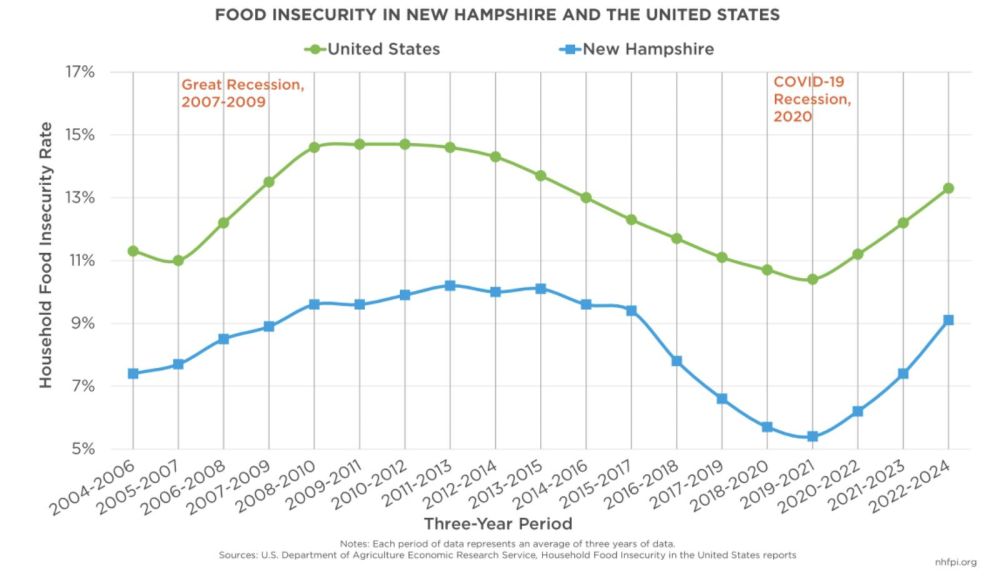
In summary, food insecurity in New Hampshire, while still lower than the national average, has been rising since the COVID-19 pandemic-era low. An estimated 52,600 New Hampshire households (9.1 percent) were food insecure in 2022–2024, the highest point estimate since 2015–2017, reflecting the erosion of pandemic-era supports like the expanded Child Tax Credit that had temporarily reduced hardship.
New Hampshire Trends
To help ensure reliable state-level estimates, the USDA aggregates food insecurity data across three-year periods, with the most recent report covering 2022 through 2024. During this period, an estimated 52,600 households in New Hampshire, or 9.1 percent of Granite State households, were food insecure. While this rate was statistically indistinguishable from the 2021-2023 period, longer-term trends suggest that the number of food insecure households has continued to increase in the years following the COVID-19 pandemic. The latest data show the Granite State’s food insecurity rate rose by 2.9 percentage points from the 2020-2022 period, and by 3.7 points from 2019-2021. New Hampshire’s food insecurity rate in the 2022-2024 period was the highest point estimate rate that it had been since 2015-2017.
During the 2019-2021 period, food insecurity in New Hampshire reached its lowest point in the previous two decades, with 5.4 percent of households impacted. Increased COVID-19 pandemic-related federal assistance, including the expansion of the Child Tax Credit and Economic Impact Payments or “stimulus checks,” likely helped alleviate some economic hardship and contributed to decreased rates of food insecurity. Poverty, which is closely linked to food insecurity, also declined during the pandemic; child poverty was cut in half with the help of the expanded Child Tax Credit, according to the Supplemental Poverty Measure.
During the 2022-2024 period, New Hampshire recorded the second-lowest estimated food insecurity rate across the country after the estimated 9.0 percent in North Dakota; however, data limitations render this rate statistically indistinguishable from 15 other states, including Rhode Island and Vermont. While the food insecurity rate in New Hampshire has remained historically low compared to many other states, national trends have followed similar overall patterns to New Hampshire over the past two decades.
National Trends
According to annual national-level data, approximately 13.7 percent of U.S. households were food insecure in 2024, an increase of 3.5 percentage points from the 10.2 percent in 2021. While food insecurity has increased nationwide, rates remain disproportionately elevated among households with incomes below 185 percent of the federal poverty guidelines ($47,767 for a family of three in 2024), for which nearly one in every three households, or almost 5.5 million households nationwide, were food insecure. Households with householders identifying as Black or Hispanic, households with children, and single-parent households also had elevated food insecurity rates. In 2024, single-female-headed households with children experienced the highest rates of food insecurity among the household compositions measured by the USDA, with more than one in three, or 36.8 percent, impacted.
The number of children in food insecure households has increased by an estimated 6.7 percentage points since 2021, an increase of about 4.8 million food insecure children and reaching approximately 19.5 percent of children nationwide in 2024. Food insecurity has also continued to increase among households with at least one older adult, although the increase has been slower relative to the rise in the number of children. In 2024, approximately 9.9 percent of older adult households experienced food insecurity, up from 7.1 percent in 2021.
Looking Ahead
As the USDA phases out future releases of the Household Food Security Report, alternative data sources will be increasingly important for measuring food insecurity in the Granite State.
Feeding America’s Map the Meal Gap provides modeled estimates of food insecurity based on a range of other data and research. According to recent estimates, approximately 149,800 people in New Hampshire were food insecure in 2023. Using the state’s average household size of 2.39 people that year, this would equate to around 62,700 households. That figure for 2023 is higher than the 52,600 households estimated to be food insecure during the 2022-2024 period based on USDA data.
Enrollment in the Supplemental Nutrition Assistance Program (SNAP) also provides insight into food assistance needs across the state. In State Fiscal Year 2025, approximately 76,000 Granite Staters were enrolled in SNAP, with the highest enrollment rates in rural northern and western regions of the state. SNAP provides both food assistance and economic stimulus, which can be particularly effective in rural areas. While SNAP data can highlight those with the greatest need, not all food insecure households qualify for, or enroll, in the program.
New Hampshire continues to experience food insecurity rates lower than national averages, but recent data suggest that the number of food insecure households in the Granite State is continuing to rise. As federal data sources become more limited, utilizing alternative datasets and methods of measuring hardship will be crucial for continuing to monitor trends and to help ensure that more Granite Staters have reliable access to food.
The New Hampshire Fiscal Policy Institute is sharing these articles with the partners in The Granite State News Collaborative. NHFPI is an independent nonprofit organization that explores, develops and promotes public policies that foster economic opportunity and prosperity for all New Hampshire residents. For more information visit nhfpi.org. These articles are being shared by partners in The Granite State News Collaborative. For more information visit collaborativenh.org.