
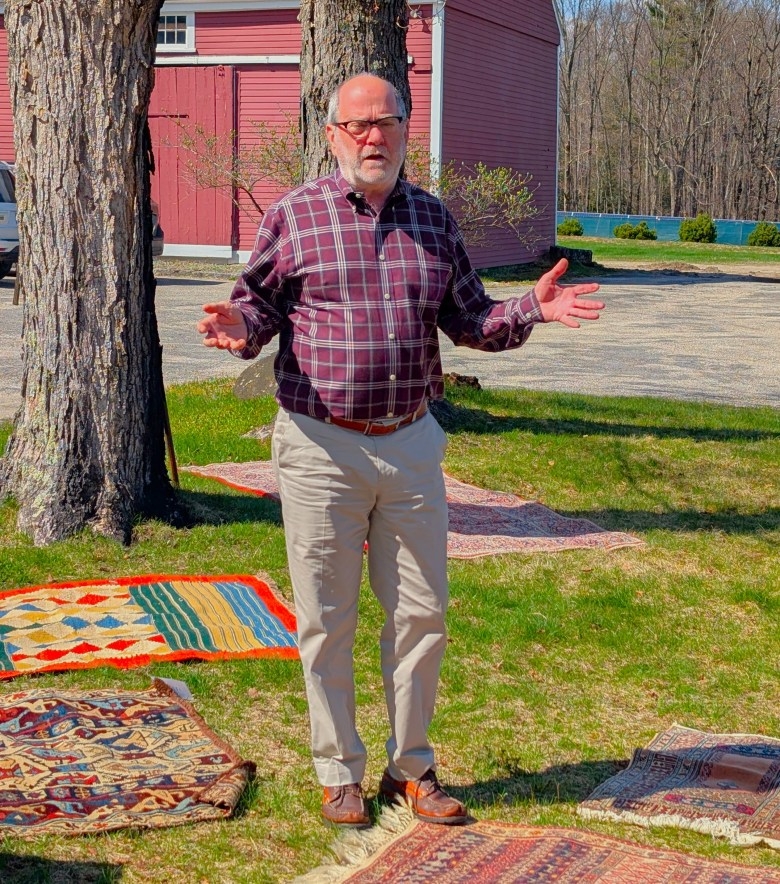
Peter Pap talks about his rugs displayed outside his shop in Dublin. (Credit: Tyler Dion/Ledger-Transcript)
Peter Pap has spent 50 years doing what many have tried and failed at: building a thriving business around one of the world’s oldest art forms.
Pap, the owner Peter Pap Oriental Rugs, 1225 Main St., in Dublin, credited his passion and diligence for the company’s continued success.
“This is a very demanding business, and a lot have tried and failed,” Pap said. “You need to be as passionate as possible to be successful.”
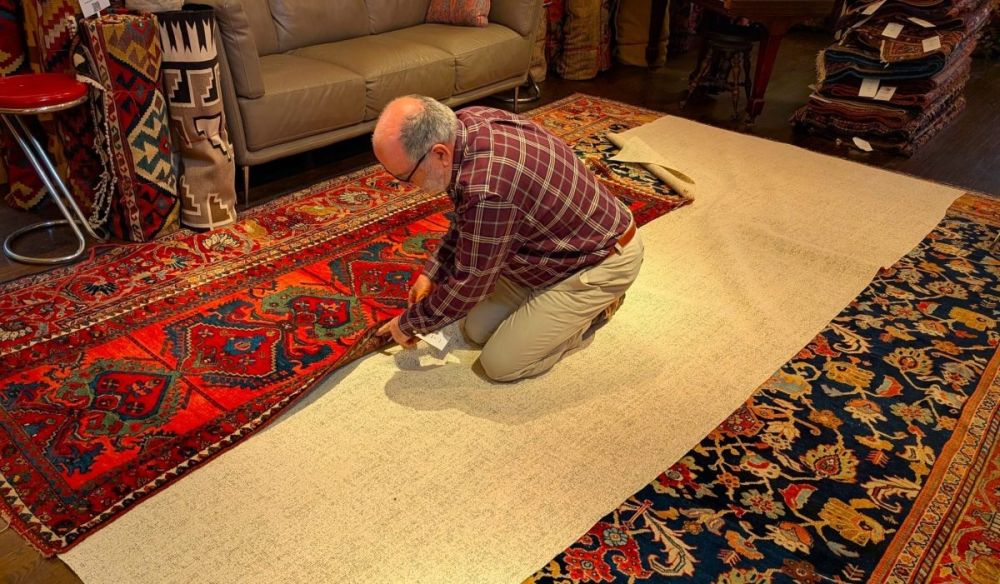
Over five decades, Pap amassed some 2,500 rugs totalling about $10 million in value by his estimate. While the rugs originate from places like China, Turkey, India, Afghanistan and what was once Persia, but is now Iran, Pap said he’s gathered most from inside the U.S. and on trips to Europe.
“Most rugs have been in this country since the late 19th century,” Pap said. “Back then, we were the number one consumer of rugs.”
Between the 17th and 19th centuries, because many producers lived in eastern exporter economies, wealthy Europeans collected rugs along the Silk Road.
Many of those rugs made their way west on ships bound for the New World with captains carrying them as luxury items or curiosities.
According to Pap, 90% of antique oriental rugs are in Western countries. Due to their availability in the U.S., he was never a serious importer.
Pap thinks westerners are responsible for being the art form’s custodians.
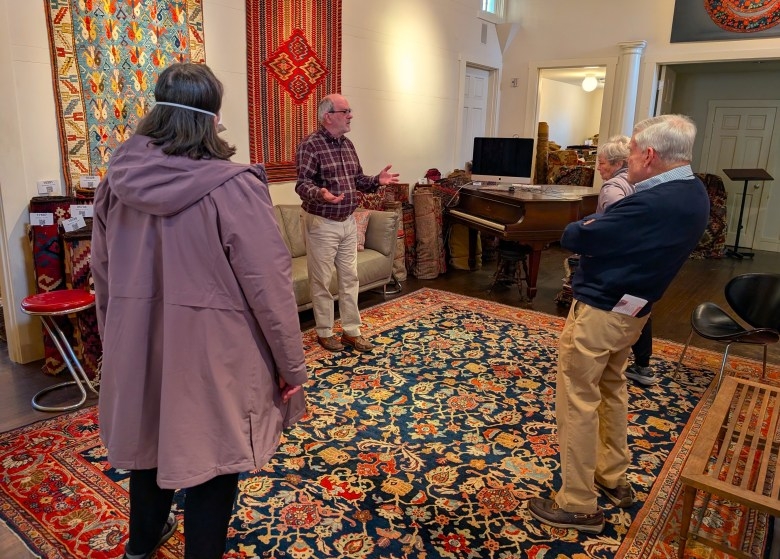
“Iranians, Turks, Afghans, none of them are in an economic position to buy back their rugs,” he said. “Because they were exporters, they don’t have a repository of things from that period.”
Pap noted this could change in 20 or 30 years, however, as economies aren’t fixed.
“If the economies are in a better place, there could be a huge export of these rugs to their original countries.”
Pap said the business still thrives because people respect that the rugs aren’t mass-produced.
The 3,000-year tradition, Pap said, was one of the last vestiges of true creativity before commercialization.
“Up until the 1920s, rugs still had remnants of previous centuries,” he said. “One hundred and fifty years ago, people didn’t have TV or social media; they were just practicing a learned skill from their mother or grandmother.”
This, he said, makes the rugs unique snapshots of what the world was like at specific points in time before they became standardized department store staples.
Pap hasn’t always sold rugs, according to the Connecticut native. He entered the business in the 1970s at age 20, while working in Boston.
“I had an opportunity to work at a second-generation Armenian oriental rug store that had been around since the 1920s,” he said.
After finding antique rugs in stock, Pap’s interest in the trade blossomed.
“That particular business sold modern rugs, which I didn’t care for very much,” he said. “But because they’d been around for so long, they had antique rugs from my boss’ father’s tenure.”
It wasn’t until rugs the shop had previously sold started reappearing that Pap began considering striking out on his own.
“My boss was buying back rugs that the children of his father’s customers had inherited,” noted Pap. “Then he would very quickly flip them.”
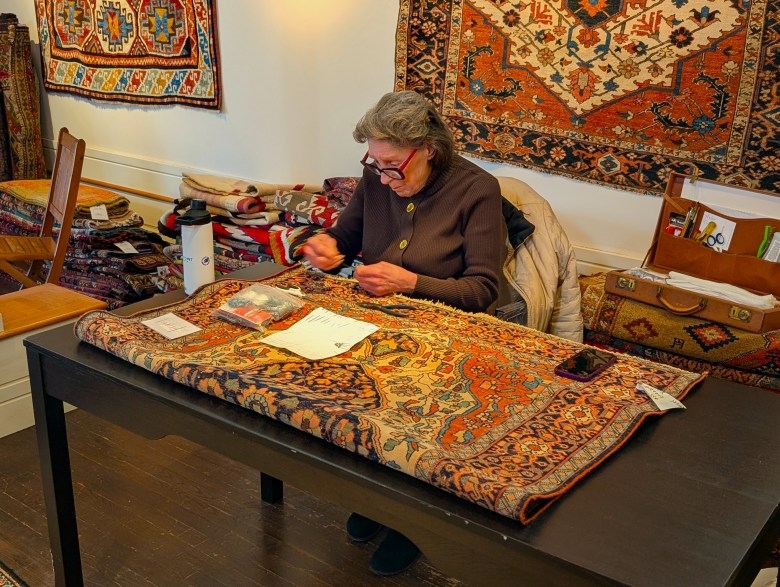
Resident restorer Hope Taylor repairs an antique rug in Pap’s Dublin gallery. (Credit: Tyler Dion/Ledger-Transcript)
Pap said middlemen came from New York and bought the rugs cheaply, only to turn a profit selling them in Europe.
“Because the appreciation for them was so much greater, the market was much stronger in Europe.”
The transactions lit a spark in Pap, who decided he could eliminate the middleman.
“I realized the middleman was making a lot of money easily,” he said. “I figured I could go out on my own with a very small amount of working capital and do the same.”
In 1976, the aspiring rug dealer started traveling around New England alone, gathering and flipping rugs.
“I collected them at flea markets, yard sales, estate sales — I even started running ads in the Boston Globe,” he said. “The region was a treasure trove.”
As he spent the late 70s and early 80s flipping rugs, he built a steady and dedicated clientele, turning him into the middleman.
“Once I got my own customers, there was less need for me to flip as the end users started appreciating the rugs,” Pap said. “I started getting better prices and then developed my own private clientele.”
In 1982, he opened his first gallery in Keene. He relocated to Dublin in 1992, where he renovated the red barn into a rug bazaar. That same year, he also opened his San Francisco gallery.
In addition to selling, Pap also served 16 seasons as an appraiser on PBS’ Antiques Road Show.
“When I started out, I had an incentive to buy as cheaply as possible,” he said. “But after 16 years on the Antiques Road Show as an appraiser, I learned I could work with people on a consignment basis.”
He said that in doing so, his customers earn more money, allowing him to build their trust.
Pap looks for color quality, technical skill and a balanced design in a prized rug, and he cited the thrill of the hunt as what keeps him going.
“There’s a hierarchy of rugs where you’re always looking for the best of a particular type,” he said. “When you come across a rug you’ve had in the past or have never seen before and it ends up in the best condition you’ve seen, you’re always excited.”
Pap said he continues looking toward the future. An influx of potential customers during the pandemic and the younger generations’ taste for handmade goods keep his hopes high.
“People moved here from urban centers that were focused around arts and culture,” he said. “It’s a great discovery for them when they find antique rugs that compete on an international level.”
For the rest of the year, Pap said he doesn’t have any major events planned around the 50th anniversary, but will continue using it for branding.
His next major event in June will exhibit Frank Stella’s Navajo textile collection in New York City.
These articles are being shared by partners in the Granite State News Collaborative. Don’t just read this. Share it with one person who doesn’t usually follow local news — that’s how we make an impact. For more information, visit collaborativenh.org.