
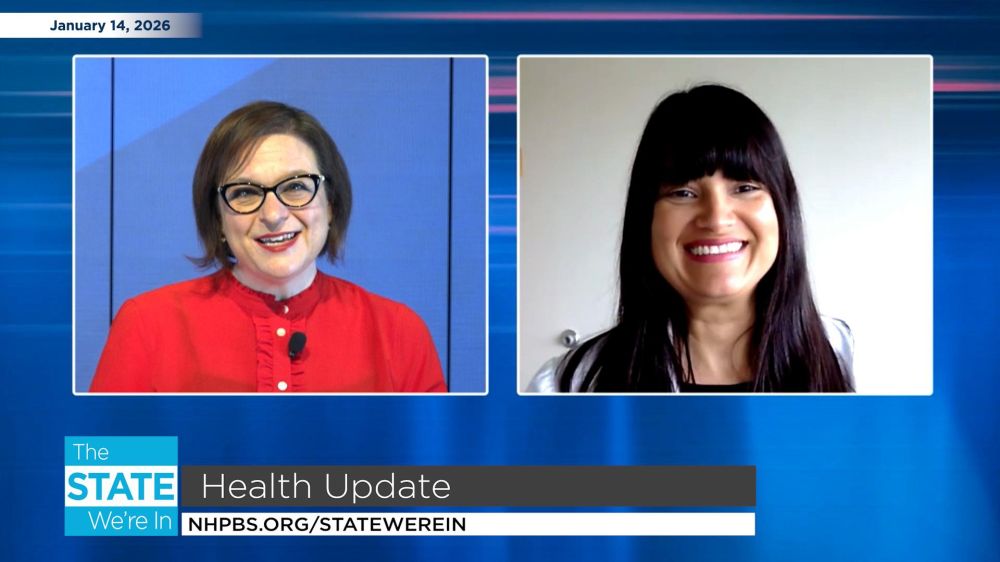
This is the 250th episode of “The State We’re In,” which began during the pandemic with updates about COVID-19. Today we’re going back to our roots in a conversation with Dr. Gabriela Andujar Vazquez, hospital epidemiologist at Dartmouth-Hitchcock Medical Center, about COVID as well as the rise in cases of flu and norovirus and what you and your loved ones can do to protect yourselves.
Melanie Plenda:
Is COVID still an issue in New Hampshire?
Gabriela Andujar Vazquez:
It definitely is. I think maybe some of you might remember that we had a little bit of a spike of cases during the summer, a little bit of a lull in the fall, and we are seeing an increasing trend of COVID-19 cases in the community across the state.
Melanie Plenda:
What about flu cases this year? According to news reports, serious cases are on the rise at most hospitals. Is there something different about this strain of flu?
Gabriela Andujar Vazquez:
There is. Currently, the predominant strain is an influenza A virus, and that particular strain has had significant accumulation of mutations. This is what we call an “antigenic drift.” “Antigenic” actually refers to accumulation of mutations by the virus over time, and this is actually what drives seasonal flu epidemics every year, and why we need to update our flu vaccines every year.
This particular clade is called K, and it has high antigenic drift, and what that means is that, compared to prior years, it has accumulated a little bit more mutations, and what results in is larger outbreaks, a quicker and very steep increase in cases and higher transmission rates, which is what we’re seeing this season
Melanie Plenda:
What are the symptoms of flu?
Gabriela Andujar Vazquez:
Fever, usually, which makes it distinct from common colds. Usually, people will have some high fevers,particularly young children and older adults. Cough, which can be dry or productive. You can have some shortness of breath, body aches, muscle aches. It really can send people to bed or home for a day or two. This is regardless of whether you're healthy or have medical problems.
It can hit people quite quickly for the first two days of the illness. Illnesses like common colds, where you have maybe the sniffles, you feel like you're still able to sort of function. But the flu can take a toll on one's body quite quickly.
Melanie Plenda:
When should you head to a hospital, versus just staying home and resting?
Gabriela Andujar Vazquez:
When you feel shortness of breath — you're not able to breathe well, and it just keeps persisting. It can lead to seizures, febrile seizures, in those less than two years of age, mostly. It's keeping an eye on the temperatures, and if you feel that by day four or five, the person who is sick continues to feel sick and is not able to function, seeking medical attention with either your primary care provider, depending on the urgency, or an emergency room or urgent care clinic visit would be appropriate to to get ahead of it.
Melanie Plenda:
What about norovirus? Are cases also on the rise?
Gabriela Andujar Vazquez:
Norovirus is an interesting virus. It has some seasonality to it. There are some years where there are lulls. There is some component of climate, meaning that it can sort of spread quicker in certain summers, for example. Every three to four years, we see high epidemics and then lulls, years where it sort of stays low. In 2025, we did see a higher incidence of norovirus being identified during the summer and into the winter months than compared to other years.
Melanie Plenda:
What are some of the symptoms of norovirus?
Gabriela Andujar Vazquez:
It's very explosive diarrhea. It's a very contagious virus. You just need a little bit of exposure to a couple of those variants to get ill. It usually lasts 24 to 48 hours. Some patients that have weak immune systems may have more prolonged days of symptoms. What makes people very sick and needing to seek medical attention, or sometimes emergency room visits, is dehydration. They're not able to keep up with any fluids orally, so patients can become dehydrated quite quickly. So the most vulnerable patients — like young children, older adults — are more susceptible to dehydration, and that would encourage them to seek medical attention.
Melanie Plenda:
Is it too late for flu vaccines at this point?
Gabriela Andujar Vazquez:
Absolutely not. The flu season started a couple of weeks earlier than the U.S. in European countries. We do have some estimates out of England regarding the flu vaccine efficacy. They found it’s about 70% to 75% effective against hospitalization for children, and about 30 to 40% for adults against hospitalization. There was more concern that it was not going to be as similar to other flu vaccine seasons because of the antigenic drift that we talked about. So what that means is that there is still a chance, if you haven't been vaccinated for the flu, to get the vaccine to protect yourself and the community.
Melanie Plenda:
When is the best time to get that vaccine?
Gabriela Andujar Vazquez:
In general, I tell my patients to get it before Halloween. Starting in December is when we see the increase in cases, but you want to get it at least two weeks before it starts circulating, because that's when you get the most protection.
Melanie Plenda:
What should you do to stay healthy? Should we break out masks and gloves again? Is hand sanitizer enough?
Gabriela Andujar Vazquez:
Wash your hands — hand hygiene is always encouraged. Hand sanitizer is effective against eliminating influenza virus and other viruses from our hands. It just has to be more than 70% alcohol to be able to kill that virus or bacteria in our hands.
Regarding the mask, if it's well-fitting and used appropriately, it should protect yourself and others, particularly if you're sick. Wearing a mask will do what we call source control, which is prevent you from spreading illness to others. I know that using a mask regularly every day is not necessarily something that's feasible, but the more you can use it in certain situations, it sort of accumulates that risk mitigation.
Melanie Plenda:
Speaking of vaccines, the federal government has released new guidelines reducing the number of required vaccines for children. What do you think of the guidelines?
Gabriela Andujar Vazquez:
I think, like all of us in the medical community, we are concerned by these changes. The childhood vaccine schedules in the United States have been developed through many, many years of rigorous review, looking at safety and effectiveness data, taking into consideration our health care system, how fragmented it is, how there are pockets of patients that are vulnerable and are unable to access care. So a lot of thought and debate over the years around how we have implemented our childhood vaccine schedules went into it, and so I think we're all concerned that this thoughtful process did not happen when these changes were issued.
The prior childhood vaccine schedules were meant to protect all, not just individual children — but entire communities. So reducing the recommended vaccines without necessarily having strong scientific justification, or at least transparency on how these decisions were made, will potentially increase preventable diseases and end up undermining the public's trust in the system that has saved countless lives for the past 50-plus years.
Melanie Plenda:
What advice would you give parents about getting kids vaccinated?
Gabriela Andujar Vazquez:
One thing we should make clear is that nothing has changed. We haven't had any evidence that the safety or efficacy of the vaccines that we have been delivering and recommending in our childhood vaccine schedules for many years has changed. No evidence has been brought to light that would prompt us to drastically change our schedule.
I would encourage parents to ask questions of vaccine safety and whether this is what's right for their child. But I would also point out that nothing has changed in terms of safety or evidence to make these unilateral changes. So I would advise parents to continue to visit their child's providers and have discussions if they do have worry or confusion. Because I think that right now, a lot of patients may be confused about whether the changes were something that they should be looking into or not.
Melanie Plenda:
Do you have any other advice for people trying to stay healthy this winter?
Gabriela Andujar Vazquez:
I almost always say similar things when I talk about general public health and staying healthy. There has been a lot of confusion and different opinions around how to stay healthy. I think that having conversations with trusted sources of information and bringing up difficult questions and challenging sometimes things that we thought were to be true — that’s part of how we move, how we evolve, how we identify issues in public health. But that doesn't mean that by asking questions that it should completely eliminate the rigorous reviews that have happened before. Continue to talk and find common ground on some of these issues that are complicated, because our health care system is complicated.
Melanie Plenda:
Thank you for those tips, doctor.
These articles are being shared by partners in the Granite State News Collaborative. For more information, visit collaborativenh.org. “The State We’re In” is a weekly digital public affairs show produced by NH PBS and The Marlin Fitzwater Center for Communications. It is shared with partners in the Granite State News Collaborative, of which both organizations are members.