
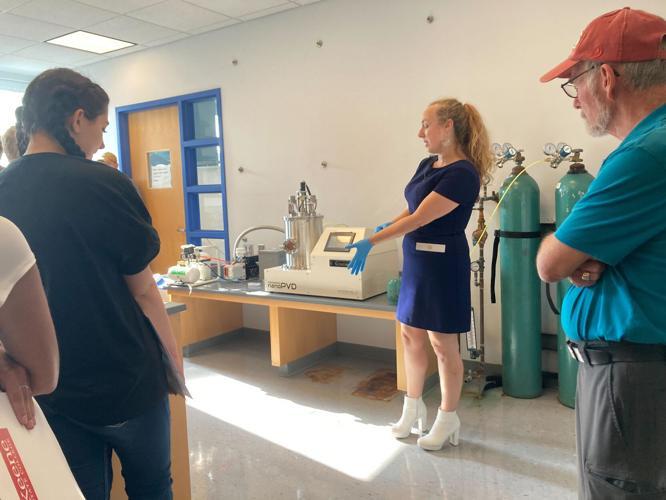
Sarah McGregor, Keene State physics department chair, demonstrates a benchtop physical vapor deposition system, which is used to deposit thin films onto surfaces at an open house for the college’s optics program on Thursday. (Noah Diedrich/Sentinel Staff)
On Thursday night, the Markem Lecture Hall at Keene State was abuzz with discussion as prospective students and their families peered through handheld spectroscopes, played with filters and probed mirrors of varying shapes and sizes.
That explorative session was part of an open house for the college’s new precision optics certificate, which is launching this fall. The program is part of a multi-million dollar venture between Keene State and industry partners to provide a hands-on educational opportunity that they say will catapult students into the workforce almost immediately.
Optics is the branch of physics that deals with light, and its findings have industry applications. Sarah McGregor, physics department chair and advisor for the optics cohort, said the science can be used to create thin films, use light to measure infinitesimal distances and craft molds for precision manufacturing processes across many different industries.
Many everyday items are made using optics: smartphones, fiber optic cables and even the technology that allows self-driving cars to recognize objects around them, she said.
The precision optics certificate at Keene State is a yearlong program, requiring students to take classes on laser optics, thin films, metrology and computer-aided design. The program is hands-on, and the college tailored it to high school graduates who do not see college as an option. Wood said the program is suited for complete beginners.
Michelle Wood, director of the strategic project management office, said the college has space for a cohort of 10 in the program’s first year, but the program is designed to expand as demand grows.
The college is using federal grants to keep tuition and housing costs down. Without the grant, students would owe roughly $15,000 and $27,000 for in-state and out-of-state, respectively. With grant funding, the price is $10,000.
The same is true with housing. A year in the dorms would typically cost about $14,000, but the grant knocks that number down to $4,700, Wood said
Last year, the college received a $3 million federal grant and began a partnership with the American Center for Optics Manufacturing. The school also hosts a STEM summer camp for middle- and high-schoolers that has recently begun focusing on optics.
The optics boom in Keene is fitting — the region is somewhat of a hub for the industry. There are 30 optics companies within 100 miles of the college, according to its website.
“It’s important to know how big this is in your backyard,” Associate Dean of Academic Programs Jim Kraly told students during his presentation on Thursday.
Part of what drew Keene State to optics is the large demand for workers in the ever-growing industry. Wood, said that, in the past, some companies were pulling people from pizza parlors and grocery stores to work these positions to fill the need for technicians. But it wasn’t a good fit — they needed employees with the appropriate scientific knowledge.
Keene State aims to fill that job market niche for students and industry, Wood said, not just churning out machinists, but workers who understand the science behind their tasks.
The optics industry is very much behind the program, Kraly said. In 2019, the college began working alongside 30 companies to tailor a program that outfits students with exactly the skills the industry is looking for in prospective technicians. And if students choose to pursue a bachelor’s degree after they complete the year of coursework, the program sets them up to do so, Kraly said.
Companies are already calling in search of students to employ, even before the program has started, Kraly said.
“They’re almost frothing at the mouth for students with these skills,” he said.
Within the new program, students will have access to state-of-the-art technology, such as a thin film inspection system, a benchtop physical vapor deposition system for thin film deposition and, the crowned jewel, the new Kingsbury Diamond Turning Lab, which was finished this spring.
The lab features two single-point diamond turning lathes, which are commonly used in producing precise molds for manufacturing, Kraly said. With these machines, students will learn to cut surfaces so smooth that they don’t need to be polished to shine.
“Engineers have yet to fully realize what diamond turning can do, and we’re using these tools in Keene,” Kraly said.
There are two main types of diamond turning machines used in the optics industry, Kraly said, and Keene State has both.
“This is just the tip of the iceberg, to have that lab full today,” Michelle Wood said of the students attending the open house.
Interested parties must submit their application materials by Monday Aug. 11, and interested parties can visit {!--StartFragment--}keene.edu/optics, Wood said. {!--EndFragment--}
Noah Diedrich can be reached at 603-355-8569, or ndiedrich@keenesentinel.com.
These articles are being shared by partners in the Granite State News Collaborative. For more information, visit collaborativenh.org.