
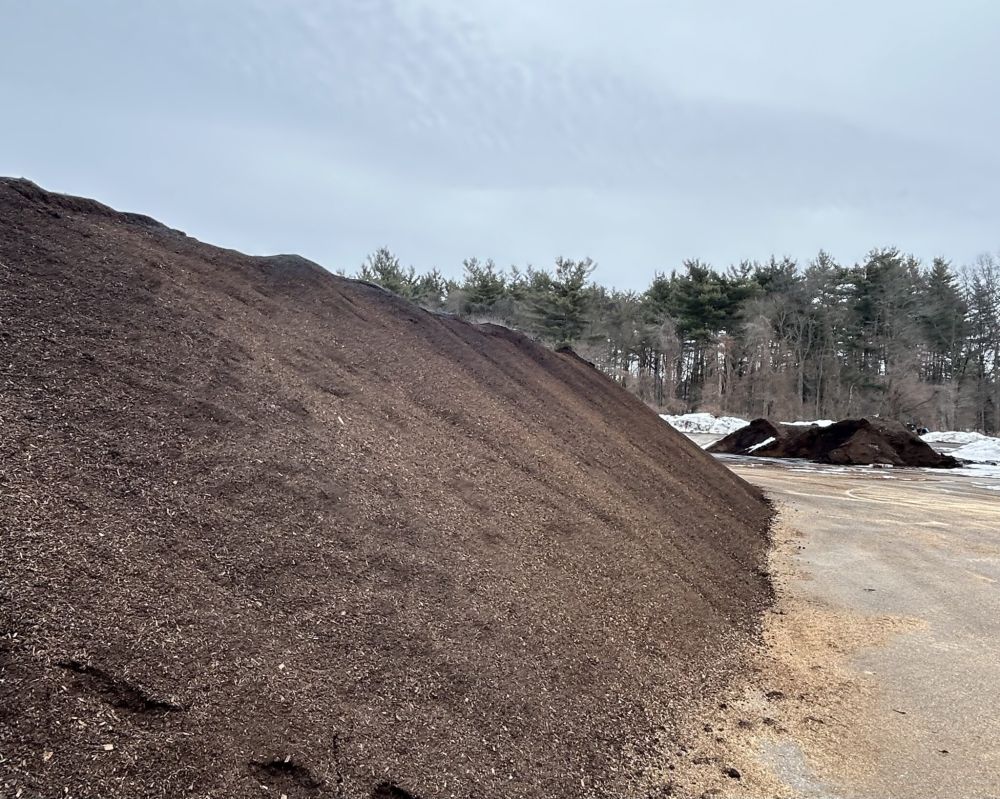
A mixture of composted biosolids and wood chips is pictured at Merrimack Wastewater Treatment Facility. Debate over how biosolids should be regulated in New Hampshire has drawn in environmental groups, wastewater treatment professionals, and farmers throughout this legislative session. (Photo by Molly Rains/New Hampshire Bulletin)
Earlier this year, a proposal from the New Hampshire House sought to pause the practice of applying PFAS-containing sewage sludge to farmland in New Hampshire. But over the course of multiple packed hearings and after a handful of amendments, the bill’s provisions have changed shape, sparking concern among some early supporters.
The latest twist in the bill’s journey was a “replace-all” amendment adopted in the Senate May 7 that removed all references to sludge. Lawmakers and staff said that was a procedural error; some said they expected much of the bill to be reinstated later this week, when the Senate takes up the bill once more on Thursday.
Some stakeholders are not so sure that’s good news.
Allison Jumper, of Durham, said the bill had morphed from its original form into something completely different — harmful rather than protective. The version of the bill that existed just before the error lawmakers will aim to fix this week “not only fails to solve the PFAS problem — it entrenches it,” she said in a statement.
Twists and turns
House Bill 1275, from prime sponsor and Merrimack Democratic Rep. Wendy Thomas, was grounded in concerns about PFAS, Thomas said when she introduced it to a House hearing room in February.
The toxic “forever chemicals,” used in many man-made goods, ultimately find their way into sewage, which is processed into sludge. Sometimes called “biosolids,” this treated byproduct of wastewater processing can be spread on fields as fertilizer or a soil amendment. But “forever chemicals,” linked to multiple illnesses including some cancers, have been detected at high levels in farms and in farmers themselves at sites in other states where sludge with high PFAS content was used as fertilizer.
As introduced, HB 1275 proposed a moratorium on the practice of spreading treated wastewater sludge, or biosolids, on farmland in New Hampshire; a relief fund for farmers whose land or water was contaminated by PFAS; and liability protections for them against possible legal fallout related to the PFAS content of fertilizer they have used on their fields.
Thomas said she wanted to pause the practice while the state learned more about whether, and to what extent, sludge use had contaminated New Hampshire farms. Liability protection could help encourage farmers to test their land, she said, especially if they were otherwise discouraged to do so by concerns about what they might discover.
But wastewater professionals raised concerns about the effects of a moratorium on the wastewater industry.
Using sludge to treat fields is known as “beneficial reuse,” and the practice is seen in the industry as preferable to alternatives like placing sludge in landfills or incinerating it, said Leo Gaudette, assistant director of public works and wastewater in Merrimack, in a February interview. Gaudette said a moratorium on sludge spreading would debilitate facilities that rely on the practice to move biosolids out of their facilities.
That includes the Merrimack Wastewater Treatment Facility, where sewage from multiple towns in both New Hampshire and Massachusetts is converted into biosolids and then into compost, which is distributed as a soil amendment for turf — not for agricultural use. Gaudette said his team tests their product for multiple PFAS chemicals, and reports that information to the Department of Environmental Services.
Gaudette was among the wastewater professionals and biosolids distributors who pushed back against the moratorium proposal at hearings this winter. The moratorium ended up being one of the first elements of the bill to be removed, through an amendment from Keene Democratic Rep. Nicholas Germana and Exeter Democratic Rep. Linda Haskins recommended by the House Committee on Environment and Agriculture in early March.
That amendment also required the New Hampshire Department of Environmental Services to begin the process of crafting PFAS limits for biosolids — a standard that does not yet exist — by the end of June 2027.
Wastewater processors who distribute biosolids already test and report levels of certain PFAS chemicals in their product, said James Martin, a spokesperson for the New Hampshire Department of Environmental Services. That protocol will become a requirement under department rules on May 15, he said. But without a state standard in place, the results of that test do not affect a producer’s ability to distribute the material in New Hampshire.
The department is conducting soil modeling tests that will help them develop a safe standard, Martin said. They expect the rulemaking process for those standards to begin next year.
At the same House session where the amendment eliminating the moratorium was approved, Thomas protested the move and requested a floor amendment that would reinstate it until the Department of Environmental Services establishes a PFAS standard for the material. But the floor amendment was voted down.
Thomas said in an interview on Friday that including liability protection for sludge users without requiring a pause to the practice “defeated the purpose” of the bill by failing to address the source of the problem.
“It still allowed people to put contaminated sludge on their land, and it gave them legal protection,” she said.
The change prompted some groups that had previously backed the bill to withdraw their support, Thomas said, including the Conservation Law Foundation.
“HB 1275 began as a roadmap for protecting farmers and communities from the consequences of toxic PFAS contamination from sludge, but along the way it drifted off course,” said Erica Kyzmir-McKeon, director of communities and toxics at the Conservation Law Foundation, in a statement. She said the organization was concerned about the “sweeping” liability protections included in recent versions of the bill.
“We cannot in good faith support a bill that no longer protects the people it was meant to serve,” she said.
Another amendment from Germana, co-sponsored by Barnstead Republican Rep. Barbara Comtois, was approved March 11, without the proposed mechanism for farmers to access funds for PFAS testing.
The bill was amended again after crossing over to the Senate Committee on Energy and Natural Resources, which recommended an amendment that would change another section of New Hampshire law, which limits the sale of certain PFAS-containing consumer goods starting in January 2027. The amendment would exempt certain products “authorized by or under contract with the United States Department of Defense” from the ban.
On the Senate floor last Thursday, Sen. Debra Altschiller, a Stratham Democrat, said the exemption was concerning because military materials have, historically, been a significant source of PFAS contamination. She added that reducing the PFAS content of sludge would not be possible without reducing inputs, including from defense-related sources.
“This amendment … takes a bill that was originally about preventing PFAS contamination of land and protecting the public from PFAS exposure, and pulls it in an opposite and harmful direction,” Altschiller said. “… While powerful actors receive exemptions, like defense contractors, our farmers, our municipalities, and our residents are going to be left dealing with the consequences of that contamination. The imbalance raises serious equity issues.”
Sen. Howard Pearl, a Loudon Republican, said there were already multiple other approved exemptions to the impending product bans.
“The amendment simply adds a sixth one, which is important to national security,” he said.
The Senate then approved the amendment. Immediately after, Sen. Regina Birdsell, a Hampstead Republican, introduced another amendment that was approved without debate, relating to PFAS standards for drinking water. The amendment was a replace-all amendment that overwrote all previous language in the bill.
That was not intentional and came about as a result of a “drafting error,” said Senate Deputy Chief of Staff Grant Bosse.
Birdsell did not respond to a request for comment. But Michael Wimsatt, director of the New Hampshire Department of Environmental Services’ Waste Management Division, said he believed the contents of the amendment itself were intended to be additive, rather than a replacement.
The amendment deals with PFAS, but in public water supplies rather than sewage sludge. Its language would allow the New Hampshire Department of Environmental Services to offer financial support to more water systems in the state, by expanding eligibility criteria for the support to include federal standards for two PFAS chemicals, PFOA and PFOS, that are currently more stringent than New Hampshire’s standards.
The change would expand funding eligibility for the New Hampshire PFAS Response Fund to an additional 196 public water supplies across the state, Wimsatt said. The money would help fund assistance for PFAS remediation for those water systems.
Bosse said the Senate would reconsider the bill on Thursday.
Thomas said that during the discussions around the bill, she has encountered the idea that New Hampshire does not face the same level of contamination as Maine. But without more testing, Thomas said, it isn’t clear that’s the case.
“I don’t see that, because I live in Merrimack, which is heavily contaminated, and we have a ton of cancer,” Thomas, who herself has cancer, said. “We certainly have areas of heavy contamination in New Hampshire.”
She added that any level of contamination with PFAS, which is found at some level nearly ubiquitously in sludge, should raise alarm bells.
“The more information that we get, the more science that we collect, the more that we’re finding out that the only safe level of PFAS is zero,” she said. “So even if we have a lower level of contamination and a lower level of PFAS in our water and our soil, it’s still not zero. It’s still dangerous.”
This story was originally published by New Hampshire Bulletin and is being reprinted here under Creative Commons license CC BY-NC-ND 4.0. Click here to visit NH Bulletin and view their other stories.